The Edge of Rome
Rome built a city in Morocco. Then they left it standing when the empire fell.
The mosaics are still on the floors where Romans walked on them.
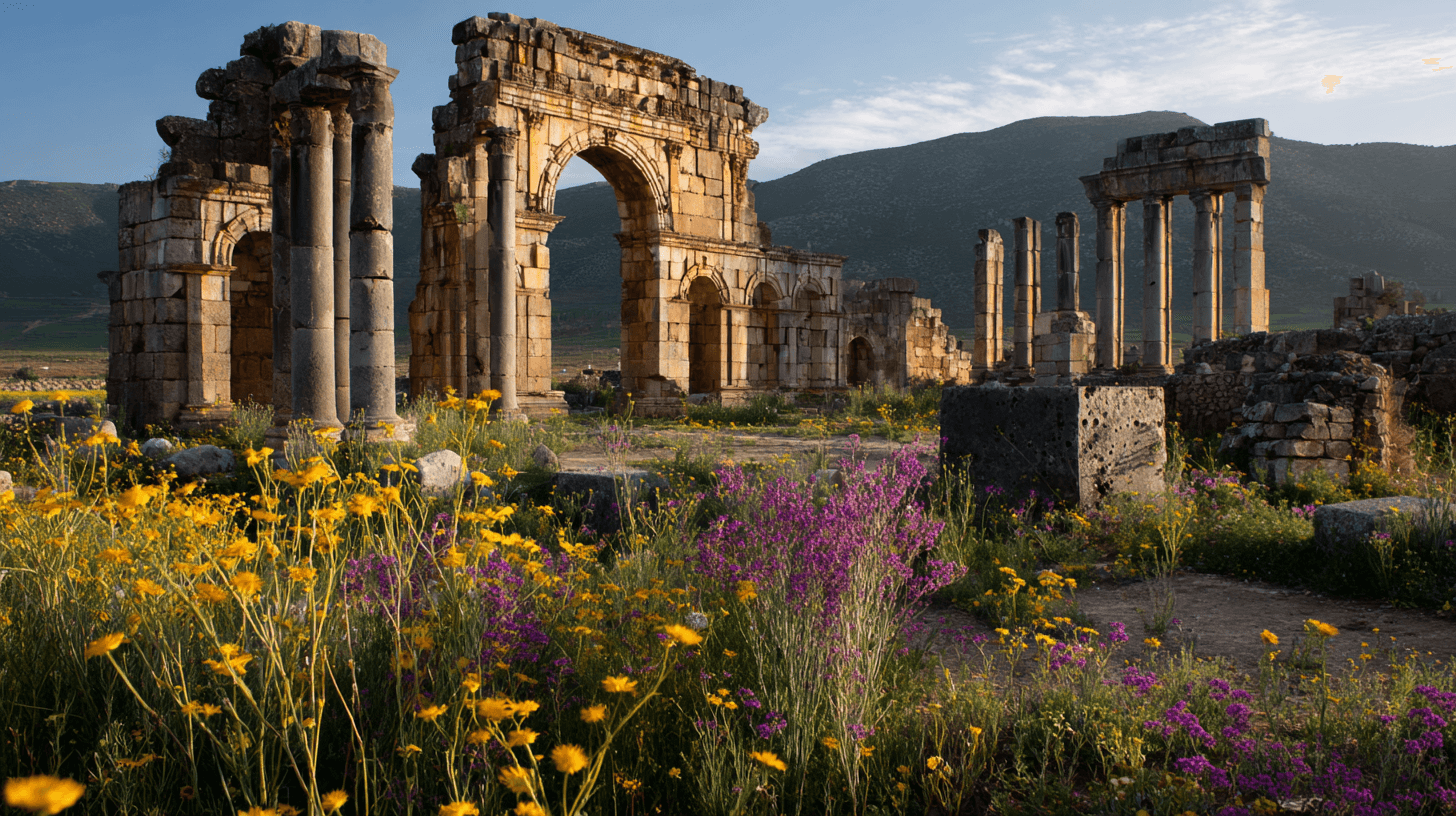
Volubilis sits on a plain below the Middle Atlas, surrounded by wheat fields and olive groves. At its peak in the 2nd century CE, it was home to 20,000 people — a proper Roman city at the edge of the known world. It had a forum, a basilica, temples, bathhouses, an olive oil industry that exported across the Mediterranean, and houses with mosaic floors depicting Orpheus, Bacchus, and the labors of Hercules.
It was Rome's southwestern frontier. Beyond here lay the Atlas Mountains and the desert — territories Rome never bothered to conquer. The city existed to extract olive oil and grain from the fertile plains, to project power to the Berber tribes, and to remind everyone where civilization ended.
The strange part is what happened next.
In 285 CE, Rome pulled back. The empire was contracting; Morocco wasn't worth defending. The legions marched out. But unlike most abandoned Roman cities — which were stripped for building materials, burned by invaders, or simply crumbled — Volubilis kept going.
The locals stayed. They maintained the aqueducts. They patched the walls. They converted temples to churches, then churches to mosques. They lived in Roman houses, walked on Roman streets, bathed in Roman baths. The city remained occupied until an earthquake in 1755 finally emptied it — nearly 1,500 years after the legions left.
The ruins you see today are remarkably intact. The Arch of Caracalla still frames the Atlas Mountains. The House of Orpheus still has its mosaic floor. The olive presses — dozens of them, industrial scale — still show how the economy worked. It's not a reconstruction. It's what survived.
Rome is gone. The Berbers who inherited Volubilis are gone too, absorbed into Arab Morocco. But the stones remain — a reminder that even empires are temporary, and sometimes the people they leave behind keep the lights on longer than anyone expected.
The Facts
- •Volubilis was founded in the 3rd century BCE as a Berber settlement
- •Rome took control around 40 CE
- •At peak, population was approximately 20,000
- •Rome withdrew in 285 CE
- •The city remained occupied until the 1755 earthquake
- •UNESCO World Heritage Site since 1997
- •Over 30 mosaics remain in situ
- •Martin Scorsese filmed the crucifixion scenes of 'The Last Temptation of Christ' (1988) at Volubilis
- •David Bowie played Pontius Pilate in the film
Sources
- Akerraz, Aomar. 'Volubilis: A Roman City in Morocco.' Ministry of Culture
- Fentress, Elizabeth. 'Romanization and the City.' Journal of Roman Studies
- UNESCO World Heritage documentation