The Date Cathedral
The oasis isn't just trees. It's a three-story food factory designed by a thousand years of thirst.
The date palm isn't a tree. It's architecture.
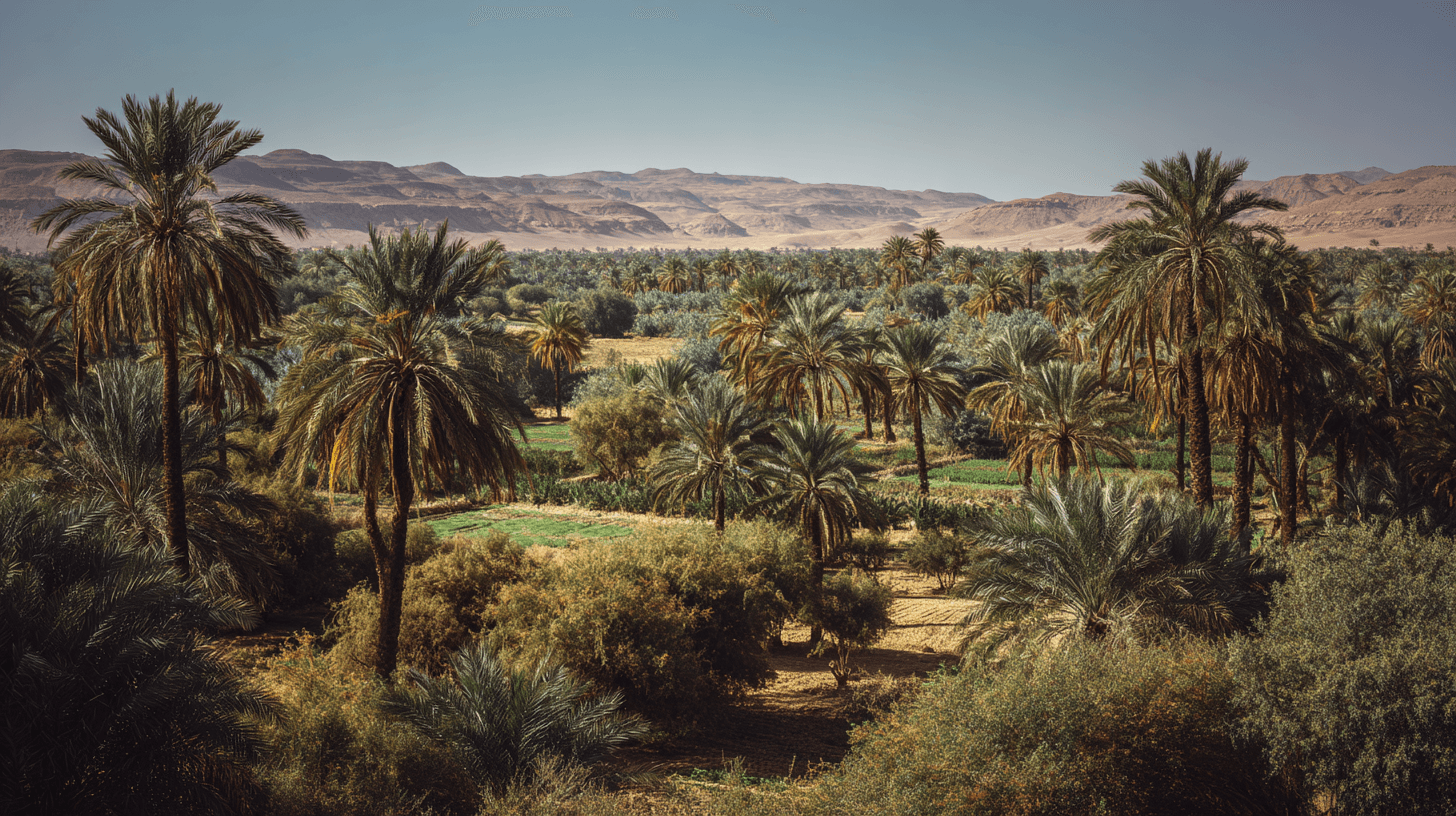
In the valleys of the Draa, the Ziz, the Todra, oases appear like mirages — sudden explosions of green in landscapes of rock and dust. They look natural, accidental, blessed. They're none of these things. Every oasis is an engineered system, refined over a thousand years, designed to turn scarce water into maximum food.
The structure is vertical, built in three layers.
At the top, date palms — the "cathedral columns" that give the oasis its shape. Their fronds create a canopy that filters the brutal sun, dropping temperatures by 10-15 degrees underneath. Their roots go deep, tapping water that surface plants can't reach. They produce dates, of course — but their primary function is infrastructure. They make the lower layers possible.
In the middle, fruit trees: pomegranates, figs, apricots, olives. These need less sun than the palms, more than the vegetables. They grow in the dappled light, protected from wind and heat. Their roots occupy the middle zone of soil, drinking what the palms don't take.
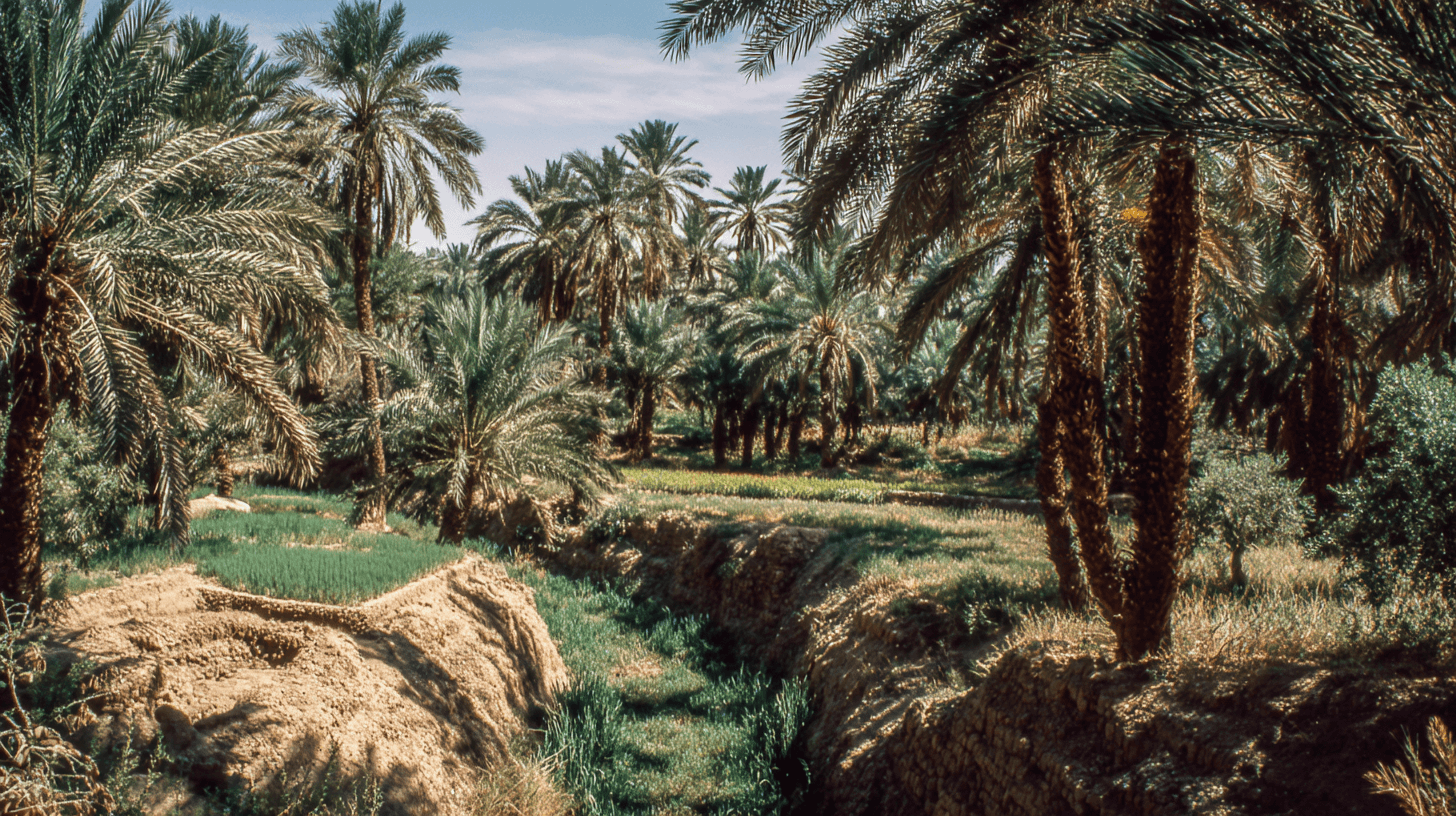
At the bottom, vegetables and cereals: wheat, barley, alfalfa, onions, tomatoes. These grow in near-constant shade, their roots in the top layer of soil, watered by the precise irrigation channels that thread through every oasis. They mature fast, provide daily food, and — crucially — protect the soil from evaporation with their leaf cover.
Three stories, three root depths, three growing seasons, all sharing the same water and the same land. It's polyculture taken to its logical extreme — a food factory disguised as a garden.
The system requires constant management. Water rights are negotiated by the hour. Channels are cleaned, repaired, redirected. Palms are pollinated by hand, their fronds trimmed to optimize light for the layers below. A single oasis might have dozens of owners, each with plots scattered across the system, each dependent on the cooperation of all the others.
The cities of the desert — Zagora, Erfoud, Tinghir — exist because of these green machines. Take away the oasis, and there's nothing but rock and wind. The date palm isn't just a crop. It's the column that holds up a civilization.
The Facts
- •Date palms can reduce temperatures below their canopy by 10-15°C
- •Morocco has over 5 million date palms
- •The Draa Valley oasis stretches over 200km
- •Traditional oases use a three-tier cultivation system
- •Water rights in oases are measured in time, not volume
- •The Tafilalet oasis is one of the largest in the world
- •Date palm pollination is done by hand in Morocco
Sources
- Battesti, Vincent. 'Gardens in the Sahara.' CNRS
- Lightfoot, Dale. 'Moroccan Khettara.' Geographical Journal
- FAO documentation on oasis agriculture