The Transhumance
40,000 sheep moving 2,000 meters twice a year
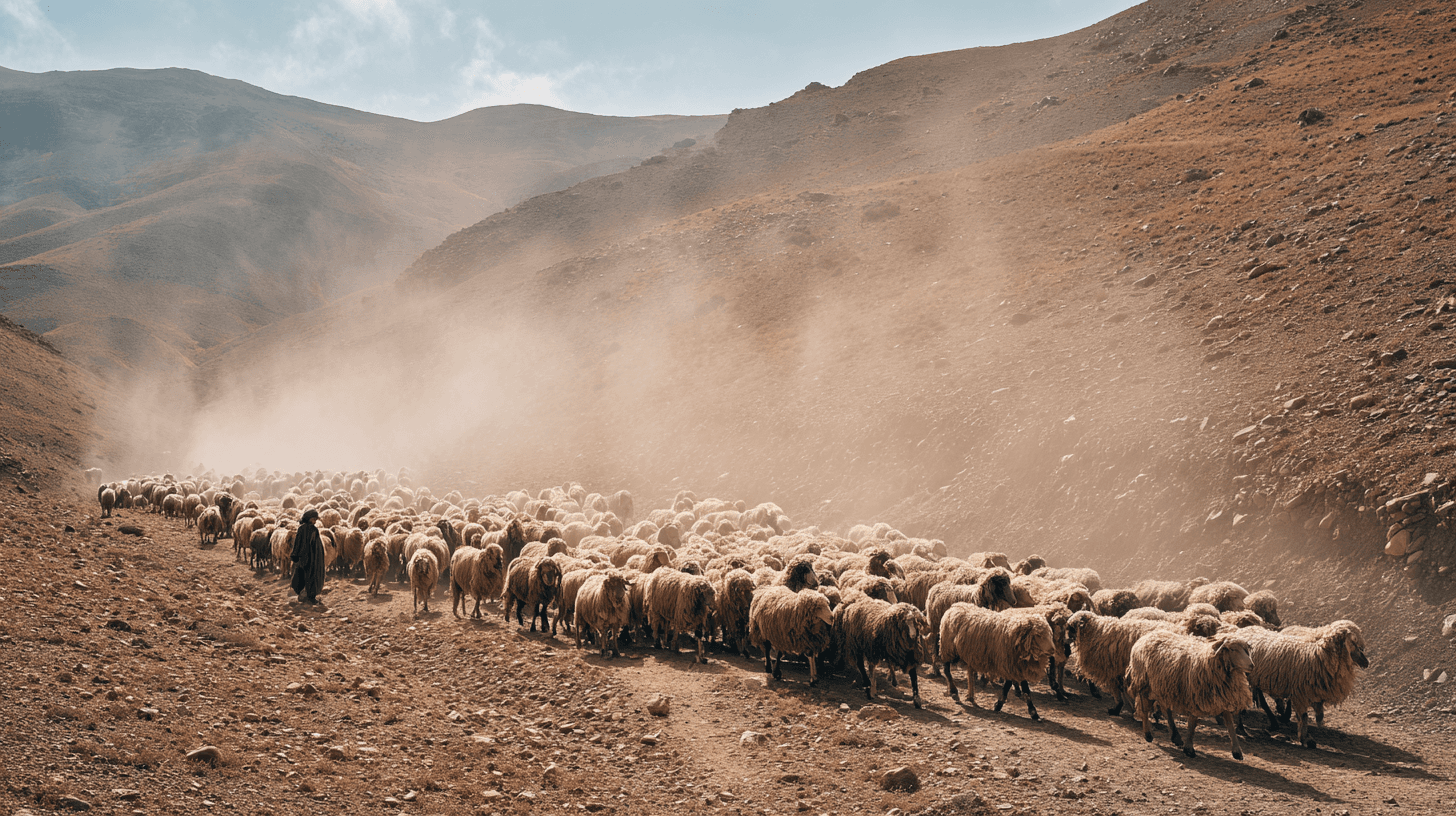
Forty thousand sheep begin to move. The sound is like nothing else — a river of bells, bleating, and hooves on stone. The shepherds click their tongues. The dogs know what to do. Spring has come to the High Atlas.
Twice each year, the Ait Atta and other Amazigh tribes enact one of the oldest migrations in Africa. As snows melt in the high passes, the flocks climb — from winter pastures at 1,000 meters to summer grazing grounds at 3,000 meters. In autumn, they descend. The pattern hasn't changed in millennia.
This is transhumance: the vertical movement of livestock following the growth of grass. It sounds simple. It is not. The timing must be precise — too early and the high pastures are still frozen; too late and the lowland grass is already burnt. The routes thread through terrain that would break a paved road. The shepherds must know every water source, every sheltered camp, every pass that becomes a death trap in sudden weather.
The families move with their animals. Tents are struck at dawn, pitched at dusk. Children grow up walking. Grandmothers who can no longer make the journey stay in village houses, waiting for the flocks to return. The economy of the tribe moves on four legs.
Each family has traditional rights to specific routes and pastures, agreements that predate any government. Disputes are settled by councils of elders applying customary law — izref — that has never been written down but is known by everyone who matters. A family's territory might be defined by a particular boulder, a certain tree, a spring that only flows in wet years.
Now the roads are paved. Trucks can move sheep faster. Many young people choose the city over the mountain. But every spring, the bells still ring in the passes. Every autumn, the dust rises from the descending herds. The rhythm continues because some things cannot be replaced by engines.
The grass grows at 3,000 meters. The sheep know how to find it. The shepherds know how to follow. The mountains accept those who learned, long ago, how to ask permission.
The Facts
- •Vertical movement spans 2,000+ meters elevation
- •Flocks can number 40,000+ animals in major migrations
- •Routes have remained consistent for millennia
- •Ait Atta confederation is one of the largest pastoral groups
- •Transhumance practiced across Atlas, Rif, and Anti-Atlas
- •Winter camps at 1,000-1,500m, summer at 2,500-3,500m
- •Traditional grazing rights predate written law
Sources
- Ilahiane, Hsain. 'Ethnicities, Community Making, and Agrarian Change.' University Press of America
- Mahdi, Mohamed. 'Pastoralism and Institutional Change in the Oriental.' ICARDA
- Bencherifa, Abdellatif. 'Land Use and Equilibrium of Mountain Ecosystems in the High Atlas.' Mountain Research