The Argan Women
Oil pressed by hand, cooperatives that changed everything
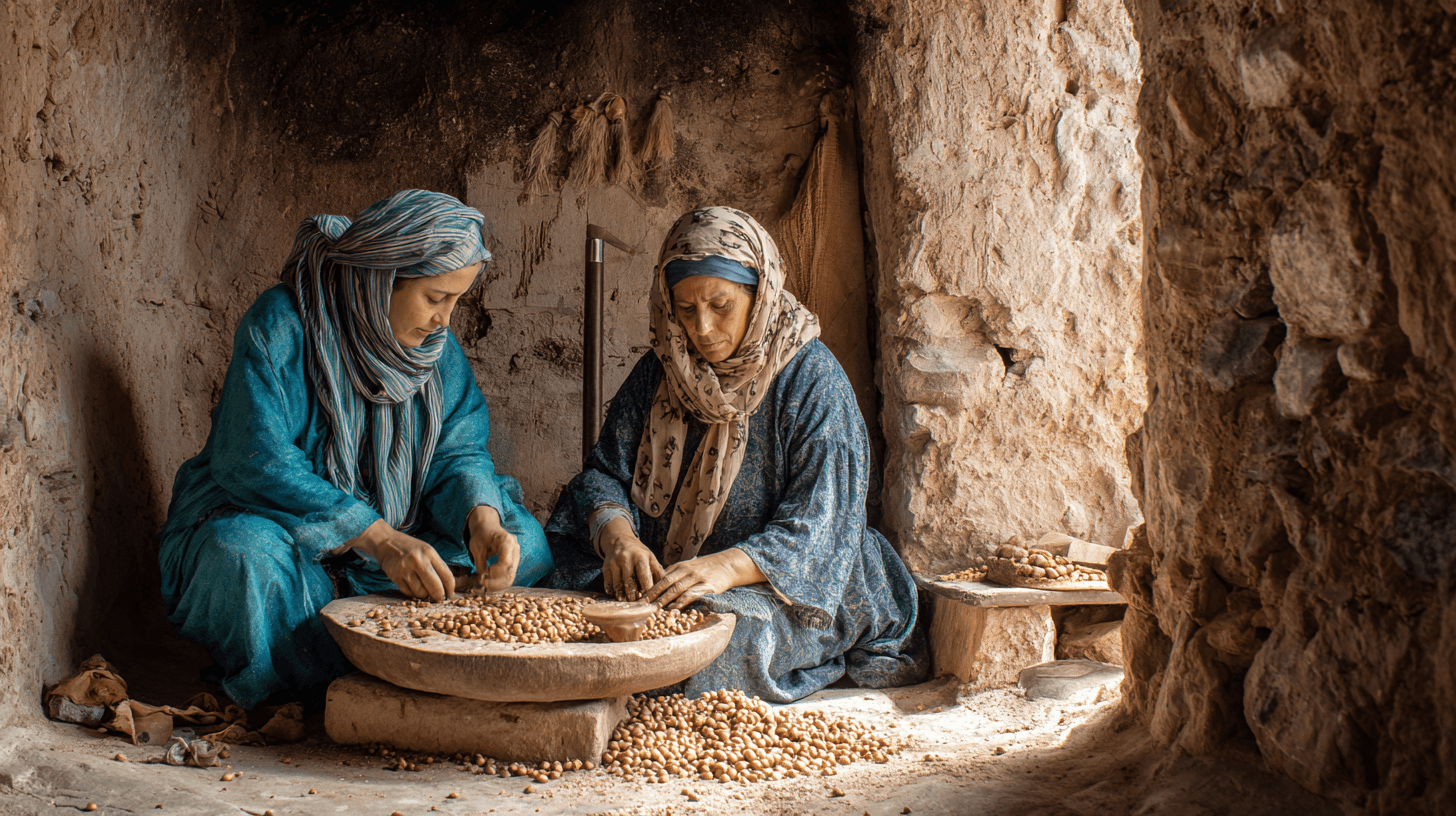
Her hands move without looking — crack, extract, crack, extract. The pile of shells grows. The pile of kernels stays small. It takes thirty kilos of fruit to make one liter of oil.
The argan tree grows nowhere else on earth. A band of forest along Morocco's Atlantic coast, stretching inland to the Anti-Atlas — this is the tree's entire range. Within it, Berber women have been extracting oil from the tree's nuts for centuries, a process so laborious it defies economic logic.
The fruit looks like a large olive, but the structure is different. Inside the flesh is a nut. Inside the nut is a shell harder than most nutcrackers can handle. Inside the shell are the kernels — two or three tiny seeds from which the oil is pressed. Every step requires work.
Traditionally, women crack the shells by hand, using stones that have been in their families for generations. The technique is precise: too hard and the kernel shatters; too soft and the shell doesn't break. A skilled woman can process perhaps two kilograms of nuts per day. For a liter of oil, that means fifteen days of labor.
The cooperatives changed everything and nothing. Starting in the 1990s, women's cooperatives organized the production, built shared facilities, and established quality standards that made Moroccan argan oil valuable in international markets. The women still do the work, but now they own shares in the enterprise. They set prices. They control the profits.
This wasn't charity; it was strategy. Argan oil's value depends on its authenticity, and authenticity requires traditional methods. Machine-processed oil exists, but it lacks the qualities — the nutty flavor, the golden color, the health properties — that make argan oil precious. The slow work of human hands is not inefficiency. It is the source of the value.
Today, argan oil sells in Paris and New York for prices that would have astonished the grandmothers who first taught the technique. The women in the cooperatives know this. They've seen the bottles in duty-free shops. They understand exactly where their labor sits in the global supply chain.
They keep cracking. The work is social — women talking, laughing, sharing news while their hands perform the ancient motions. The oil is golden, precious, theirs. The tree grows nowhere else. The knowledge lives nowhere else. The value is inseparable from the hands that make it.
The Facts
- •Argan tree endemic to Morocco (UNESCO Biosphere Reserve)
- •30-40kg fruit yields 1 liter oil
- •Hand-cracking takes 15-20 hours per liter
- •Women's cooperatives began forming 1990s
- •Over 100 cooperatives now operate
- •Cooperative model gives women direct ownership
- •Oil used culinary, cosmetic, and medicinal
- •UNESCO recognized argan practices as ICH 2014
Sources
- Lybbert, Travis. 'Patent Disclosure and the Market for Ideas.' Journal of Agricultural Economics
- Charrouf, Zoubida. 'The Argan Tree.' UN FAO
- UNESCO Intangible Cultural Heritage documentation, 2014