The Bread Ovens
Communal ferrah, neighborhood bread
She marks her dough with a pattern — two lines crossed. The boy takes it to the oven. By noon, it will return, golden and fragrant. He will know it by the marks.
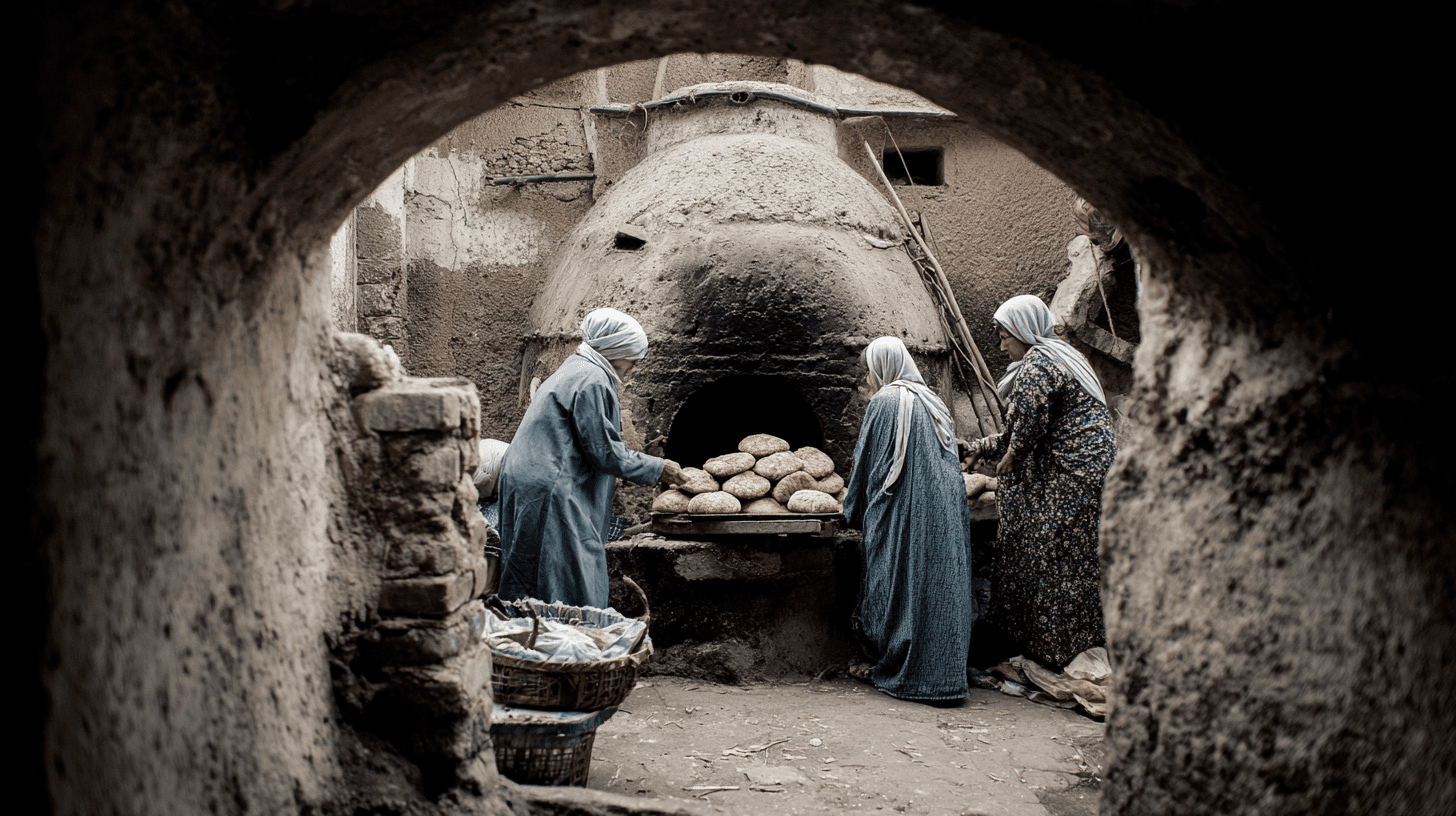
Every neighborhood in the medina has a ferran — a communal bread oven. The system is ancient and elegant: women prepare dough at home, shape it into rounds, mark it with patterns that identify each family, and send it with children to the oven. The ferran bakes it. The family picks it up. The bread is fresh, the fuel is shared, and no one needs to maintain an oven alone.
The ferran is usually a man. He has inherited his job, his oven, his knowledge of flame and timing. He knows that this family's dough is wetter than that one's, that this neighbor likes her bread darker, that certain marks mean "be careful, we're feeding guests today." He shuffles loaves in and out of the wood-fired chamber with a paddle worn smooth by generations of use.
The oven itself is a dome of clay and brick, fed by whatever fuel is available — wood, olive pits, agricultural waste. The heat is intense and uneven, which is why the ferran must rotate the loaves, must know exactly when to add more fuel, must feel the temperature with instincts developed over decades.
Children crisscross the neighborhood carrying wooden boards balanced on their heads, dough covered with cloth to keep it rising. They know the route. They know to protect the dough from jostling. They know to check the marks when they pick up the finished bread — mix-ups are embarrassing for everyone.
The system is communal infrastructure disguised as commerce. The ferran charges a small fee, but the real economy is social. The oven is a gathering point, a place where news spreads, where women chat while waiting, where children learn responsibility. The bread is the excuse; the community is the product.
Modern life offers alternatives. Gas ovens in homes. Bakeries selling finished bread. But in the medinas, the ferrans survive because they provide something the alternatives cannot: bread that comes from your kitchen, baked by your neighbor, carried by your child. The bread tastes the same. But the life that surrounds it would be unrecognizable without the journey to the oven and back.
The Facts
- •Each neighborhood traditionally has dedicated ferran
- •Families mark dough with unique patterns
- •Ferran typically a hereditary occupation
- •Wood, olive pits, or agricultural waste used as fuel
- •Children traditionally responsible for transport
- •Small fee charged per loaf
- •System provides social infrastructure beyond bread
- •Practice documented since at least medieval period
Sources
- Petruccioli, Attilio. 'Understanding Islamic Architecture.' Routledge
- Abu-Lughod, Janet. 'Rabat: Urban Apartheid in Morocco.' Princeton University Press
- Observations from medina residents