The Camps
Glamping at the end of the world
The first luxury camp in the Agafay opened sometime in the late 2000s. Now there are dozens, competing for the same sunset, the same silence, the same view of the Atlas that humans have been watching for millennia.
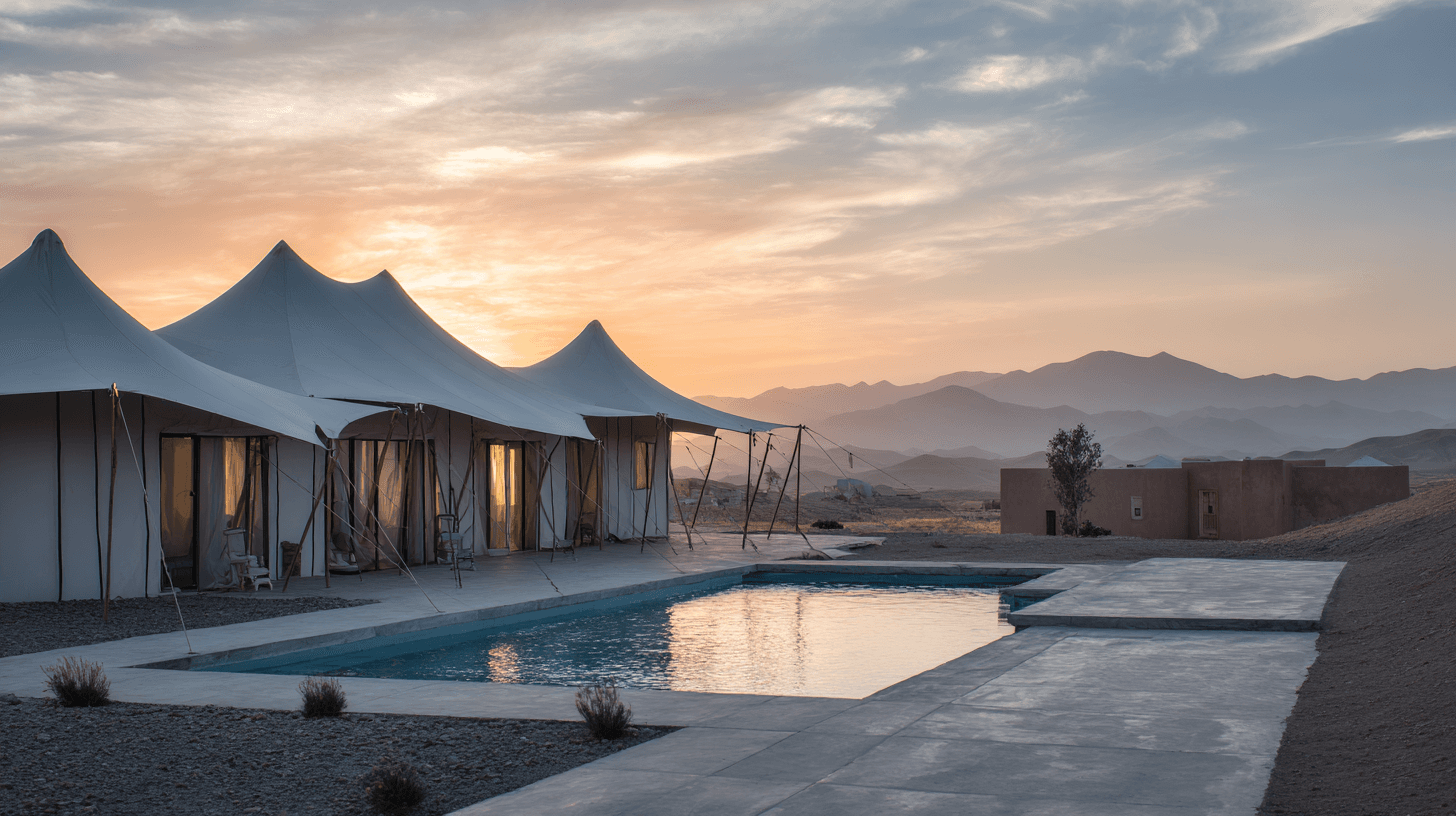
The formula is remarkably consistent. White canvas tents with real beds and proper bathrooms. A swimming pool that seems to float above the desert. A restaurant serving tagine by candlelight. A camel or two for sunset rides. Fire pits for the evening, when temperatures drop and the stars emerge with a clarity impossible in the city.
This is glamping — glamorous camping — a category invented by the travel industry to describe experiences that offer the aesthetics of wilderness without its inconveniences. You sleep in a tent, but the tent has air conditioning. You're in the desert, but the pool is heated. The contradiction is the point.
The Agafay works for this because of proximity. The Sahara requires a nine-hour drive from Marrakech, a commitment that limits it to serious travelers with time to spare. The Agafay is forty-five minutes away. You can leave the medina at noon, spend the afternoon by the pool, watch the sunset from a camel, dine under the stars, sleep in a tent that costs more than most hotel rooms, and be back in the city for a late breakfast. The desert becomes a day trip, or an overnight — not an expedition.
The camps cater to different markets. Some position themselves as retreats — yoga at sunrise, spa treatments, digital detox. Others emphasize adventure — quad bikes, dune buggies, horseback rides through the hammada. A few aim for romance — private dinners, rose petals, the kind of curated intimacy that photographs well. All of them sell the same thing: the desert, made comfortable.
The growth has been rapid. Where one camp stood fifteen years ago, dozens now cluster across the plateau. Competition has pushed prices up and amenities higher. The tents have become lodges. The lodges have become suites. The line between camping and hospitality has blurred until it no longer exists.
The locals have adapted. Berber guides who once led travelers into the deep Sahara now offer two-hour camel rides between camps. Families who farmed the scrubland sell olives and argan oil to resort kitchens. The camps employ cooks, cleaners, drivers, entertainers — a workforce that commutes from nearby villages into what was, not long ago, empty space.
There are tensions. The camps use water in a region that has almost none. The quad bikes tear up terrain that took millennia to form. The views that make the experience valuable are also finite — too many camps, and everyone stares at each other instead of the mountains. The paradox of selling wilderness is that success destroys the product.
But at sunset, when the light turns the hammada to gold and the Atlas glows pink above the horizon, the contradictions fade. The desert absorbs everything — the pools, the tents, the quad bikes, the Instagram photographers — and remains itself. The camps are temporary. The hammada is not.
The Facts
- •Agafay is ~45-60 minutes from Marrakech (vs. 9+ hours to Sahara)
- •Luxury camps began appearing in late 2000s
- •Inara Camp claims 16+ years of operation (since ~2009-2010)
- •Most camps offer: pools, spa, fine dining, camel rides, quad biking
- •Prices range from budget (~$50/night) to luxury (~$500+/night)
- •Water scarcity is a significant environmental concern
- •Camps employ locals from nearby villages
- •Best season: October to May (cooler temperatures)
- •Winter nights can drop below 5°C — camps provide heating