The Carpet Weavers
Maps, dowries, and protection woven in wool
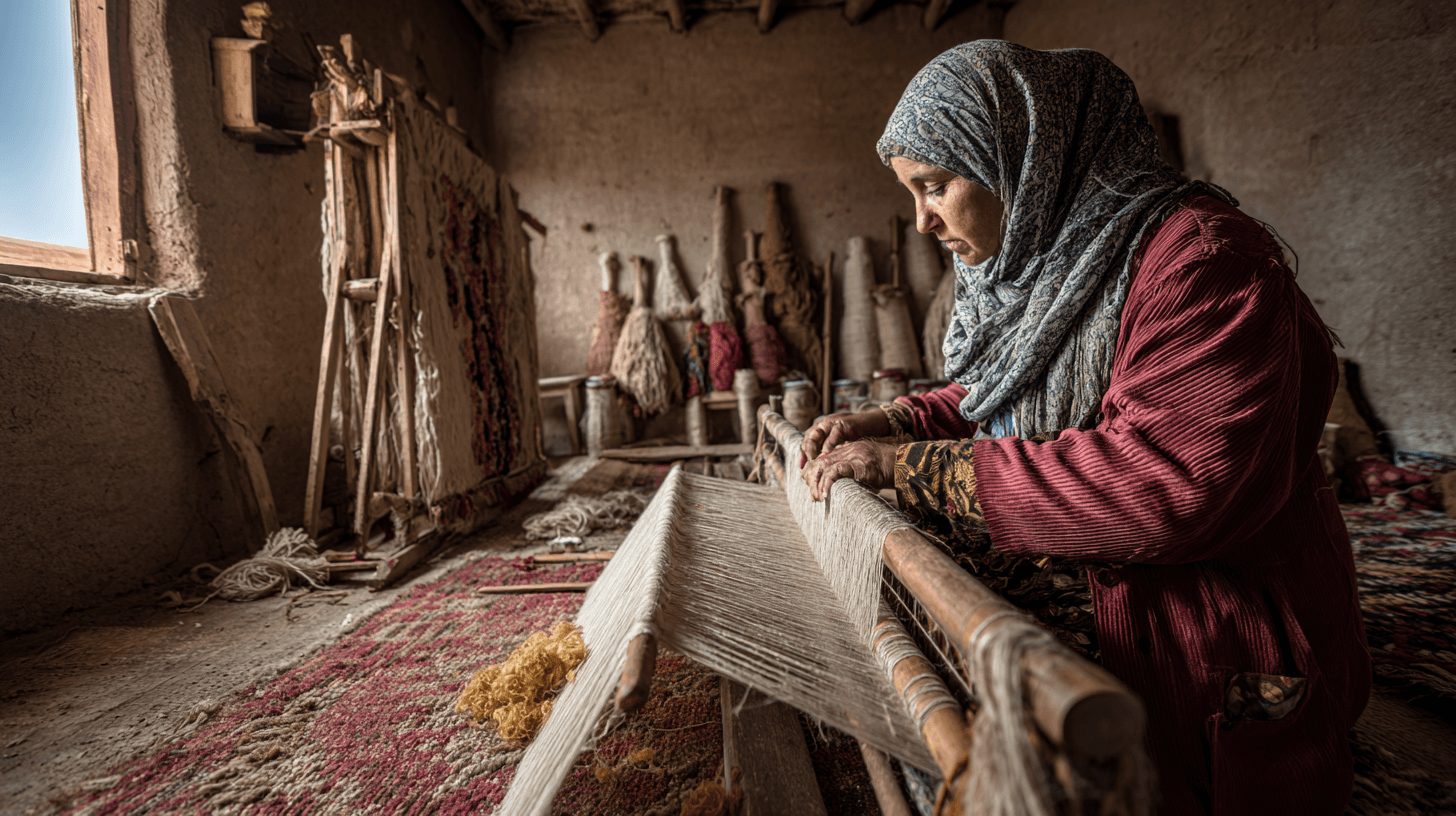
Her mother taught her to read the symbols before she taught her to read words. A diamond for protection. A zigzag for water. The carpet under her loom holds a language that outsiders buy without understanding.
In the High Atlas, women weave. They have always woven. The patterns they create are not decoration — they are communication, protection, and identity compressed into wool.
Each region has its vocabulary. A Beni Ourain carpet speaks differently than a Boujaad, which speaks differently than a Taznakht. The differences are not aesthetic choices but statements of origin, readable to anyone who grew up surrounded by carpets. The shapes encode belonging.
Within the regional language, each weaver adds personal meaning. A birth, a death, a marriage, a migration — these events find their way into the patterns, recorded in symbols whose meanings are shared only with daughters. A carpet might contain prayers for fertility, warnings against the evil eye, maps of water sources, genealogies going back generations. The buyer sees beautiful geometry. The weaver's family sees a diary.
The weaving itself takes months. The wool is sheared from sheep that graze specific pastures, giving it particular qualities of lanolin and luster. Natural dyes come from plants gathered at particular seasons — indigo for blue, pomegranate for yellow, madder root for red. Each color requires its own mordant, its own technique, its own knowledge.
The loom is simple — upright wooden beams, horizontal supports, nothing that couldn't be built from materials found in any village. But the weaver's hands move in patterns learned from watching mothers and grandmothers, techniques refined over generations to produce knots that will hold for centuries.
When a woman weaves her daughter's wedding carpet, she weaves protection into every row. She adds symbols for fertility, for household peace, for strength against hardship. The carpet will lie beneath her daughter's feet every day of her married life, a message from mother to child that never stops being sent.
Tourists buy the carpets for their patterns, their colors, their exotic beauty. The weavers smile and accept the money. They know what they've sold. They know, too, what they've kept — the meanings that remain even when the wool leaves the village.
The Facts
- •Major regional styles: Beni Ourain, Boujaad, Taznakht, Azilal, Chichaoua
- •Symbol vocabulary includes fertility, water, protection motifs
- •Natural dyes from indigo, madder, pomegranate, saffron
- •Single carpet can take 2-6 months to complete
- •Warp-weighted vertical loom design unchanged for millennia
- •Weaving traditionally women's domain across Amazigh cultures
- •UNESCO recognized Moroccan carpet traditions as ICH
Sources
- Barbatti, Bruno. 'Berber Carpets of Morocco.' ACR Edition
- Pickering, W.R. 'Moroccan Carpets.' Laurence King
- Spring, Christopher. 'North African Textiles.' British Museum Press