The Golden One
Ahmad al-Mansur and Morocco's last golden age
On August 4, 1578, three kings entered the Battle of Alc√°cer Quibir. None of them survived.
Ahmad al-Mansur was not supposed to become sultan. He was the younger brother of Abd al-Malik, who was fighting to reclaim the Moroccan throne from the usurper Muhammad II al-Mutawakkil. The Portuguese king, Sebastian I, had allied with Muhammad, hoping to make Morocco a client state. The battle was a catastrophe for Portugal: Sebastian died, Muhammad drowned fleeing, and Abd al-Malik—already ill—died during the fighting.
Ahmad inherited the victory. He took the title 'al-Mansur'—the Victorious—and set about building an empire.
He began with the El Badi Palace in Marrakech, a monument to his triumph. Contemporary accounts describe gold-leaf ceilings, Italian marble, onyx columns, and a courtyard with pools that held rare fish. He financed it partly with Portuguese ransom money—the thousands of prisoners taken at Alcácer Quibir had made him rich.
But the ransom money ran out, and Ahmad needed gold. Real gold. The trans-Saharan trade had for centuries brought gold from West Africa to Morocco, but the routes were controlled by intermediaries. Ahmad decided to take the source.
In 1590, he sent an army of 4,000 men across the Sahara under Judar Pasha, a Spanish convert. They carried gunpowder weapons—rare in sub-Saharan Africa. At the Battle of Tondibi in 1591, they shattered the Songhai Empire's army of 40,000. They captured Timbuktu, Djenné, and Gao. They deported Timbuktu's scholars and stripped its libraries.
The gold flowed north. Ahmad earned his second title: 'al-Dhahabi'—the Golden.
He was also a diplomat, maintaining friendly relations with England while resisting Ottoman demands. He wrote to Queen Elizabeth I about joint operations against Spain. He received English embassies at his court. A Moroccan ambassador visited London in 1600, where some scholars believe Shakespeare saw him—and was inspired to write Othello.
Ahmad died of plague in 1603. He was fifty-four. Within months, his sons were at war: Zidan al-Nasir controlled Marrakech, Abou Fares Abdallah controlled Fez. The empire fractured. The El Badi Palace was stripped of its treasures by later rulers—the marble went to Meknes, the gold went everywhere, the pools went dry.
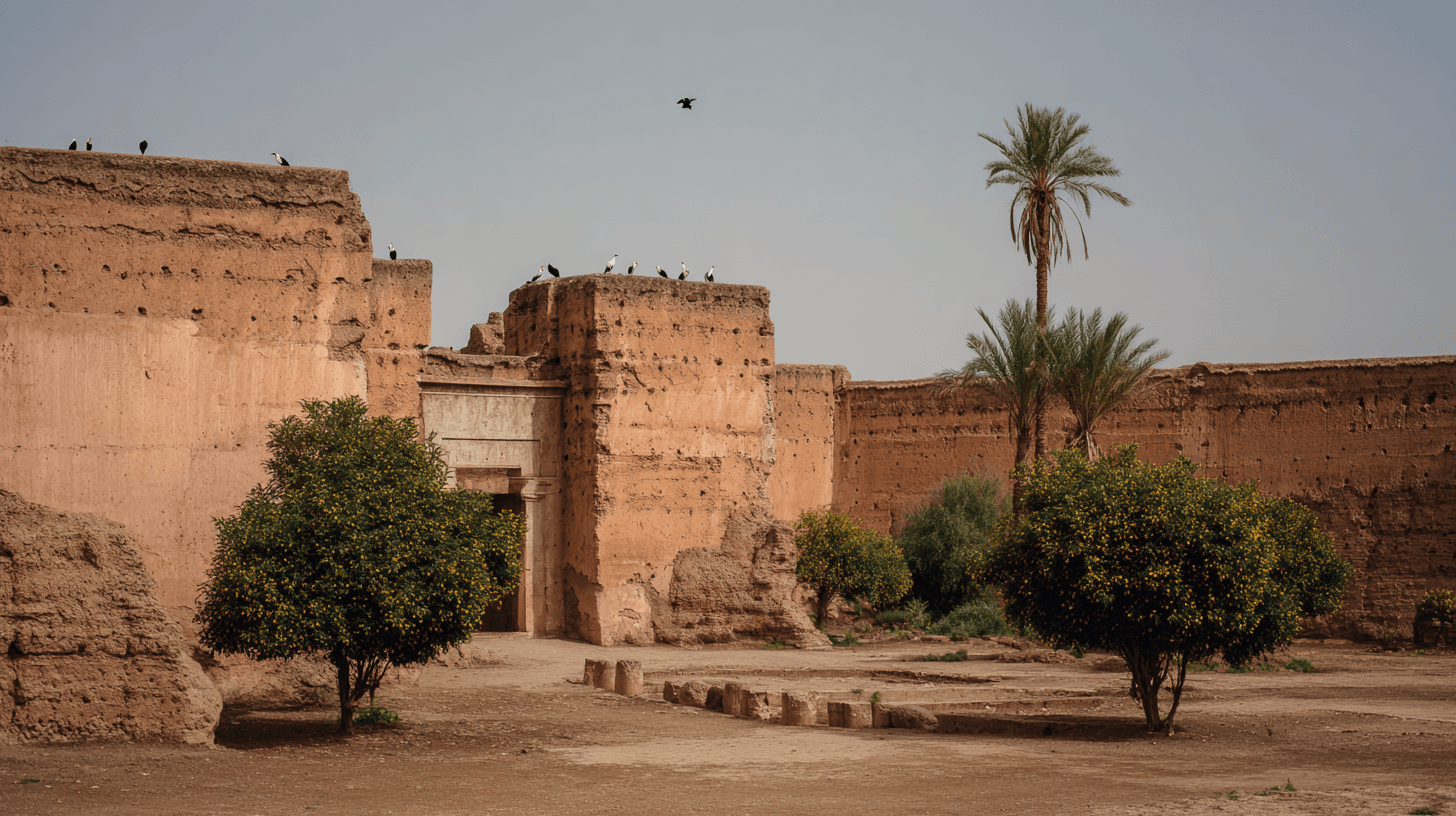
What remains is a ruin of massive walls and orange trees, patrolled by storks. The Saadian Tombs nearby contain Ahmad's grave, rediscovered in 1917 after being sealed for centuries.
Morocco would not see another golden age for a long time.
The Facts
- •Battle of Alc√°cer Quibir: August 4, 1578
- •Three kings died: Sebastian I, Abd al-Malik, Muhammad II
- •4,000-man army crossed Sahara 1590
- •Battle of Tondibi 1591 destroyed Songhai Empire
- •El Badi Palace built with ransom money
- •Moroccan ambassador to London 1600
- •Died of plague 1603
- •Saadian Tombs rediscovered 1917
Sources
- Hunwick, Timbuktu and the Songhay Empire (1999)
- García-Arenal, Ahmad al-Mansur: The Beginnings of Modern Morocco (2009)