The Hammada
The desert that isn't what you think
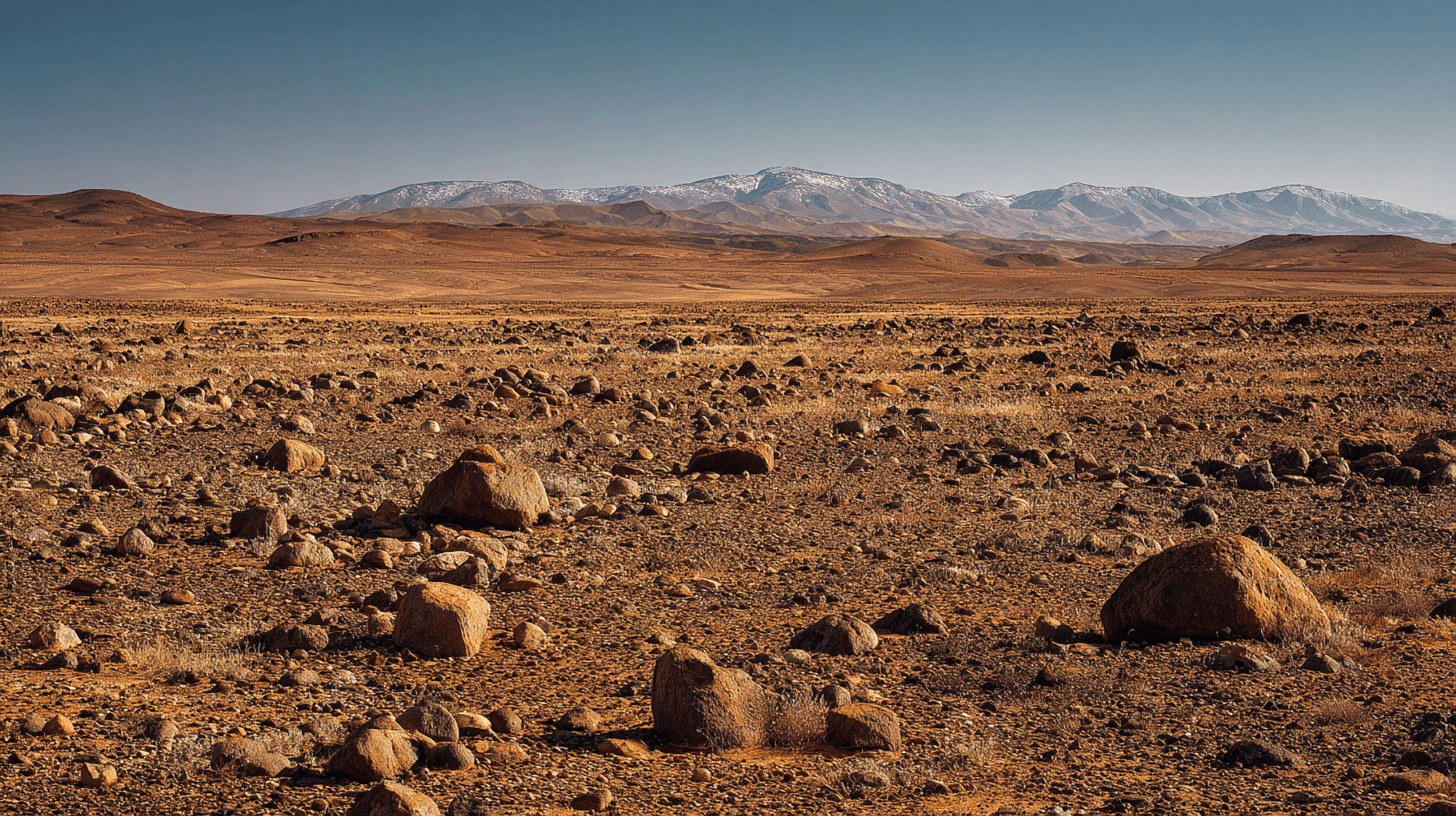
No golden dunes. No camel trains disappearing into infinite sand. The Agafay is a hammada — a stone desert — and it breaks every expectation you brought with you.
The word comes from Arabic, meaning "barren" or "stony." Geologists use it to distinguish landscapes like this from the erg — the sand seas that define the Sahara in popular imagination. An erg is what you picture when someone says "desert." A hammada is what you find when you actually get there.
Forty kilometers southwest of Marrakech, the road climbs through olive groves and scrubland, then opens onto something that looks like the surface of the moon. Ochre hills roll toward the horizon in frozen waves. The ground is compacted earth and rounded stone, sculpted by flash floods that haven't come in years. In the distance, the High Atlas rises like a wall of teeth, snow-capped from December through March.
This was once underwater.
The stones beneath your feet were shaped by ancient torrents pouring down from those mountains, depositing sediment in a prehistoric lake that covered this plateau thousands of years ago. When the water retreated, it left behind this mineral-rich terrain — beige, terracotta, rust — that geologists call a "stone desert" and travelers call otherworldly.
The hammada has its own vocabulary. The reg is gravel plain. The serir is a surface of small pebbles, polished by wind. The hamada (with one 'm') sometimes refers specifically to rocky plateaus, while hammada (with two) can mean the broader category. The distinctions matter to geologists. To everyone else, the effect is the same: a landscape stripped to its bones, where the earth's architecture shows through.
This is not the Sahara. The Sahara is nine hours south, past Ouarzazate, past the kasbahs of the Draa Valley, past everything familiar. The Agafay is something else — a stone desert at the edge of the city, close enough for a day trip, strange enough to feel like another planet.
The silence is different here than in the sand dunes. In an erg, sand absorbs sound, creating a muffled quiet. In the hammada, sound travels. You hear the wind across the stones, the distant bark of a dog in a village you cannot see, the cry of a raptor riding thermals toward the mountains. The silence is not absence — it's clarity.
At sunset, the hammada turns colors that don't exist in the city. The ochre deepens to amber, then rust, then something close to violet as the light drains west. The Atlas catches the last sun on its peaks while the plateau falls into shadow. This is the hour when the camps light their fires and the quad bikes finally stop their engines and the stone desert becomes, briefly, what it has always been — a place where humans are visitors, tolerated but not essential.
The Facts
- •Hammada: Arabic for "barren" or "stony" — refers to stone deserts
- •Erg: Arabic for sand desert — the dune fields of popular imagination
- •Agafay is ~40 km southwest of Marrakech, about 45-60 minutes by car
- •Landscape formed by prehistoric lake that dried thousands of years ago
- •Stones rounded by ancient flash floods from Atlas Mountains
- •High Atlas visible from Agafay, snow-capped December through March
- •Toubkal (4,167m) is highest peak in North Africa, visible on clear days