The Hammam
Where the body remembers what the mind forgets
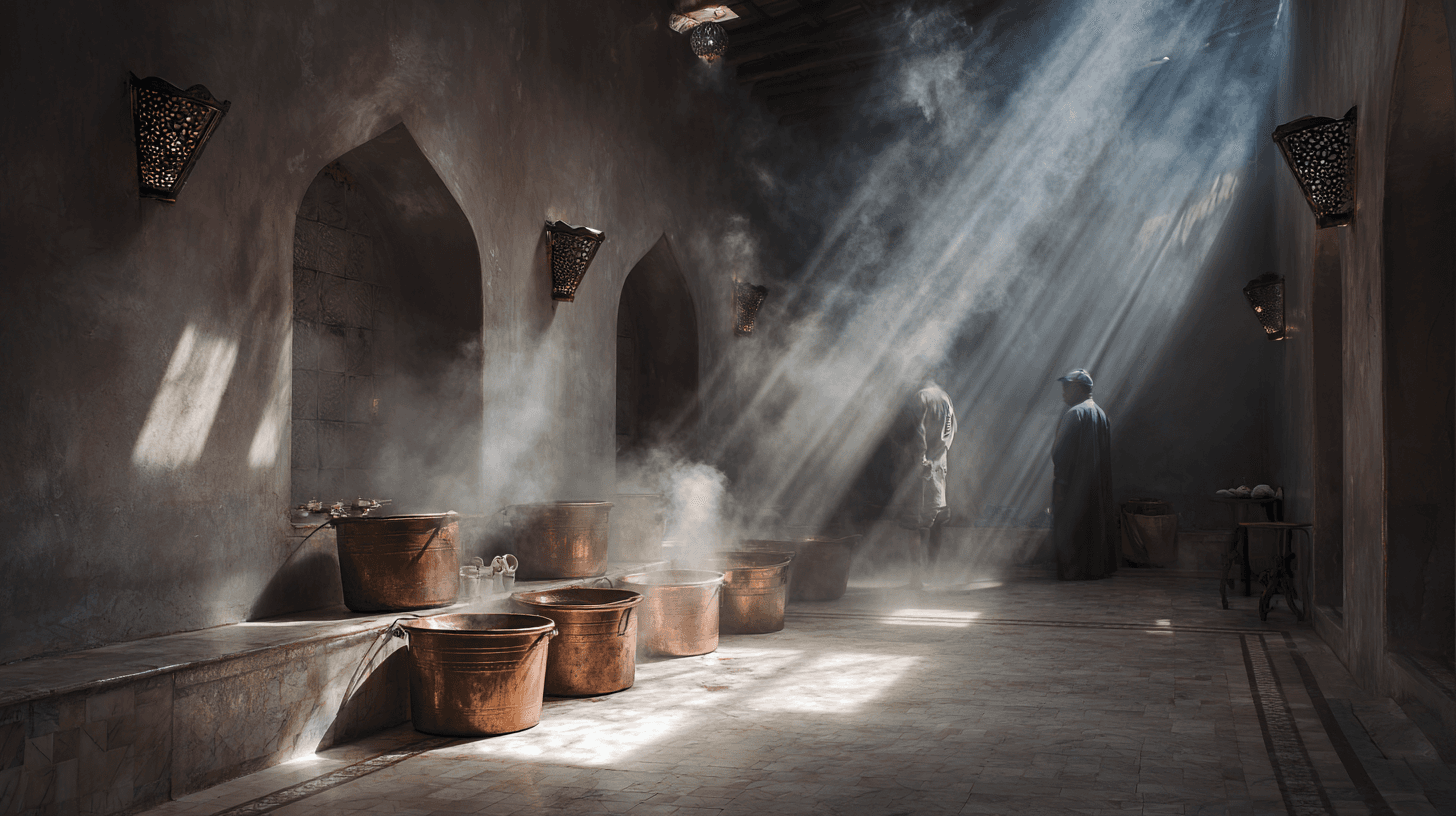
The heat hits before the door closes behind you. Steam thick enough to taste. Somewhere in the white blur, a woman is humming. You cannot see her. You can only hear her, and the slap of wet cloth on stone.
The hammam is not a spa. It is not a sauna. It is something older — a place where the body is scrubbed back to zero, where the social masks come off with the dead skin, where women have gathered for a thousand years to gossip, grieve, and be seen without being watched.
Every neighborhood has one. The entrance is usually unmarked or nearly so — a door in a wall, a passage that turns twice before opening into the changing room. You strip. You wrap yourself in a fouta. You leave your phone, your status, your name at the threshold. Inside, everyone is just a body.
The architecture is Roman by way of Islam. Three rooms of increasing heat: warm, hot, hottest. The progression is deliberate. You acclimate. Your pores open. By the time you reach the innermost chamber, where the marble is almost too hot to sit on, your skin is ready to release what it's been holding.
Then the scrubbing begins.
A tayaba — the woman who works the hammam — will take a kessa, a rough mitt woven from plant fiber, and remove what you thought was your skin. Grey ropes of dead cells roll off your arms, your legs, your back. It looks alarming. It feels like being reborn. The word they use is "gommage" — erasure. You are being erased down to something new.
For Moroccan women, the hammam is where life happens. It's where mothers inspect potential daughters-in-law (discreetly, in the steam). Where brides are scrubbed and hennaed the night before their wedding. Where new mothers bring their babies for the first bath. Where grief is sweated out after funerals. The hammam holds what cannot be said elsewhere.
Men have their hammams too — same architecture, different hours or different buildings. But the hammam is fundamentally feminine space. The tayabat who run it, the rituals that structure it, the secrets that stay within it: all belong to women.
Tourists can visit. Many riads now have private hammams, climate-controlled and rose-scented, nothing like the neighborhood originals. The public hammams are harder to find, harder to navigate if you don't speak Darija, harder to surrender to. But they're still there — behind those unmarked doors, in the steam, where the humming continues.
You leave lighter. Not just cleaner — lighter. Something has been taken from you that you didn't know you were carrying. The street outside seems too bright, too loud. Your skin is raw and new. You have been erased, and what remains is somehow more yourself than what walked in.
The Facts
- •Hammam tradition dates to Roman bath culture, adapted by Islamic civilization
- •Three-room progression: warm (barid), hot (wastani), hottest (skhoun)
- •Public hammams segregated by gender (different hours or buildings)
- •Kessa mitt made from plant fiber for exfoliation
- •Tayaba/tayabat: the women who work in hammams
- •Black soap (savon beldi) made from olive oil and eucalyptus
- •Hammams traditionally located near mosques (shared water heating)
- •Brides visit hammam night before wedding for ritual preparation