The Lila
All-night ceremonies for healing
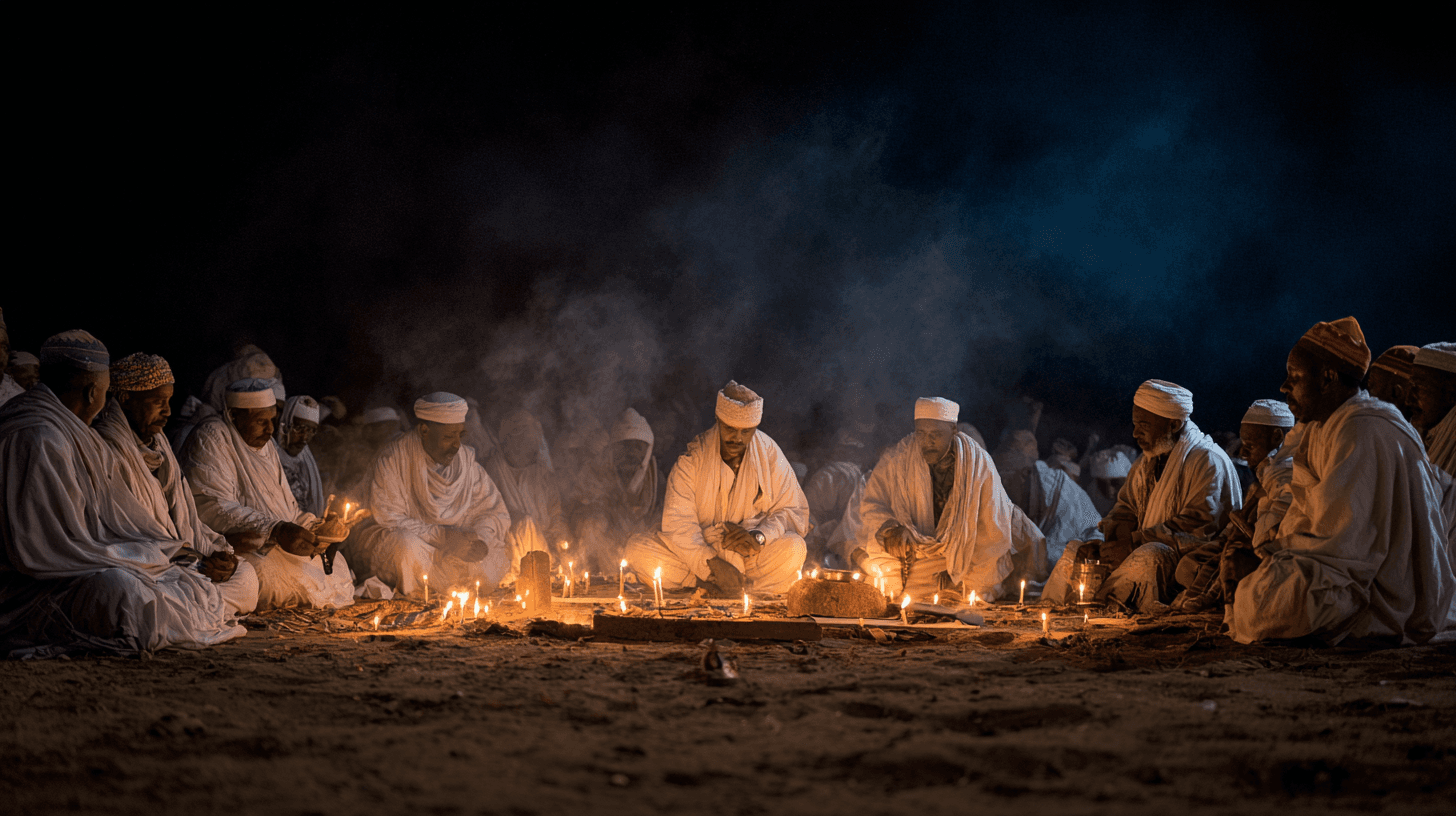
Midnight. The candles flicker. Seven colors of cloth laid out on the floor. The maalem strikes the first note and everything outside this room stops existing.
A lila is a Gnawa ceremony lasting from sunset to sunrise. It is not a concert, not a performance, not entertainment. It is therapeutic ritual, and it follows protocols that have been refined over centuries to do a specific job: heal what cannot be healed any other way.
The space is prepared carefully. Incense burns — the specific scent depending on which spirits will be invoked. Candles provide the only light. The seven-colored cloths represent the seven families of spirits, each with its own songs, its own rhythms, its own demands. Food has been prepared: sacrificial animals, traditional dishes, offerings for the mluk.
The ceremony begins with the aada — a public portion where the musicians warm up, the crowd gathers, the energy builds. This is what tourists sometimes see. But the real work comes later, in the private hours, when only the afflicted and their families remain.
The maalem plays, the krakeb keep time, and the songs cycle through the repertoire. Each spirit family has its own section. When a spirit's music plays, those who are possessed by that spirit may enter trance. They rise, they dance, they shake, they fall. The medina watches, supports, protects them from harming themselves.
A skilled maalem reads the room. He sees who is responding to which music. He adjusts the sequence, returns to songs that provoked reaction, builds intensity at the right moments. This is not improvisation — the songs are ancient and fixed — but it is interpretation, a lifetime of experience applied to reading affliction and matching it to remedy.
By dawn, the work is done. The afflicted have confronted their spirits, danced until they could not stand, received what healing is possible. Some will be cured. Some will need more lilas. Some will never be cured but will learn to live with what possesses them.
The Gnawa make no promises. The spirits are real but not controllable. The music is a conversation, not a command. What the lila offers is not certainty but witness — a community that acknowledges the invisible, a tradition that takes seriously what modern medicine dismisses. In a room lit by candles, accompanied by music older than borders, something happens. The name for it is healing, even when healing is incomplete.
The Facts
- •Ceremonies run sunset to sunrise (10-12 hours)
- •Seven spirit families each have distinct colors/songs
- •Public aada portion precedes private ritual
- •Sacrificial animals traditionally offered
- •Maalem controls sequence of spirit invocations
- •Trance states induced through specific rhythms
- •Multiple lilas may be required for healing
- •Practice documented since at least 16th century
Sources
- Kapchan, Deborah. 'Traveling Spirit Masters.' Wesleyan University Press
- Hell, Bertrand. 'Le Tourbillon des Génies.' Flammarion
- Nabti, Mehdi. 'Les Gnaoua du Maroc.' Éditions La Pensée Sauvage