The Moussems
Pilgrimages that move entire tribes
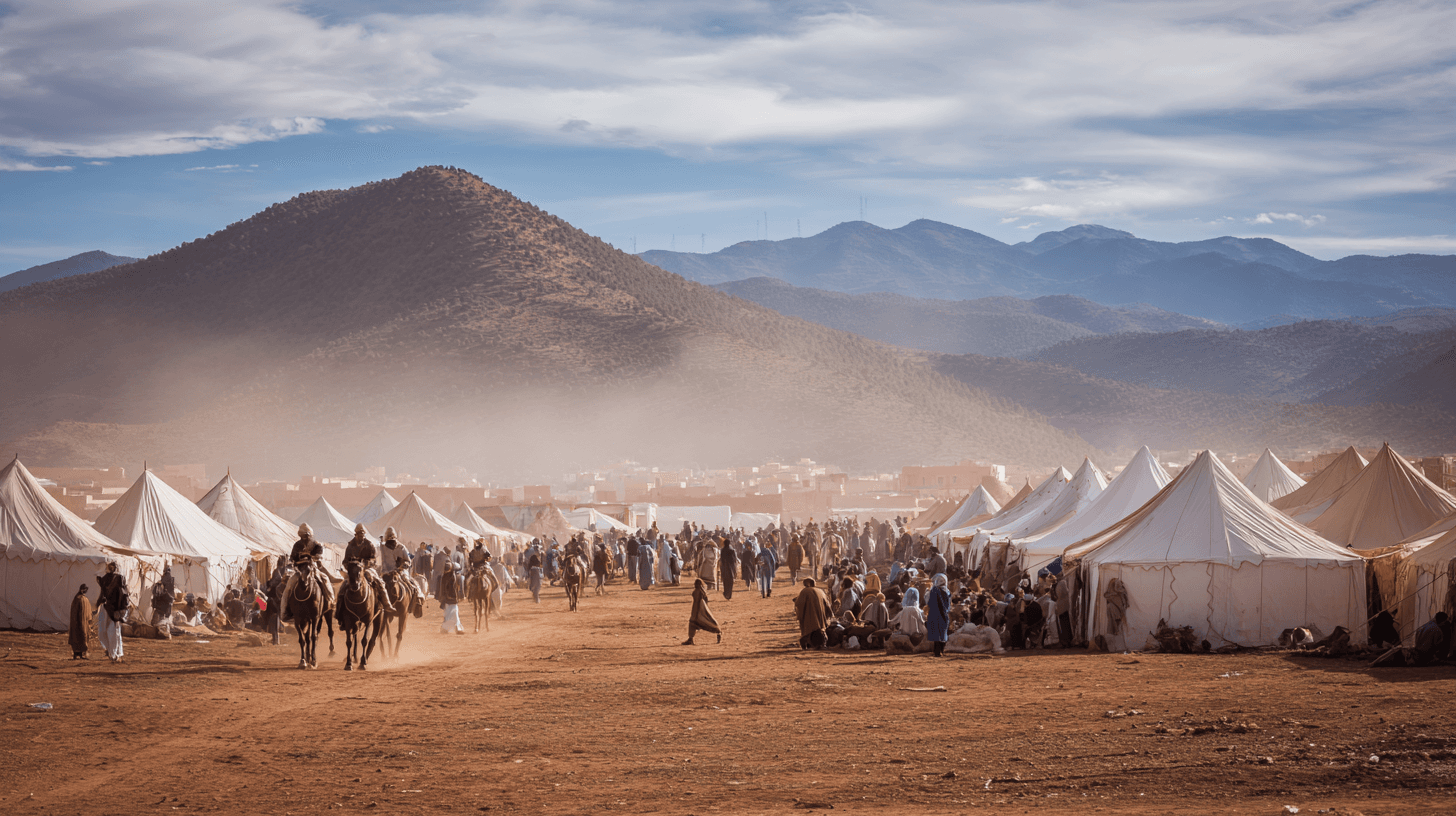
The white tents appear overnight, a thousand of them, spreading across the valley like a sudden blooming. The tribe has come to honor its saint.
A moussem is a pilgrimage festival, centered on the tomb of a saint, occurring annually at a date fixed by tradition. For one week — sometimes more — entire tribes converge on a single location. They come for blessing, for healing, for social business that can only be conducted when everyone is present.
Morocco has hundreds of moussems, each with its own character. The Moussem of Moulay Idriss honors the founder of the Idrisid dynasty and the holy city that bears his name. The Moussem of Tan-Tan brings Saharan nomads together for camel trading and marriage negotiations. The Moussem of Setti Fatma in the Ourika Valley draws Berber families to a shrine accessible only on foot.
The religious center is the tomb itself. Pilgrims circle it, touch its walls, tie threads to its grilles, leave offerings. They seek baraka — spiritual power that flows from the saint to those who approach in faith. Women pray for children. The sick pray for healing. Everyone prays for blessing in the year ahead.
But the moussem is not only religious. It is also a social technology, a way for dispersed communities to reconstitute themselves. Here, young people meet potential spouses. Elders negotiate disputes that accumulated over the year. Merchants sell goods that are impractical to transport except when crowds are guaranteed. Information flows, gossip spreads, bonds are strengthened.
The fantasia — the famous horseback display — occurs at larger moussems. Riders in traditional dress charge in formation, firing rifles simultaneously, controlling horses at full gallop. It looks like celebration. It is also practice for warfare that was real within living memory.
At night, the camps come alive. Cooking fires, music, stories told to children who will someday bring their own children to the same tents. The saint sleeps in his tomb. The living sleep under stars that have watched these gatherings for centuries.
By week's end, the tents come down as quickly as they went up. The valley empties. The tribe disperses to wherever life takes them. But they know: next year, the same week, the same place. The saint will be there. The family will be there. The moussem endures because some things can only be done together.
The Facts
- •Morocco hosts 700+ annual moussems
- •Largest draw 100,000+ pilgrims
- •Timing often tied to agricultural or Islamic calendar
- •Fantasia displays feature 15-40 riders in formation
- •Major moussems: Moulay Idriss, Tan-Tan, Imilchil, Setti Fatma
- •Functions include religious, social, commercial, and legal
- •Some moussems date to 8th century
- •UNESCO recognized Tan-Tan Moussem as Masterpiece of Oral Heritage
Sources
- Reysoo, Fenneke. 'Pèlerinages au Maroc.' Fondation Maison Sciences de l'Homme
- Hammoudi, Abdellah. 'The Victim and Its Masks.' University of Chicago Press
- UNESCO Masterpieces documentation, Tan-Tan Moussem