The Poisoned Toothpick
How Morocco's first dynasty began‚ and almost ended
Idris ibn Abdallah was running for his life.
It was 786 CE. At Fakhkh, near Mecca, a pro-Shi'a rebellion against the Abbasid caliphate had been crushed. The surviving rebels scattered. Idris‚ a great-great-grandson of the Prophet Muhammad through the line of Hasan, fled west with a single servant, a man named Rashid al-Urbi.
They crossed Egypt, crossed Libya, crossed Tunisia and Algeria, and finally reached Volubilis the old Roman city that the Berbers called Oualili. The Awraba tribe, already converted to Islam but independent of the caliphate, welcomed him. In 789, they proclaimed him their leader.
He married Kenza al-Awrabiya, a Berber noblewoman. He founded a city called Medinat Fas‚ the city of Fez. He spread Islam among the Berber tribes of northern Morocco. He conquered Tlemcen, in what is now Algeria. For three years, he built the foundations of a new state: the first Islamic kingdom in Morocco, independent of both the Abbasids in Baghdad and the Umayyads in Cordoba.
Then, in 791, a stranger arrived. The sources describe him as a scholar or doctor, sent from Baghdad with gifts. He brought the Imam a scented toothpick—or, in some versions, perfume or a piece of cloth. Whatever it was, it was poisoned. Idris used it and died.
The assassination was ordered by Harun al-Rashid, the Abbasid caliph‚ the same Harun al-Rashid who appears in the Thousand and One Nights as a wise and generous ruler. In reality, he was eliminating a rival claimant to Islamic legitimacy.
But the assassination failed to end what Idris had started. Kenza was pregnant. Two months after Idris's death, she gave birth to a son: Idris II. The child was raised by the loyal Rashid and by the Awraba Berbers. When he came of age, he continued his father's work.
Idris II expanded Fez, making it a capital that would shape Moroccan history for centuries. He welcomed refugees from al-Andalus and Kairouan, creating the divided medina that still exists: the Andalusian quarter on one side of the river, the Kairouanis on the other. The Idrisid dynasty ruled until 974.
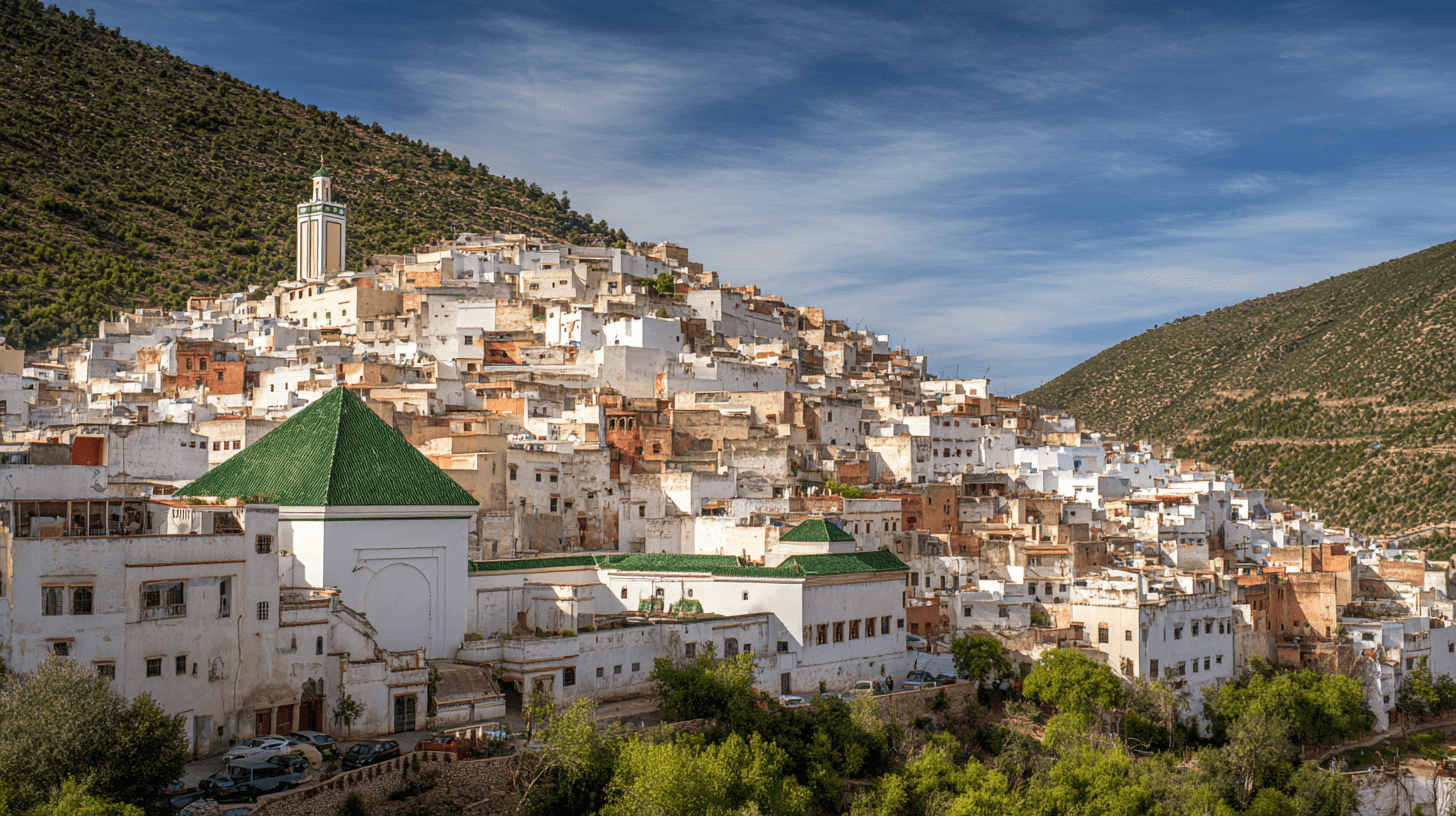
The tomb of Idris I is in Moulay Idriss Zerhoun, a white town on a hillside near Volubilis. For centuries, non-Muslims were forbidden to enter. Now they can visit‚ but not stay overnight. The tomb is a shrine, a place of pilgrimage, a reminder that Morocco was founded by a refugee.
He came fleeing one dynasty. He founded another.
The Facts
- •Fled Battle of Fakhkh 786 CE
- •Founded Morocco's first Islamic state 789
- •Assassinated by Abbasid agent 791
- •Harun al-Rashid ordered the assassination
- •Son Idris II born posthumously
- •Idrisid dynasty ruled 788-974
- •Tomb in Moulay Idriss Zerhoun
- •Non-Muslims couldn't enter town until 20th century
Sources
- Ibn Khaldun, Kitab al-Ibar
- Eustache, L'origine des Idrissides (1978)
- Park, Historical Dictionary of Morocco (2006)