The Singing Sands
Why the dunes of Erg Chebbi hum
The dune begins to hum. A low vibration, felt in the chest before the ears register it. The tourists freeze. The guide smiles. The sand is speaking.
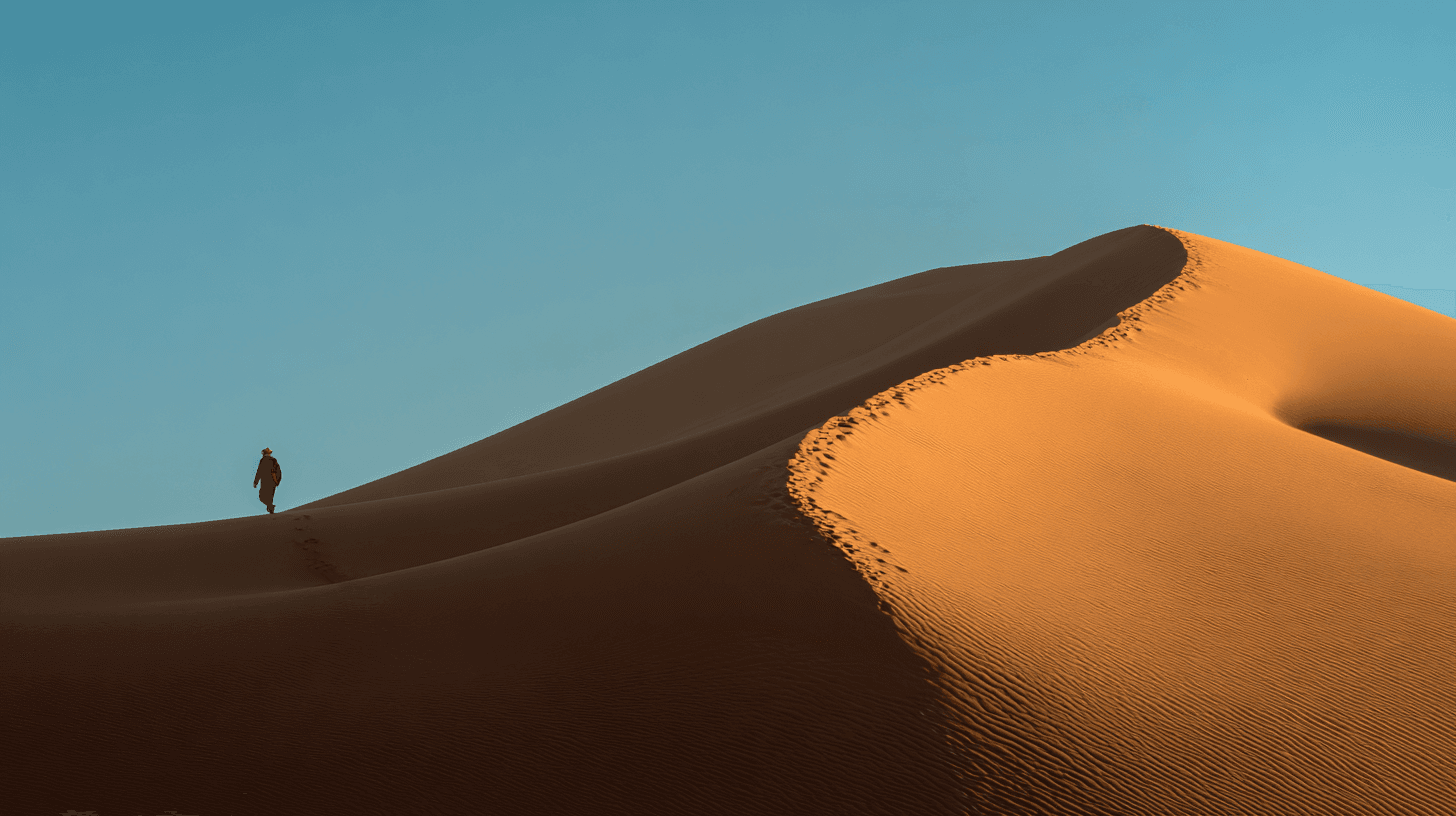
Erg Chebbi rises from the hammada like a mirage made solid — a sea of dunes reaching 150 meters high, glowing orange and pink and gold depending on the hour. It is one of only two true ergs in Morocco, a sandbox fifty kilometers long and five wide, dropped inexplicably into a landscape of black gravel.
And sometimes, it sings.
The phenomenon has been documented since at least Marco Polo, who wrote of sands that produced sounds like drums. Scientists now understand the mechanism: when grains of a specific size and smoothness slide against each other — triggered by wind or footsteps — they vibrate at frequencies that amplify through the dune's structure. The result is a sound that can reach 105 decibels, a roar heard kilometers away.
But understanding the physics doesn't explain the experience. The sound rises from everywhere and nowhere, a chord held by ten million instruments too small to see. Some visitors describe it as music. Others as machinery. The Berbers say it is the jinn — spirits of the desert, stirring in their homes beneath the sand.
The dunes move. Satellite images show Erg Chebbi shifting, reforming, breathing across decades. The orange color comes from iron oxide, rusted over millennia. The grains themselves originated in ancient riverbeds, when the Sahara was green. You are walking on a beach from a sea that evaporated ten thousand years ago.
Visit at dawn or dusk, when the angle of light reveals ripples and ridges invisible at noon. Watch the shadows climb the slip faces. Listen for the sound that no algorithm could compose — the voice of geology, physics, and time, collaborating on a frequency we are only beginning to learn how to hear.
The Facts
- •Erg Chebbi dunes reach 150+ meters high
- •Sound can reach 105 decibels
- •Only 2 major ergs exist in Morocco (Chebbi and Chigaga)
- •Grains must be 0.1-0.5mm and well-rounded to sing
- •Phenomenon documented since Marco Polo (13th century)
- •Dune movement tracked at 1-5 meters per year
- •Orange color from iron oxide coating
Sources
- Nori, Franco. 'Booming Sand.' Physical Review Letters
- Douady, Stéphane. 'The Song of the Dunes.' Physics Today
- Moroccan National Tourism Office documentation