The Storytellers of Jemaa el-Fna
The last oral tradition
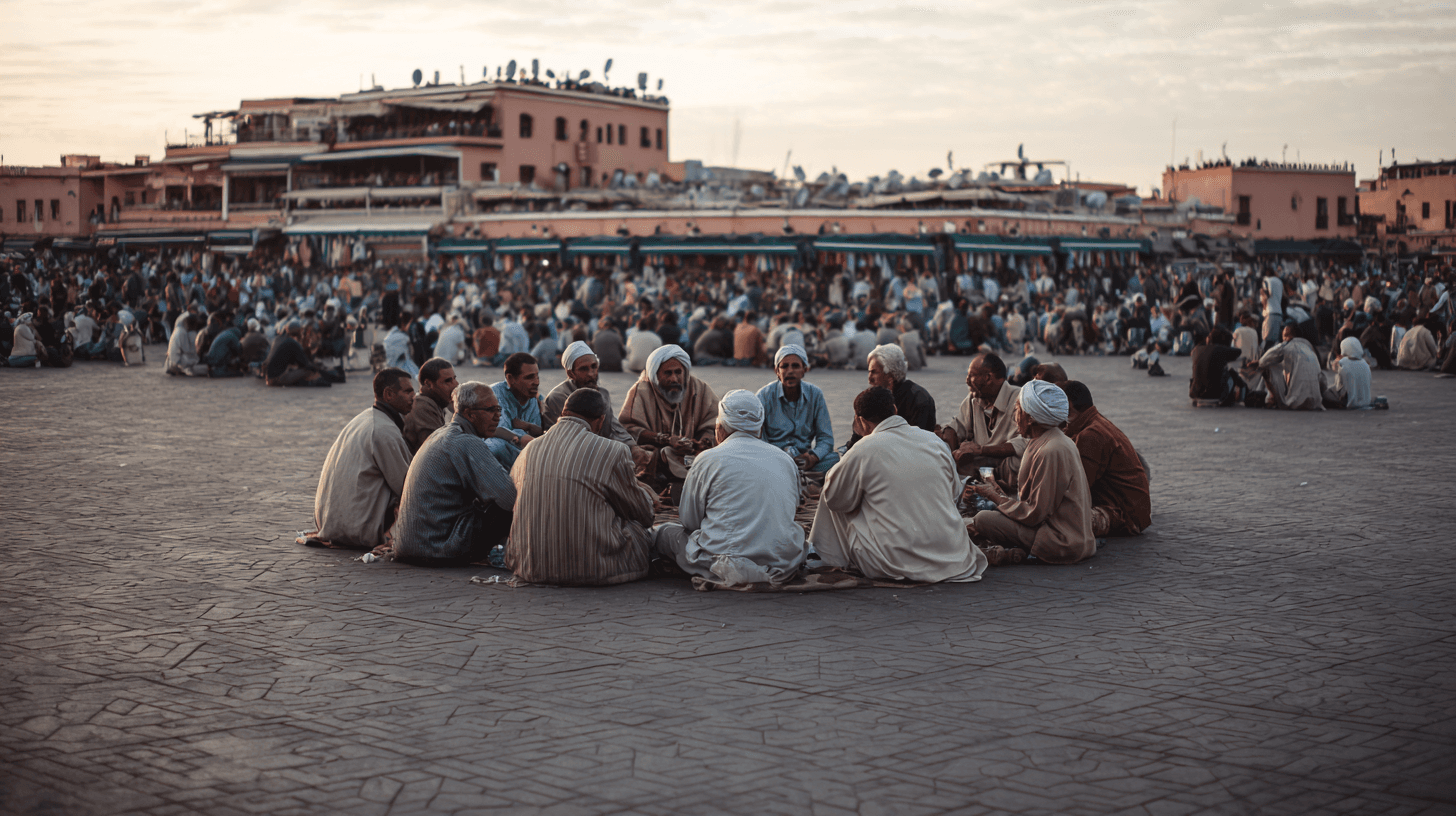
The crowd forms a circle. In the center, an old man sits on a wooden stool. He begins to speak, and eight hundred years of stories pour through his mouth.
Every evening, as the sun drops toward the Atlas, Jemaa el-Fna transforms. The fruit sellers pack up. The snake charmers settle their cobras. And the halaiqiya — the storytellers — take their places in the square.
This is oral tradition in its purest form. No script, no notes, no prompt. The storyteller carries tales learned from his master, who learned from his master, back through generations that never wrote anything down. The stories are epics: tales of sultans and thieves, of djinn and saints, of heroes whose names have been spoken in this square for centuries.
The performance is physical. The storyteller doesn't merely recite — he embodies. His voice shifts for each character. His hands paint scenes in the air. His pauses are precisely timed to the reaction of his audience. A skilled halaqi can hold a crowd for hours, carrying them through plot twists that have been working for five hundred years.
The tradition is dying. In 2001, UNESCO recognized Jemaa el-Fna as a "Masterpiece of the Oral and Intangible Heritage of Humanity" — the first urban space to receive this designation. The recognition was urgent because the storytellers were disappearing. Television, smartphones, the acceleration of modern life — who has time to stand in a square for three hours listening to a tale of ancient wars?
The old storytellers remember when the circles were ten deep, when children sat on fathers' shoulders to see over the crowd, when the tales of Antar and Abla, of the Thousand and One Nights, of the Hilali epic were public property, known by everyone, anticipated and beloved.
Now a handful remain. They come to the square each evening not because the crowds are large — often they are not — but because the stories must be told. Somewhere in the circle, a child is listening. Somewhere in the city, a young man is memorizing what he hears. The tradition survives as long as someone speaks and someone listens.
The old man on the stool raises his voice. The tale reaches its climax. The crowd leans in. For this moment, in this square, stories still matter more than screens. For this moment, the ancient art breathes.
The Facts
- •UNESCO recognized Jemaa el-Fna as Masterpiece of Oral Heritage in 2001
- •First urban space to receive this designation
- •Storytelling tradition documented since at least 12th century
- •Major epics: Hilali, Antar and Abla, Thousand and One Nights
- •Performances can last 3+ hours
- •Halaiqiya typically learn through apprenticeship
- •Fewer than 20 traditional storytellers remain active
- •Square hosts storytellers, musicians, acrobats, healers
Sources
- UNESCO Proclamation of Masterpieces, 2001
- Kapchan, Deborah. 'Gender on the Market.' University of Pennsylvania Press
- Waterbury, John. 'North for the Trade.' University of California Press