The Zellige Cutters
Geometry by eye, not measurement
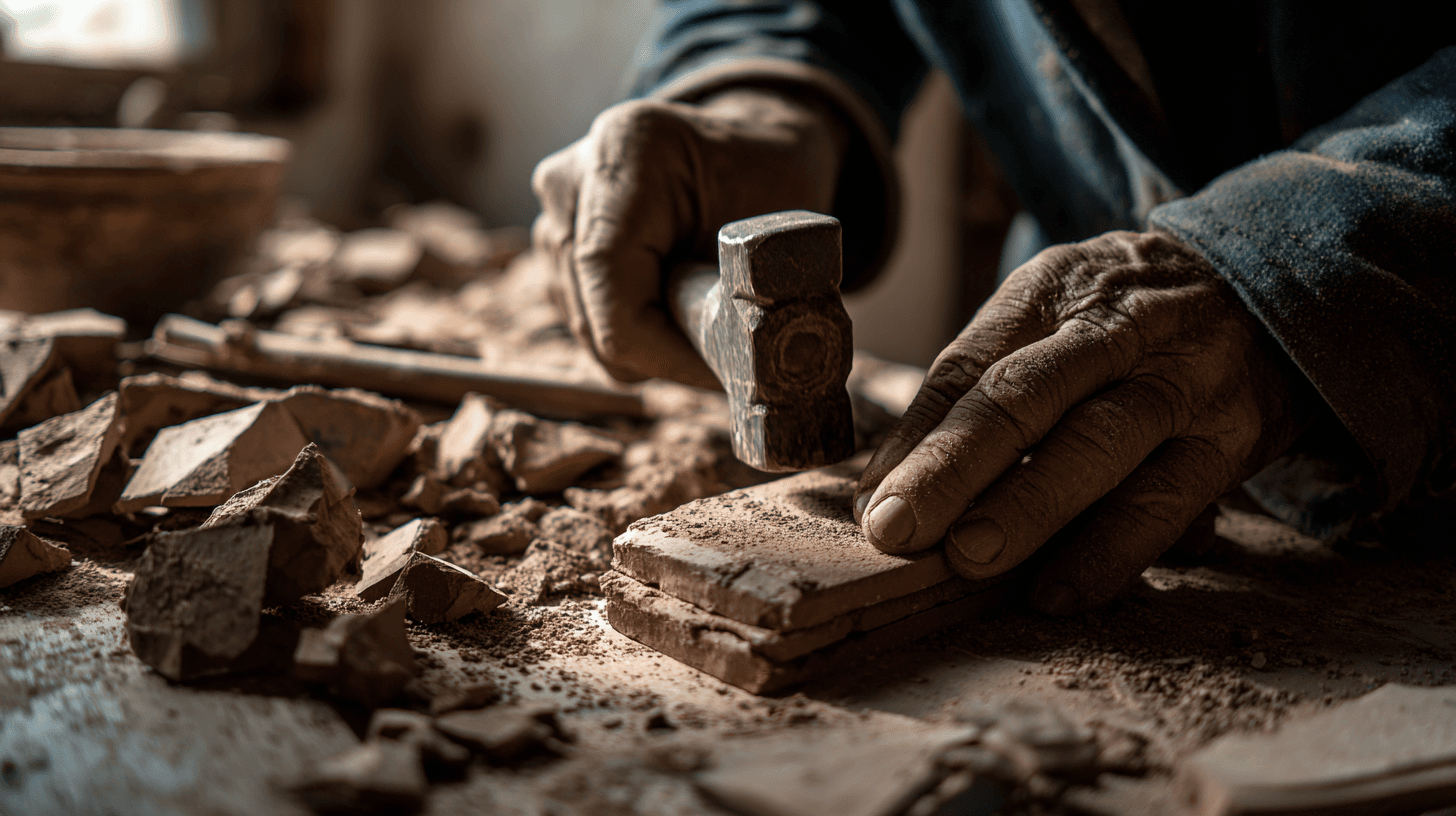
The hammer falls. A chip of glazed clay spins away. He doesn't look at what he's cut — he's already reaching for the next piece. Forty years of this. The geometry lives in his hands.
In a workshop in Fes, a man sits cross-legged on the floor, surrounded by fragments of glazed clay in twenty colors. Before him lies a pattern — a star within a star within a star, mathematically perfect, assembled from hundreds of pieces no larger than a fingernail. He did not draw this pattern. He carries it in his memory, as his father carried it, as his grandfather carried it, back through generations to artisans whose names were never recorded.
Zellige is the art of absence. You do not paint the pattern; you cut away everything that isn't pattern. Each tile begins as a glazed square, colors fired to glass at temperatures that medieval Moroccan kilns somehow achieved perfectly. The cutter — the maalem zellige — strikes with a special hammer, chipping the square into whatever shape the pattern demands. Triangles, parallelograms, eight-pointed stars. The shapes have names: khatem (seal), taouss (peacock), zellijat (little tiles).
There are no rulers. No protractors. The master learns to see angles, to feel when a cut is true. His mentor sits beside him for years, correcting imperceptible errors, building the vocabulary of shapes until the apprentice's hands know geometry as the musician's hands know scales.
The assembly is equally precise. On a flat surface, the pieces are arranged face-down — a puzzle solved in reverse, where you cannot see the pattern forming until you flip the completed section. Any error, any gap, any misalignment becomes permanent when the plaster is poured. There are no second chances.
A single fountain might contain twenty thousand individual pieces. A wall of a palace might contain millions. The Alhambra, the Medersa Ben Youssef, the great mosques of Fes — these are not decorated with zellige. They are built from zellige, the patterns holding up the walls as much as the walls hold the patterns.
The young men in Fes complain that the work is too slow, the pay too poor, the learning too long. Some workshops have closed. Others struggle to find apprentices. But in the ones that survive, the hammer still falls, the chips still fly, and hands that carry centuries of knowledge still cut geometry from clay.
The Facts
- •Zellige dates to 10th century Morocco
- •Traditional patterns number in the hundreds
- •Apprenticeship typically takes 8-10 years
- •Colors created from natural mineral pigments
- •Largest installations contain millions of individual pieces
- •Fes remains the primary center of production
- •UNESCO recognized zellige as Intangible Cultural Heritage
- •Cutting uses no measurement tools — only trained eye
Sources
- Paccard, André. 'Traditional Islamic Craft in Moroccan Architecture.' Saint-Jorioz
- Castéra, Jean-Marc. 'Arabesques: Decorative Art in Morocco.' ACR Edition
- UNESCO Intangible Cultural Heritage documentation, 2018