The Carpet Code
Symbols, knot density, tribal markers — reading the language woven into Moroccan rugs
The diamond (lozenge) is the most common motif. In its simplest form — an open diamond shape — it represents the female body, fertility, and protection. Nested diamonds create concentric fields of meaning. The diamond appears in carpets from every region, but its proportion, orientation, and combination with other motifs vary by tribe.
The zigzag represents water — rivers, rain, the essential element in a semi-arid landscape. Horizontal zigzags suggest flowing water. Vertical zigzags suggest rain. The motif appears more frequently in carpets from dry regions — the pre-Saharan oases, the eastern steppes — where water is scarce and its symbolic importance is greatest.
The cross (plus sign) represents balance — the four cardinal directions, the intersection of earth and sky. The eight-pointed star — two overlapping squares — appears across the Islamic world but in Moroccan carpets it specifically references Amazigh cosmology: the eight directions, the eight seasons of the agricultural calendar.
Fibulae — the clasped brooch motif — reference Amazigh women's jewellery. The fibula is the pin that holds a woman's haik (draped garment) at the shoulder. In carpet iconography, it represents femininity, adornment, and identity. The motif appears almost exclusively in women's weavings from the Middle Atlas.
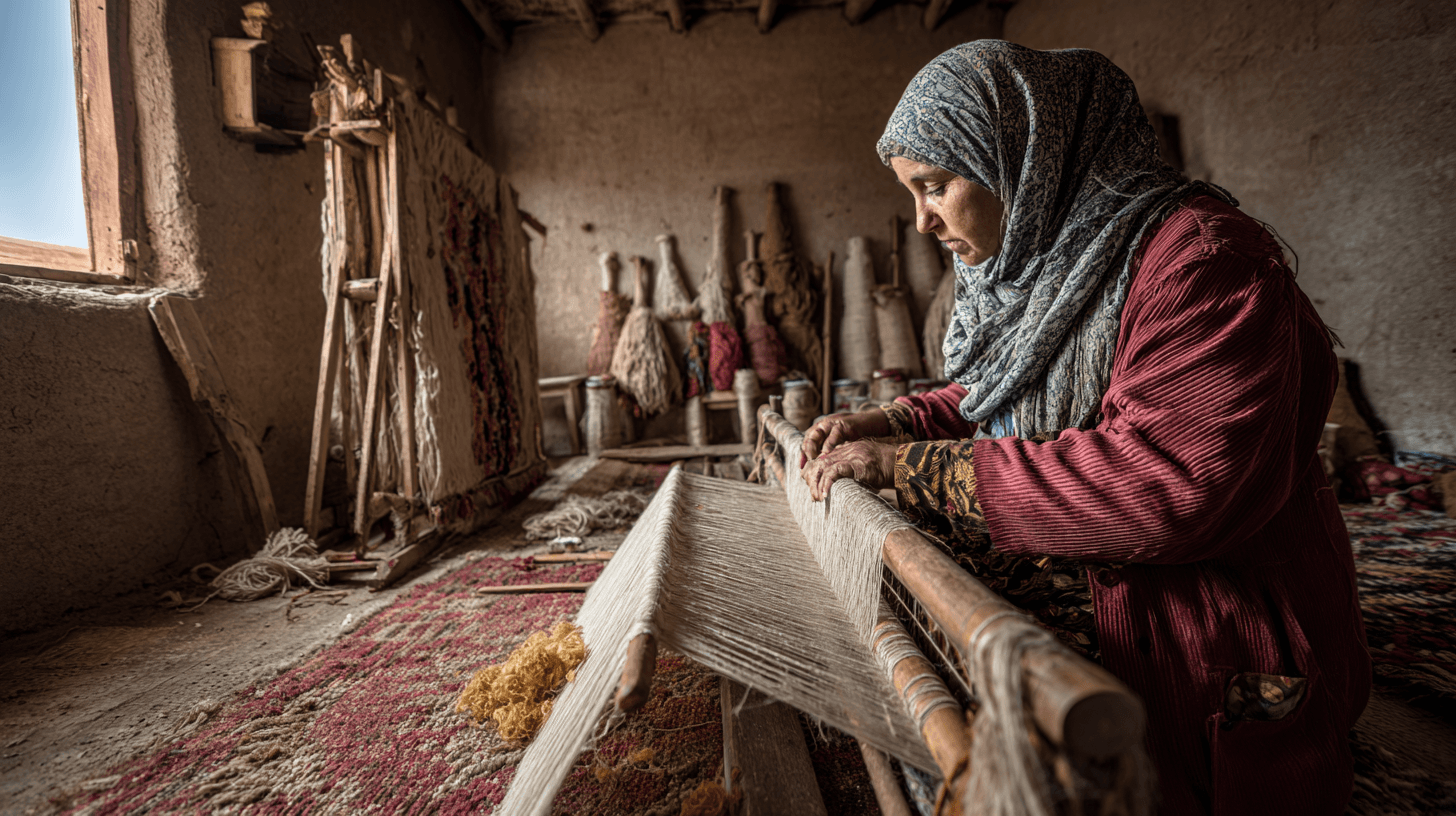
Knot density tells its own story. A Rabati carpet might have 160,000 knots per square metre — tight, fine, and urban. A Beni Ourain carpet from the Middle Atlas might have 40,000 — loose, thick, and designed for warmth rather than display. The density reflects the weaver's tools, time, and purpose. High-knot carpets take months. Low-knot carpets take weeks.
Colour encodes geography. Undyed cream and brown wool — the natural palette of sheep — dominates the Middle Atlas. Bright synthetic dyes mark post-1960s urban production. Natural vegetable dyes — indigo, madder, saffron, henna, pomegranate — indicate either traditional production or contemporary revival. The presence of certain dyes can date a carpet to within a decade.
No two handwoven Moroccan carpets are identical. Each is a document — a record of the weaver's tribe, region, vocabulary, and life circumstances encoded in fibre, colour, and pattern.
Explore the full interactive module — with the symbol dictionary, knot density analysis, and tribal attribution guide — at Dancing with Lions: https://www.dancingwiththelions.com/data/carpet-code
Interactive Module
Data and visualisation by Dancing with Lions