The Geometry of Zellige
Star patterns, tessellation, 17 wallpaper groups — the mathematics behind Moroccan tilework
A zellige artisan in Fes works with no ruler. No computer. No printed template. A compass and a straightedge — the same tools Euclid used — generate every pattern.
The process begins with a circle. The compass steps off points around the circumference. Straight lines connect these points to create stars — 8-pointed, 12-pointed, 16-pointed. The negative space between the stars generates new shapes: crosses, hexagons, kites, darts. These interlock to fill a plane with no gaps.
Mathematicians call this tessellation. In 1891, the Russian crystallographer Evgraf Fedorov proved that there are exactly 17 distinct ways to tile a plane with repeating patterns — the 17 wallpaper groups. Moroccan artisans had been producing examples of all 17 for at least 500 years before the proof existed.
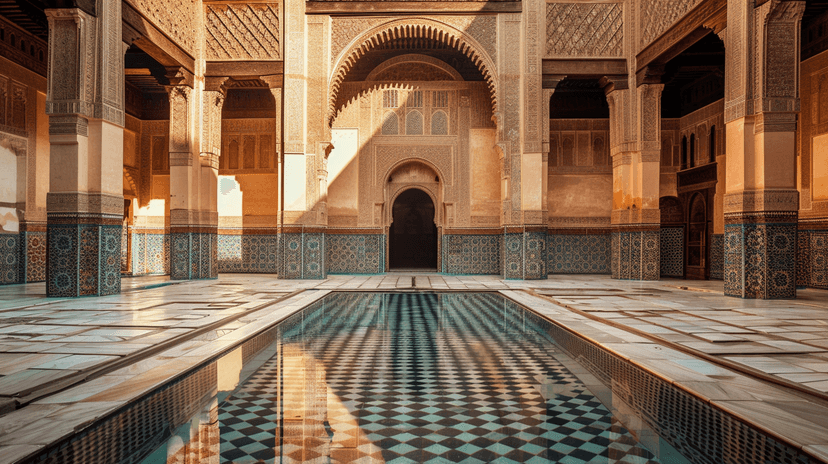
The Alhambra in Granada contains examples of all 17 groups. The Bou Inania madrasa in Fes contains at least 13. The Saadian Tombs in Marrakech layer zellige with carved plaster and painted cedar in combinations that encode multiple symmetry groups on a single wall.
The colour is not paint. Each piece of zellige is cut from a glazed tile — traditionally in about ten colours. The glaze is applied before the tile is fired, then each small piece — called a furma — is chipped by hand with a hammer on a chisel. An experienced cutter produces hundreds of pieces per day. The irregularity is intentional. Slight variations in size and colour create a visual texture that machine-cut tile cannot replicate.
The assembly is face-down. Pieces are arranged in reverse on a flat surface, then plaster is poured over the back. When the panel is flipped and mounted, the face is flush. A single wall panel can contain thousands of individual pieces.
The tradition is concentrated in Fes, where the maalems — master craftsmen — train apprentices over seven to ten years. The knowledge is oral and manual. There is no textbook.
Explore the full interactive module — with compass constructions, wallpaper group classifications, and the mathematical anatomy of Morocco's greatest art form — at Dancing with Lions: https://www.dancingwiththelions.com/data/geometry-of-zellige
Interactive Module
Data and visualisation by Dancing with Lions