The fall of Granada on January 2, 1492 ended 781 years of Muslim presence in the Iberian Peninsula. The Treaty of Granada initially promised religious freedom. That promise lasted eight years, which is generous by the standards of broken promises but insufficient by any other measure. By 1502, the Mudéjars were ordered to convert or leave. The Jews had already been expelled in 1492 — the same year Columbus sailed, a coincidence of timing that says everything about what Spain was becoming.
The exodus was massive. Estimates range from 300,000 to 800,000 Muslims and 100,000 to 200,000 Jews leaving Spain and Portugal over the following century. Many came to Morocco. Tetouan, Chefchaouen, Fes, Rabat, and Salé received the largest numbers. The Moriscos — Muslims who had nominally converted to Christianity and spent a century trying to be invisible — were expelled in a final wave between 1609 and 1614. The Spanish crown decided that even conversion wasn't enough. The blood had to leave.
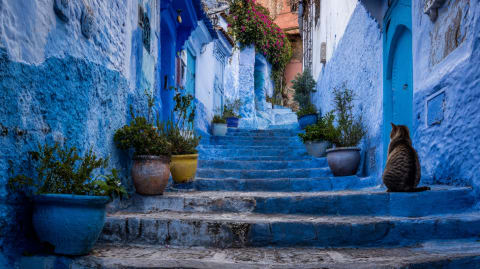
The impact on Morocco was transformative. Tetouan was essentially rebuilt by Andalusian refugees — its medina, a UNESCO World Heritage site, has the whitewashed walls, tiled courtyards, and wrought-iron balconies of a Spanish city reassembled from memory on the wrong side of the strait. Chefchaouen, founded in 1471 as a fortress against Portuguese expansion, was populated largely by Andalusian refugees who brought their skills, their grief, and — some say — the blue paint that now covers the walls, though the blue may have come later from Jewish tradition. The origin is debated. The beauty is not.
Rabat and Salé received Moriscos who brought agricultural techniques, irrigation systems, and a talent for corsairing — piracy against the Christian powers that had expelled them. The Bou Regreg corsairs operated from Salé for over a century, raiding as far as Iceland. Revenge, it turns out, has excellent range.
The Andalusian legacy is woven through Morocco's DNA. The music. The architecture. The garden design. The pastries — bastilla, the layered pigeon pie dusted with cinnamon and sugar, is Andalusian in origin. What Spain expelled, Morocco absorbed. What was lost on one side of the strait was preserved on the other.
The Reconquista scattered Sephardic Jews across Morocco. The heritage route follows the communities they built.
Tell us about your trip →Data and visualisation by Dancing with Lions
The Facts
- —Reconquista: 711-1492
- —Granada: last Muslim stronghold, fell January 2, 1492
- —Alhambra Decree: March 31, 1492
- —Jews given 4 months to convert or leave
- —Muslims expelled progressively 1502-1614
- —Refugees to Morocco, Ottoman Empire, Netherlands
- —Moriscos: forced converts who stayed
- —Morocco received the largest Sephardic communities
Sources
- Harvey, L.P. Muslims in Spain 1500 to 1614. University of Chicago Press, 2005
- Menocal, María Rosa. The Ornament of the World. Back Bay Books, 2002
- Abun-Nasr, Jamil. A History of the Maghrib in the Islamic Period. Cambridge University Press, 1987
Further Reading
Practical questions