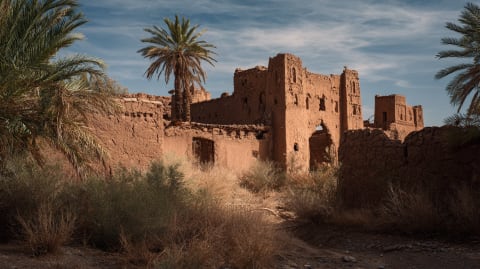
The riverbed is dry. Has been for months. But the palms are green, the gardens lush, the wells full. The Draa has not abandoned its valley. It has simply gone underground.
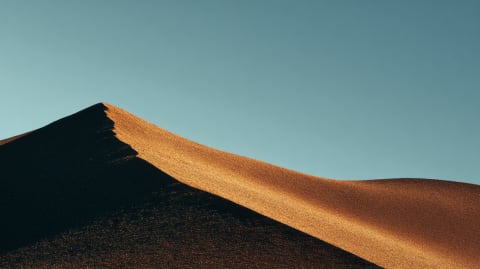
Morocco's longest river begins in the High Atlas, where snowmelt feeds streams that converge into a force strong enough to carve canyons. For two hundred kilometers, the Draa flows as rivers should — visible, bankable, photographable. Then it reaches the desert.
And disappears.
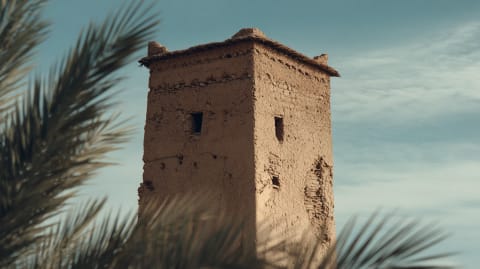
The water sinks into the sand, joining an aquifer that runs beneath the valley floor. The river becomes invisible but not absent. It feeds the wells, sustains the palms, makes possible the string of ksour that line its ancient banks. The riverbed above may crack and whiten, but six feet down, the water waits.
This is not drought. This is design. The valley learned long ago that surface water in the Sahara is surface water lost — to evaporation, to the relentless sun, to the wind that steals moisture and carries it to places that don't need it. Better to let the river hide, to access it through wells and khettaras, to take only what rises rather than watch it all burn away.
Once, in wet years, the Draa ran all the way to the Atlantic. Twelve hundred kilometers of continuous flow, emptying into the sea south of Tan-Tan. The last time this happened was 1989. Before that, the 1960s. Before that, memory grows hazy.
The people of the valley don't need the river to flow on the surface. They need it to flow beneath. They've built their lives around the paradox of a river that sustains by vanishing. The kasbahs rise from the banks of a waterway you cannot see. The palms drink from a source that leaves no trace.
Stand in the dry riverbed at Zagora. Look at the palm groves thick on either side. Ask where the water comes from. The answer is beneath your feet, patient, invisible, keeping faith with a valley that learned to stop demanding what the desert cannot give.
The Draa Valley is the journey we recommend most. The river, the kasbahs, the silence between villages — this is Morocco before the postcards.
Tell us about your trip →The Facts
- —Total length: 1,100km from Atlas to Atlantic
- —Surface flow reaches the sea only in exceptional years
- —Last continuous flow to Atlantic: 1989
- —Aquifer runs 100+ km beneath the valley
- —Over 200 ksour line the valley
- —The name 'Draa' may derive from the Arabic for 'arm'
- —Supports over 2 million date palms
Sources
- Mezzine, Larbi. Le Tafilalt: contribution à l'histoire du Maroc aux XVIIe et XVIIIe siècles. Faculté des Lettres, Rabat, 1987
- Julien, Charles-André. History of North Africa. Routledge, 1970
- Bovill, E.W. The Golden Trade of the Moors. Oxford University Press, 1968