The door in the wall is plain. You would walk past it without a second thought. Then it opens, and you fall into a garden surrounded by sky.
A riad is not a house with a courtyard. It is a courtyard that happens to have rooms around it. The distinction matters more than it sounds. In Western architecture, outdoor space is what's left over after you build the building. In a riad, the outdoor space is the building. Everything else — the bedrooms, the salons, the kitchens — exists in service to the garden. The garden is the employer. The rooms are the staff.
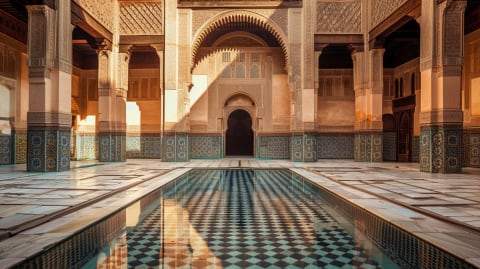
The word comes from the Arabic for garden — ryad — and the garden is the point. At the centre, a fountain. Around the fountain, fruit trees — orange, lemon, pomegranate. Around the trees, the tiled courtyard. Around the courtyard, the rooms. Above everything, the sky, framed by walls that show the street nothing at all.
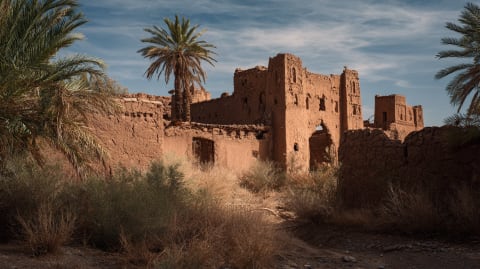
This is inward architecture. The riad presents a blank face to the world: no windows on the street, a door that reveals nothing, the kind of discretion that would make a Swiss banker feel underdressed. Islamic culture values privacy, and the riad enforces it with the quiet absolutism of stone. What happens inside stays inside. The street gets a wall.
The design is also climate engineering, though it wears this function as lightly as it wears everything. The courtyard creates a microclimate — cooler than the street in summer, sheltered from wind in winter. The fountain adds humidity. The tall walls shade the garden through the hottest hours. A well-designed riad needs no air conditioning because it is air conditioning, built into the structure by people who understood thermodynamics without knowing the word.
Light enters from above, falling into the courtyard and filtering through doorways into the rooms. The quality changes through the day — bright and vertical at noon, golden and angled at sunset, blue and soft at dawn. Living in a riad means living in constant conversation with the sky. You see it framed. You watch it change. You feel the day's rhythm through light alone, which is a more intimate relationship with weather than most modern buildings permit.
The largest riads were palaces. The smallest are family homes with a fountain the size of a washbasin and a single orange tree. The principle is the same: the world is outside. The garden is inside. And the door between them, plain and ordinary from the street, is doing more work than any door has a right to.
The riads of the medina are still cooling their rooms the way they did four centuries ago. Three days is enough to feel it.
Tell us about your trip →The Facts
- —Name derives from Arabic 'ryad' (garden)
- —Central courtyard with fountain is defining feature
- —Exterior walls typically windowless or minimally windowed
- —Design predates modern climate control
- —Microclimate can be 10°C+ cooler than exterior
- —Largest riads in Fes and Marrakech were palatial
- —Many converted to guesthouses since 1990s
- —UNESCO recognizes medina architecture including riads
Sources
- Ragette, Friedrich. Traditional Domestic Architecture of the Arab Region. Edition Axel Menges, 2003
- Wilbaux, Quentin. La médina de Marrakech. L'Harmattan, 2001
- Fathy, Hassan. Natural Energy and Vernacular Architecture. University of Chicago Press, 1986