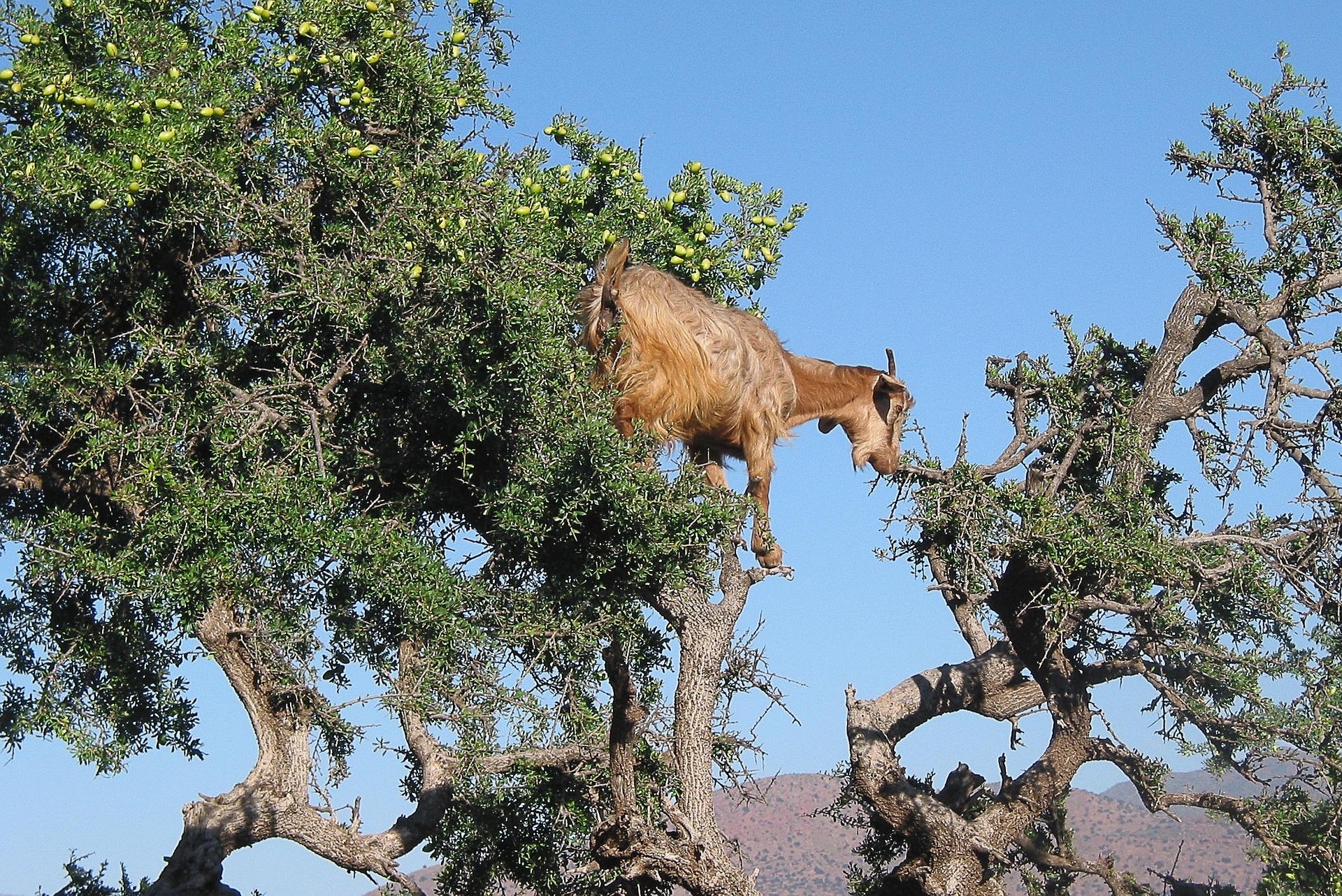
The most photographed scene on the road between Marrakech and Essaouira is half real and half staged. The goats are real. The trees are real. What is happening between them is more complicated than the photos suggest, and the complications tell you something about Morocco, tourism, and what happens when a natural behaviour becomes a revenue stream.
The truth first. Yes, Moroccan goats climb argan trees. They are attracted to the fruit, which ripens between May and September, and they have developed climbing skills that would embarrass most goats anywhere else on earth. The argan tree's low, gnarled branches make it possible. This is natural behaviour — goats are climbers, argan fruit is desirable, and nobody taught them except gravity and appetite.
Now the complication. Starting in the early 2000s, farmers noticed that tourists would stop and pay to photograph goats in trees. Some began placing goats in trees deliberately — carrying them up, tying their feet to branches, rotating exhausted animals when they grew tired. The roadside "goat trees" between Marrakech and Essaouira are now staged photo opportunities that charge 20-50 dirhams per snapshot. The goats standing in the tree you are photographing may not want to be there. The branch they are standing on may be the branch they were tied to. The charming scene may be a performance in which the performers have no say.
Animal welfare organisations have documented the conditions. Goats standing in trees for hours in heat, unable to access shade or move normally. Baby goats tied to trunks for tourists to pose with. The line between natural behaviour and exploitation runs through every photograph, and the photographer rarely knows which side they are standing on.
The argan tree itself is remarkable without the goats. Argania spinosa is a Tertiary relict — a survivor from the age before the Sahara was a desert. It grows nowhere else on earth except this triangle of southwest Morocco and a tiny population in Mexico that nobody can fully explain. The tree produces the nuts from which argan oil is pressed, an industry worth hundreds of millions of dollars. The goats, historically, helped: they ate the fruit, excreted the nuts, and the women collected them. The traditional system was symbiotic. The tourist system is not.
If you want to see goats in trees, drive the road in June. The fruit is ripe. The goats are climbing voluntarily. The difference between a goat that chose the branch and a goat that was placed on it is the difference between a story and a lie. Both make good photographs. Only one is true.
The goats-in-trees road between Essaouira and Agadir is one we drive with context, not just cameras.
Tell us about your trip →The Facts
- —Goats naturally climb trees May-September when fruit ripens
- —Roadside attractions staged since early 2000s
- —30 hours labor per liter of argan oil
- —$200/liter international price
- —Arganeraie UNESCO biosphere reserve 1998
- —Trees live 200+ years, roots 30m deep
- —Cooperatives hire mostly widows
- —2019 investigation called it 'exploitative scam'
Sources
- Charrouf, Zoubida & Guillaume, Dominique. "Argan Oil." European Journal of Lipid Science, 2008
- UNESCO Biosphere Reserve. Arganeraie, 1998
- Moroccan Haut-Commissariat aux Eaux et Forêts. Argan forest survey
Further Reading
Practical questions