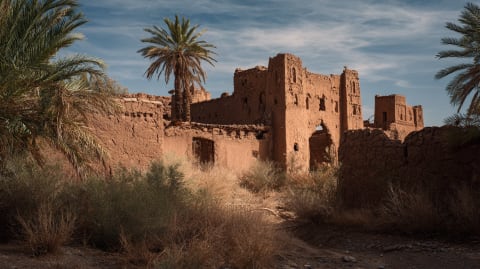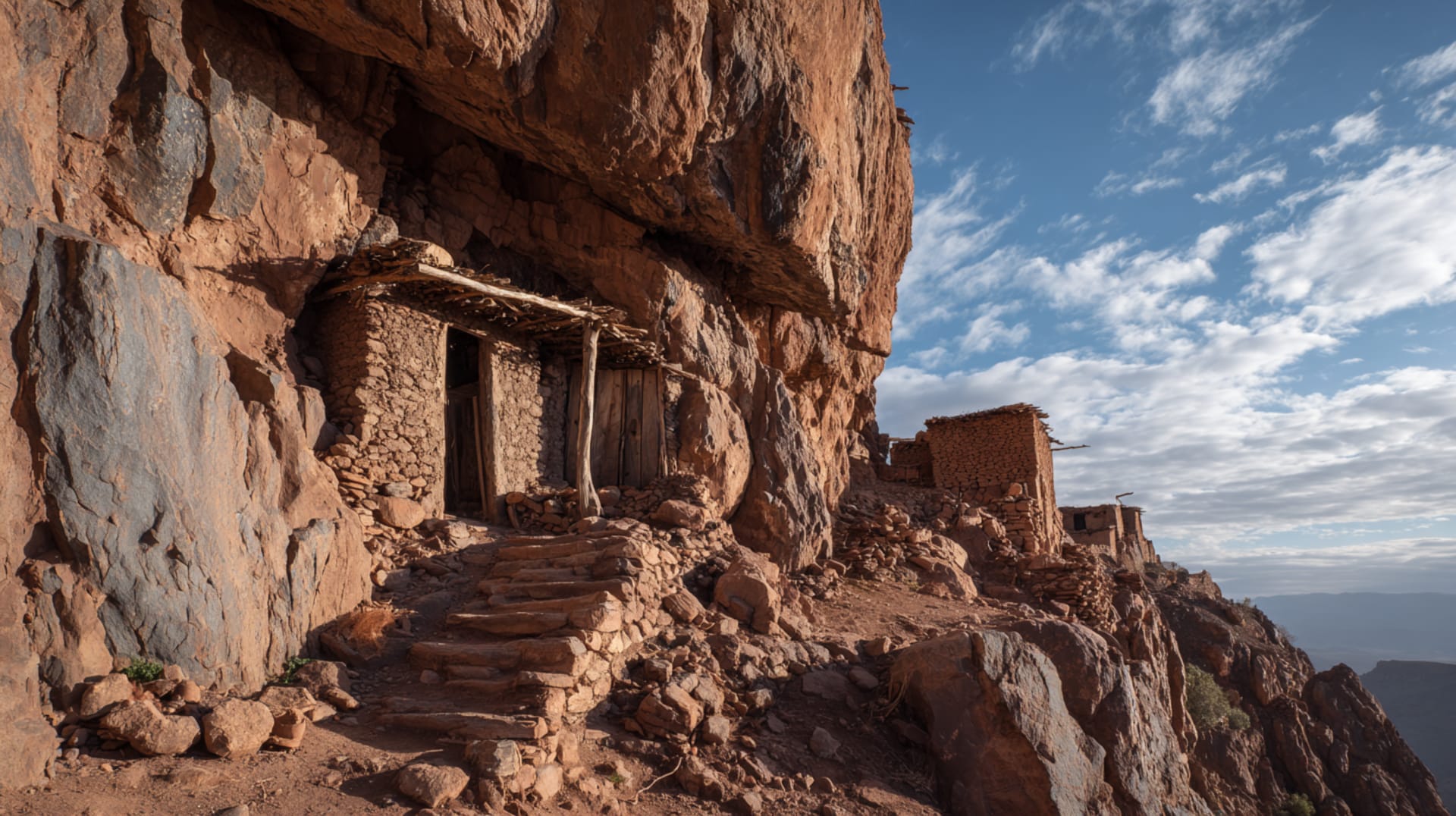
The doors are barely two feet high. There are hundreds of them, stacked four or five storeys up a cliff face, each one opening to a compartment just large enough to hold a family's survival. This is an agadir — a fortified granary — and it looks like a honeycomb designed by people who took food security personally.
In the Anti-Atlas mountains, where rainfall is scarce and one bad year could mean the difference between eating and not, grain was wealth. But grain stored at home could be stolen, burned, seized by raiders. The solution was collective: build a fortress, give each family a vault, and guard it together. A bank, essentially, but older than banking and more honest about what was being stored.
The rules were precise and, by modern standards, elegant. Each family owned their compartment — the right passed through generations like property. Keys were unique, hand-forged, impossible to duplicate. The agadir had a guardian, elected by the community, who lived on-site and controlled access. No one could enter alone. No one could enter at night. The guardian answered to the jmaa — the village assembly — and could be removed for any breach of trust. The system ran on reputation, which is the oldest currency and, in small communities, the most valuable.
A family that violated the rules — that stole, that cheated — would be expelled. Their compartment sealed. Their name worthless across the region. In a landscape where survival depended on trade and mutual aid, social death was worse than physical death. This sounds dramatic until you remember that "social death" in a desert community meant nobody would trade with you, lend you water, or help you when the harvest failed. The Anti-Atlas was not a place that forgave twice.
The agadirs held more than grain. Families stored documents, jewellery, weapons, anything too valuable to keep at home. Some compartments haven't been opened in decades — the families have moved away, but the doors remain theirs, the contents undisturbed. A storage system so trustworthy that people leave their valuables in it after leaving the village entirely. Try that with a modern bank.
Many agadirs are abandoned now, crumbling back into the hillsides. A few have been restored — Agadir Ikounka, Agadir Id Aissa — and opened to visitors who climb the wooden ladders, peer into the tiny compartments, and try to imagine a world where your family's food supply sat behind a two-foot door on a cliff face, guarded by nothing more than a neighbour's word and a hand-forged key.
The granaries of the Anti-Atlas are locked libraries of trust. We visit them on our deep south journeys, when someone local can open the doors.
Tell us about your trip →The Facts
- —Some agadirs in the Anti-Atlas date to the 12th century
- —Agadir Id Aissa near Amtoudi has over 300 compartments
- —Each family's compartment rights were hereditary
- —The guardian (amin) was elected by village assembly
- —Many agadirs are UNESCO-recognized heritage sites
- —The word 'Agadir' (the city) means 'fortified granary'
- —Brad Pitt and Cate Blanchett filmed 'Babel' (2006) at Kasbah des Caids in Tamnougalt — the film won Best Director at Cannes and was nominated for 7 Oscars
Sources
- Naji, Salima. Art et architectures berbères du Maroc. Édisud, 2001
- Jacques-Meunié, Djinn. Architectures et habitats du Dadès. Klincksieck, 1962
- Terrasse, Henri. Kasbas Berbères de l'Atlas et des Oasis. Horizons de France, 1938
Practical questions