The elephant is engraved on sandstone at 2,300 metres, in a valley that has not seen elephants for five thousand years. The artist knew what an elephant looked like. The rock remembers what the landscape has forgotten.
Morocco holds more than 300 documented rock art sites, clustered in two regions: the High Atlas plateaux south of Marrakech, and the Draa Valley stretching toward the Sahara. The engravings date from roughly 3000 BCE to the early centuries of the common era. They record a Morocco that no longer exists — green, wet, populated by animals that would not survive a day in the current climate.
Oukaïmeden, 70 kilometres south of Marrakech, is now a ski resort. Its sandstone slabs hold more than a thousand Bronze Age engravings: halberds, daggers, shields, battle scenes. People were fighting here four thousand years ago and recording their fights on stone, which is the earliest form of war reporting and possibly the most honest, since the engraver had no editor and no deadline.
The Draa Valley sites are older and wilder. Foum Chenna holds over 800 engravings — riders on horseback, ostriches, mouflons, Libyco-Berber inscriptions in Tifinagh script. The engravings are exposed, unprotected, and quietly disappearing under the boots of hikers who do not know they are walking on a library.
The British Museum's TARA project has documented 921 images for digital preservation. The work is urgent. What the climate has not eroded, human activity is finishing. The galleries are open-air, unfenced, and unknown to most visitors, which has protected them from tourism and exposed them to everything else.
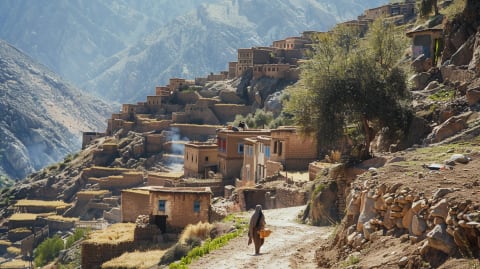
The rock art at Oukaimeden is a two-hour drive from Marrakech. We go in spring when the snow has cleared and the carvings catch the low sun.
Tell us about your trip →The Facts
- —Morocco: 300+ documented rock art sites
- —Two zones: High Atlas plateaus + Draa Valley/Sahara fringe
- —Oukaimeden: 1,000+ Bronze Age engravings at 2,300m (now a ski resort)
- —Foum Chenna: 800+ engravings — riders, ostriches, mouflons
- —Engravings date ~3000 BCE to early common era
- —Technique: pecking then polishing on sandstone
- —Elephants, rhinoceros depicted — absent from region for 5,000 years
Sources
- Lightfoot, Dale. "Moroccan Khettara: Traditional Irrigation and Progressive Desiccation." Geoforum, 1996
- English, Paul Ward. "The Origin and Spread of Qanats in the Old World." Proceedings of the American Philosophical Society, 1968
- Moroccan Agence du Bassin Hydraulique. Khettara survey data