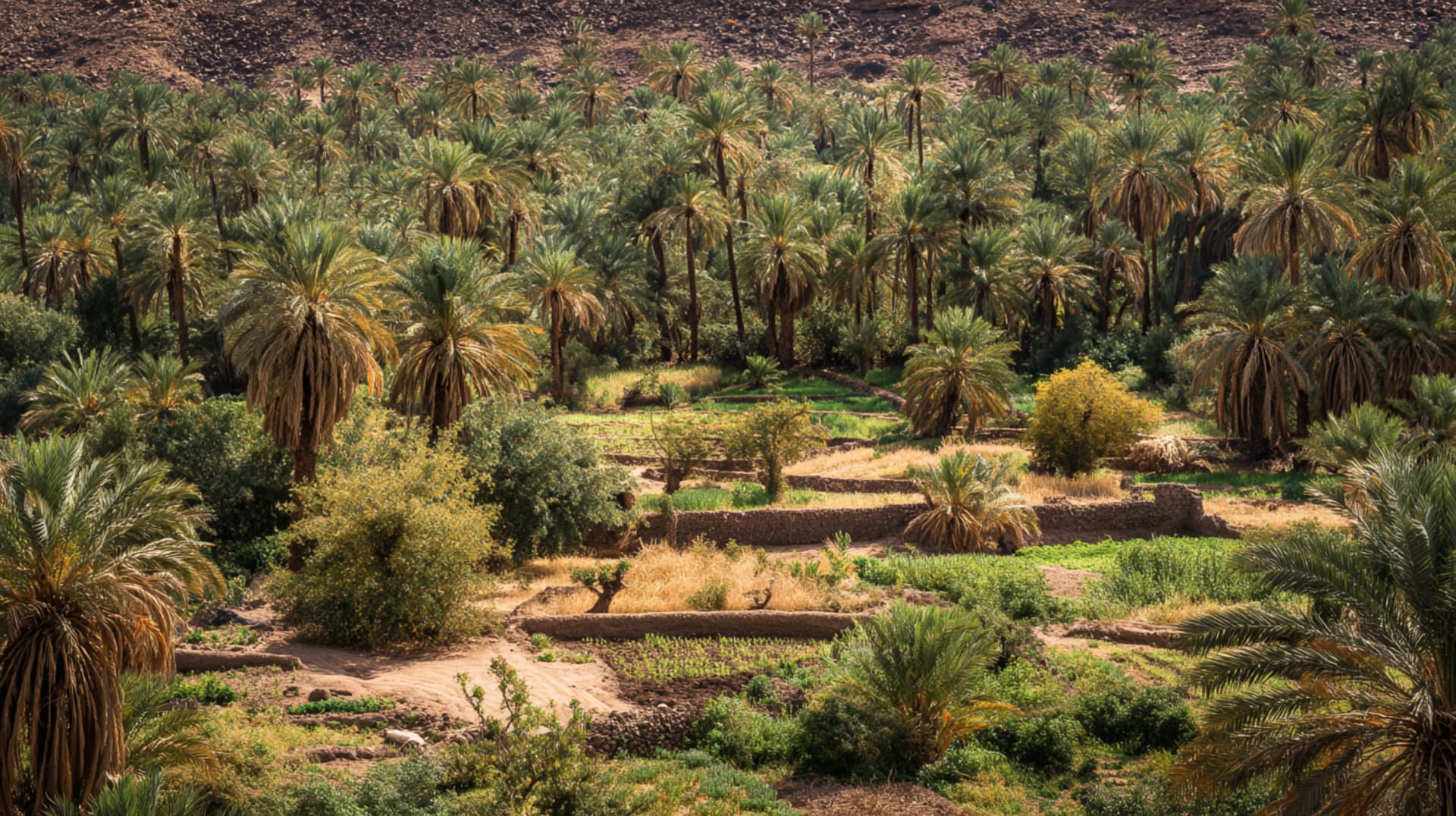
Fatima stands in the shade of a date palm, sixty feet of trunk rising above her. Below, pomegranate trees filter the light. Below those, her garden — onions, carrots, mint. Three layers of life, each one making the next possible. It looks like nature. It is engineering.
An oasis is not an accident. It is not a gift from a generous geology. It is a three-tiered system designed over centuries by people who understood that the desert will kill everything you plant unless you plant everything in the right order.
The date palms stand tallest, their fronds catching the brutal sun and casting dappled shade below. Their height lets them reach for light while their roots reach for water far beneath the sand — sometimes twenty metres down, which is a commute by anyone's standards. They break the wind that would otherwise strip moisture from everything beneath them. They are, in effect, a living roof.
In their filtered light grow the fruit trees — pomegranate, fig, olive, apricot. These medium-height trees create a second canopy, further softening the light and reducing evaporation from the soil below. Their leaf litter enriches the ground. They are the middle managers of the oasis — not glamorous, but the whole system falls apart without them.
At ground level, protected by two layers of living architecture, vegetables and herbs flourish in conditions that should be impossible. The temperature beneath the palms can be fifteen degrees cooler than the open desert. Humidity hovers where it would otherwise evaporate instantly. Fatima's mint grows in the Sahara because someone, centuries ago, understood microclimate engineering without having a word for it.
The date palm itself is a marvel of stubbornness. It drinks from water tables twenty metres deep. It tolerates salt that would kill other crops. A single tree can produce two hundred kilos of fruit per year for a century — a hundred years of sweetness from a trunk that looks like it died decades ago. The Berbers say: "The date palm must have its feet in water and its head in fire." It is the kind of saying that sounds like poetry but is actually a technical specification.
When the French arrived, they called the oases primitive. They introduced modern irrigation — open channels, mechanical pumps. The water evaporated. The aquifers dropped. The salt rose. The oases began to die. The primitive system, it turned out, had been solving problems the modern one didn't know existed.
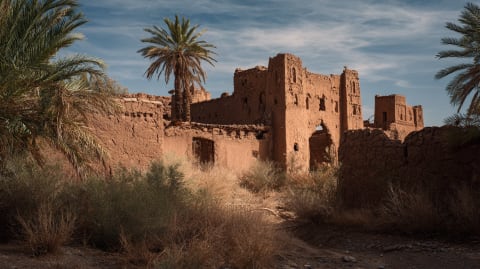
Now, in valleys throughout the Draa, farmers are returning to the old ways. Three layers. Gravity irrigation. Shade as technology. They call it traditional. It might be the most advanced agriculture in the world. Fatima, standing in the shade of her palm, her carrots growing in what should be uninhabitable desert, is not inclined to argue the point.
The oasis engineers built the water systems that keep the Draa alive. Five days on the southern route and you see every kind.
Tell us about your trip →The Facts
- —Date palms can live 100+ years and produce 200kg fruit annually
- —Three-layer system creates temperature drop of 10-15°C
- —Roots can reach water 20+ meters deep
- —Over 400 varieties of dates grown in Morocco
- —Oases can sustain 100+ plant species
- —Traditional irrigation loses 70% less water than open channels
- —UNESCO recognized Draa Valley oases in 2015
Sources
- Lightfoot, Dale. "Moroccan Khettara." Geoforum, 1996
- Mezzine, Larbi. Le Tafilalt. Faculté des Lettres, Rabat, 1987
- FAO. Traditional water management systems in Morocco