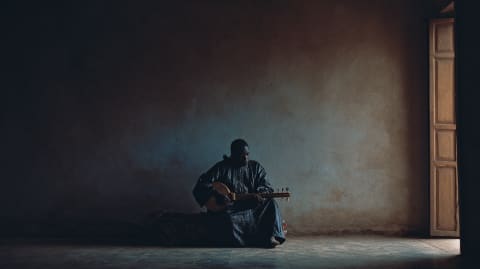
The Gnawa Lila is known for the maalem — the master musician who plays the guembri, the three-stringed bass lute, and leads the troupe through the seven suites of the ceremony. His name appears on festival posters. His face appears in documentaries. He is the visible figure. He is not the one in charge.
The moqaddema — sometimes spelled moquademma — is the woman who designs the ceremony. She is the priestess, the diagnostician, the ritual architect. The maalem provides the music. The moqaddema provides the prescription.
What she does
Before the Lila begins, the moqaddema has already done the work. She has met with the family requesting the ceremony. She has assessed the person who needs healing — not with a medical examination but with a reading of symptoms that the Western world would call psychosomatic and that the Gnawa world calls possession. Insomnia. Anxiety. Unexplained pain. Emotional paralysis. Recurring dreams. Behaviour that the family cannot explain and that the person cannot control.
The moqaddema determines which spirits — which mluk — are involved. Each spirit belongs to a colour, a scent, and a musical suite. Lalla Aicha wears black. Sidi Musa wears blue. Lalla Mirra — the indigenous Amazigh spirit who wears Amazigh clothes and jewellery — wears yellow. The moqaddema decides which spirits need to be addressed, in what order, and with what intensity. She designs the Lila the way a physician designs a treatment plan — based on diagnosis, not on a fixed protocol.
During the ceremony, she is the one who manages the room. She reads breath and movement. She adjusts the incense — jawi in red, white, and black varieties, each corresponding to different spirits. She arranges the coloured fabrics. She watches for the moment when the person enters jedba — the trance state — and she watches for the moment when they need to be brought back. The maalem follows her signals. The troupe follows the maalem. The entire architecture of the night runs through her.
What she is
The moqaddema is not a shaman in the Western sense. She does not claim to enter the spirit world herself. She is a mediator — between the spirits and the humans, between the patient and the maalem, between the seen and the unseen. The academic Maisie Sum, who studied the Gania family in Essaouira, diagrammed the moqaddema's role as the central node in a network connecting spirits, patients, musicians, and the community.
The role is hereditary. Moqaddema Zaida Gania of Essaouira inherited the position from her family and passed it to her daughters. She buys the sacrificial bull for the annual Sha'ban ceremony. She nourishes the guembri with incense before the instrument is played. She performs alongside the maalem, leading the female Gnawa ensemble — the haddarat — who play the seniya, the large metal tray that is the women's primary instrument.
The moqaddema's knowledge is not written down. It is transmitted within families, from mother to daughter, through observation and participation over years. A young woman does not decide to become a moqaddema. She is raised inside the practice. By the time she leads her first Lila, she has been watching the room since childhood.
What it means
The Gnawa tradition is often presented as a masculine art — the maalem on stage, the guembri in his hands, the festival poster with his face. The moqaddema is rarely photographed, rarely interviewed, rarely named in articles about Gnawa music. But the tradition itself knows the hierarchy. The music is the vehicle. The ceremony is the purpose. And the ceremony belongs to the moqaddema.
When Cassandra or someone like her arrives in Morocco seeking healing through sound, the person she needs to meet is not the maalem. The maalem is the musician. The moqaddema is the healer. She is the one who will sit with you before the ceremony and listen — not to your story but to the thing underneath your story, the pattern your body is holding, the spirit that needs to be addressed. She will design a night around what she hears. And when the guembri begins and the qraqeb lock the rhythm and the incense fills the room, she will be the one watching your breath.
The word moqaddema means "the one who presents" or "the one who puts forward." In the Gnawa world, she puts forward the patient to the spirits, and the spirits to the music, and the music to the healing. She is the architect of the night. The maalem builds what she designs.
Sources
- Kapchan, Deborah. Traveling Spirit Masters. Wesleyan University Press, 2007
- Pâques, Viviana. La religion des esclaves. Istituto Italo-Africano, 1991
- Cornell, Vincent J. Realm of the Saint: Power and Authority in Moroccan Sufism. University of Texas Press, 1998
Practical questions