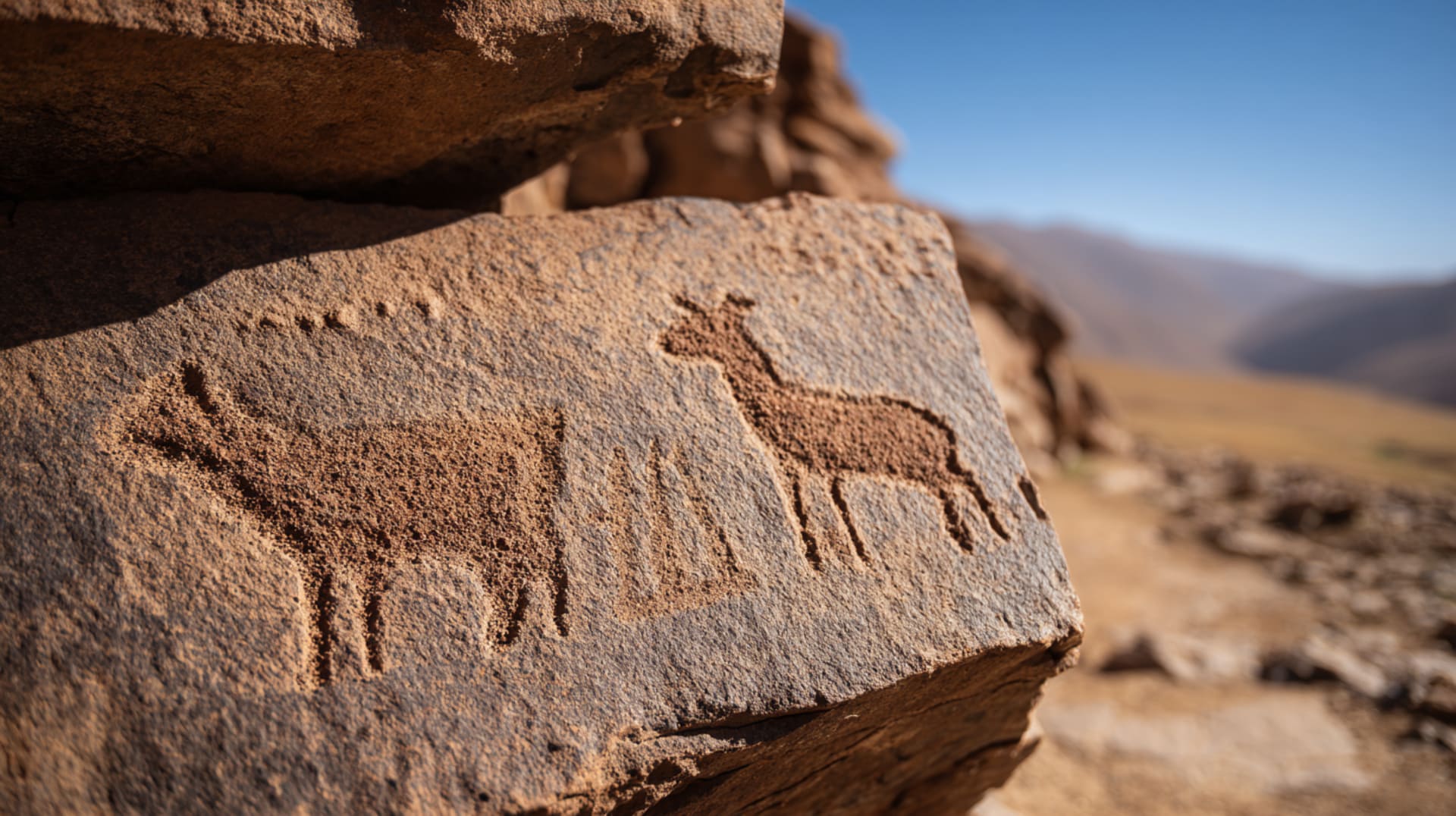
The engraving shows an elephant. Full-sized, pecked into sandstone with a pointed tool, then polished smooth. Behind it, a rhinoceros. Two human figures stand facing the animals with their arms raised. The panel is at Oukaimeden, seventy kilometres south of Marrakech, at 2,600 metres altitude. Today it is a ski resort. Five thousand years ago, it was summer pasture.
Morocco has more than 300 documented rock art sites, concentrated in two zones. The first is the High Atlas — the plateaus of Oukaimeden, Yagour, and Jbel Rat, all above 2,000 metres. The second is the arid south, running from the Draa Valley through Tata, Akka, and Tazzarine to the Saharan fringe. Together they hold roughly a thousand catalogued engravings. The technique is almost always the same: pecking followed by polishing. These are not paintings. The Sahara has its cave paintings at Tassili n’Ajjer in Algeria. Morocco’s rock art is carved into exposed stone, in the open air, facing the sky.
The oldest engravings belong to what archaeologists call the Tazina style — polished outlines of wild animals, mostly in the southern sites. Antelope, cattle, elephants, giraffes. Animals that required grassland and water. The engravings are evidence: this landscape was not desert. It was savanna, watered by rivers that now run dry, grazed by herds that no longer exist here. The dates are debated — long chronology says 4000 BCE, short chronology says 2500 BCE — but either way, these images record the last green centuries before the Sahara took over.
At Oukaimeden, the sequence is readable. The earliest carvings are animals — cattle, mostly, the species that benefited from the mountain pastures. Then, from the second millennium BCE, the animals give way to weapons. Daggers, halberds, shields, clubs. The pasture was getting scarce. The communities that used the valley in summer were competing for it. The art changed because the conditions changed. Cattle gave way to conflict.
The third period is Libyan-Berber — roughly first millennium BCE through the arrival of Islam. Riders on horseback, battle scenes, geometric symbols. Stick figures with spears. Tifinagh script scratched alongside the images. And finally, the Camel Period: the dromedary appears, marking the shift to desert-adapted transport. By then the Sahara was the Sahara.
The best-known panel at Oukaimeden is the Elephants’ Frieze — four elephants, a feline, and two human figures on a horizontal rock face near a stream that was once a main route into the valley. Two vertical Libyan-Berber inscriptions were added later, centuries apart, on the same stone. The same canvas, used and reused.
In the south, the Aït Ouazik site near Tazzarine has some of the finest Tazina-style engravings in North Africa. Getting there requires a half-day drive from Zagora, much of it on piste. The reward is a broad dry valley where the animal outlines are so clean they look recent. Giraffes, oryx, figures that might be hunting traps — concentric circles and spirals interpreted as game corrals. At Imaoun, thirty kilometres north of Akka in the Tata province, the geometric engravings are unlike anything in the Atlas. The site at Adrar n’Metgourine, west of Tata, features an extraordinary frieze of pecked domestic cattle.
The National Centre of Rock Art Heritage, based in Marrakech, coordinates research and protection. The government has classified the Oukaimeden sites since 1951. But the threats are ongoing: stone extraction for construction in nearby Marrakech, tourist foot traffic, and vandalism. The British Museum’s TARA project has digitally catalogued roughly 700 Moroccan images since 2013, preserving what the weather and the tourists are slowly wearing away.
You can visit Oukaimeden in a day trip from Marrakech. There is a tourist information centre with a panel explaining the engravings. The stones are just there, among the shepherd huts and the summer grass, the way they have been for five thousand years. Nobody carved them in a gallery. They carved them where they lived.
The rock engravings at Oukaimeden are at 2,600 metres. The photography journey reaches them in the High Atlas section.
Tell us about your trip →The Facts
- —Oukaimeden: 2,600m altitude, now a ski resort, 5,000 years ago summer pasture
- —300+ rock art sites in Morocco
- —Two zones: High Atlas plateaus + arid south (Draa to Saharan fringe)
- —~1,000 catalogued engravings total
- —Technique: pecking followed by polishing on sandstone
- —Elephants, rhinoceros, ostriches depicted
- —Libyco-Berber inscriptions at Foum Chenna (800+ engravings)
Sources
- Searight, Susan. The Prehistoric Rock Art of Morocco. Archaeopress, 2004
- Muzzolini, Alfred. Les images rupestres du Sahara. Self-published, 1995
- INSAP (Institut National des Sciences de l'Archéologie et du Patrimoine). Moroccan rock art surveys
- Camps, Gabriel. Monuments et rites funéraires protohistoriques. Arts et Métiers Graphiques, 1961.
Further Reading
Practical questions