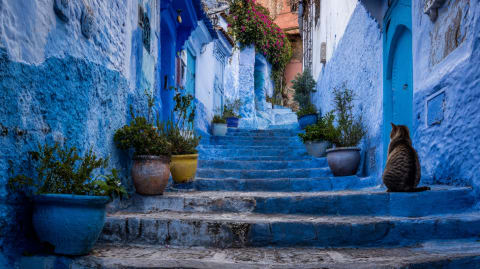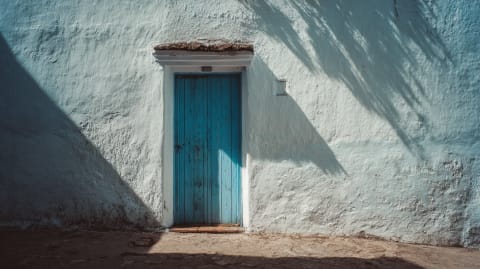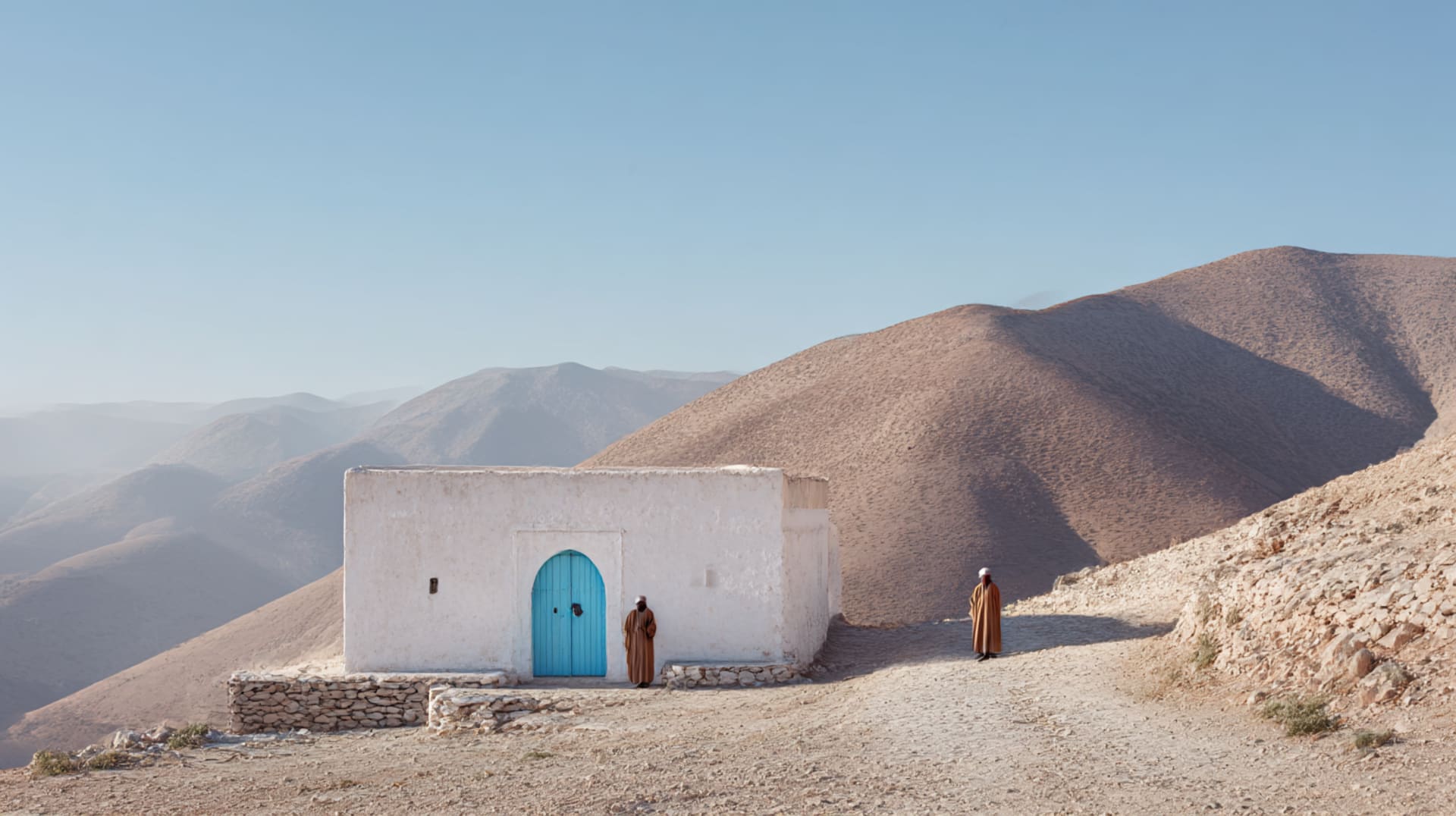
The village has about 500 people, no paved road, and one stony path lined with cactus leading to a mosque and a school. It sits in the Ahl Srif hills of the Rif Mountains, 85 kilometres south of Tangier. The whitewashed houses have blue-painted doors. There is no hotel. There is no restaurant. There is nothing, in fact, to explain why the Rolling Stones, Ornette Coleman, Led Zeppelin, William Burroughs, Patti Smith, and the Smashing Pumpkins all came here.
Except the music.
The Master Musicians of Joujouka are a collective of more than fifty Sufi trance musicians. All are from the village. All are sons of previous members. All carry the surname Attar — perfume maker. The tradition is believed to be over a thousand years old, rooted in the teachings of a 9th-century Sufi saint, Sidi Ahmed Schiech, whose sanctuary in Joujouka remains a place of pilgrimage for the Ahl Srif tribe.
The instruments are ghaitas — double-reed horns, similar to oboes, carved from mahogany — and goatskin drums. The ghaitas are loud. Louder than you expect. Louder than a rock band, some visitors say. The musicians use circular breathing to sustain notes for minutes at a time, dividing into sections that play interlocking loops around a lead melody. The sound is not background music. It fills the valley.
The music is designed to induce trance. The repetition, the drone, the accumulation of rhythm over hours — the body responds before the mind does. This is Sufi practice: dissolution of the self through sound. The Master Musicians have been doing this since before the concept of Western music existed.
Boujeloud — The Father of Skins
At the annual festival, a dancer appears in goatskins. He is Boujeloud — a figure older than Islam, older than the village, a Pan-like spirit of fertility and chaos. He dances through the crowd striking people with oleander branches. The strikes are blessings. Boujeloud is the wildest thing in the ceremony, and also the oldest — a survival of pre-Islamic North African ritual absorbed into Sufi practice rather than erased by it.
The festival runs for several days. The village fills with music from dusk to dawn. Visitors — limited to about forty — sleep in the homes of the musicians. There is no separation between audience and ceremony.
The Beats found them first
In the 1950s, Mohamed Hamri — a painter and folklorist born in Joujouka — ran a restaurant in Tangier that the international art crowd frequented. Brion Gysin ate there. William Burroughs ate there. Paul Bowles came. Hamri told them about the music in his village. Gysin went, heard the Master Musicians, and abandoned the Western art scene. He spent twenty-three years in Morocco to be near them.
Burroughs listened and wove the sound into Naked Lunch — the hallucinatory piping that runs through the book is Joujouka, even if he never named it. Bowles, during his 1959 field recordings for the Library of Congress, documented Moroccan music across the country. He knew what the Master Musicians were. The word spread through the Tangier Interzone: there is a village in the Rif where the music does something to you.
Brian Jones, 1968
When the Rolling Stones came to Tangier in 1967, Hamri and Gysin met them. Hamri formed a bond with Brian Jones — the band's founder, the one who played sitar and marimba and dulcimer, the one who kept reaching for something the blues could not give him. Jones went to Joujouka. He fell in love with the music. He later said he did not know if he possessed the stamina to endure the incredible, constant strain of the festival.
He returned in July 1968 with an engineer, George Chkiantz, and recorded the Master Musicians. For Jones, the experience dominated the last year of his life. He wanted to incorporate the sound into the Stones' music. It was yet another thing that separated him from Jagger and Richards. His friend John Dunbar remembered Jones coming to his flat to play the tapes: "Brian loved Joujouka and he hawked those tapes around trying to do something for the musicians. This really was going in a different direction from Mick and Keith."
Jones spent the rest of that summer preparing the artwork and sleeve design for the album. He died on July 3, 1969 — drowned in a swimming pool in Sussex, aged twenty-seven. Brian Jones Presents the Pipes of Pan at Joujouka was released in 1971 on Rolling Stones Records. It was the first time most of the world had heard this music. It remains one of the most important field recordings of the 20th century.
After Brian
Ornette Coleman came. He recorded with the Master Musicians in the early 1970s — fragments of those sessions appeared on his 1975 album Dancing in Your Head. The collision of free jazz and thousand-year-old Sufi trance was exactly what Coleman had been looking for.
The Rolling Stones returned. The track "Continental Drift" on their 1989 album Steel Wheels features the Master Musicians. In 2009, Bachir Attar — son of the leader during the Brian Jones era — performed with Ornette Coleman, Patti Smith, and Flea from the Red Hot Chili Peppers at the Southbank in London. In 2024, the Master Musicians animated the Dior défilé in the grounds of an ancient palace outside Marrakech — one hundred of the world's top models walking to thousand-year-old Rif Mountain trance music.
Billy Corgan of the Smashing Pumpkins spent a week in the village in 2006. He said the music was the loudest and most intense acoustic music imaginable.
Anthony Bourdain went in 2013, for Parts Unknown. He sat in the home of Bachir Attar, ate briouat, and listened. You can see it on his face in the footage — this is not performance. This is something else entirely.
The village today
The Master Musicians still live in Joujouka. The sons are still learning from the fathers. The festival still runs each summer — limited to forty guests, three days and nights, transport from the nearest city of Ksar el-Kebir included. Visitors sleep in the musicians' homes. There is no hotel because there was never a need for one.
The two factions that split in the early 1990s — one led by the Hamri lineage, the other by Bachir Attar — both continue to perform and record. The music itself has not changed. It cannot change. The ghaitas still drone. The drums still build. Boujeloud still dances in goatskins. The sound still carries across the valley, as it has for a thousand years, long after the tape recorders and the film crews have packed up and driven back to Tangier.
The village has 500 people. The music changed the world. The world did not change the village.
Sources
- Davila, Carl. The Andalusian Music of Morocco. Wesleyan University Press, 2013
- Shannon, Jonathan Holt. Among the Jasmine Trees: Music and Modernity in Contemporary Syria. Wesleyan University Press, 2006
- Pacholczyk, Jozef. "Andalusian Music of Morocco." In The Garland Encyclopedia of World Music, Vol. 6. Garland, 2002
- Davis, Ruth. Ma'luf: Reflections on the Arab Andalusian Music of Tunisia. Scarecrow Press, 2004.
Practical questions