Tamnougalt is one of the few kasbahs in southern Morocco where the Jewish quarter is still visible inside the walls.
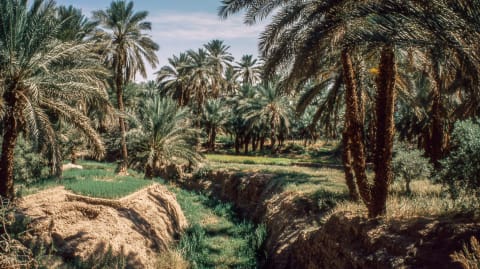
The kasbah sits in the Draa Valley, about 10 kilometres from Agdz on the road from Ouarzazate to Zagora. It was built roughly 600 years ago by the Mezguita tribe as a fortified village — a cluster of pisé towers and houses arranged around narrow alleys, with a communal granary, a mosque, and a small mellah where a Jewish community lived alongside their Muslim neighbours.
The Jewish families of Tamnougalt were merchants and silversmiths. They occupied a separate quarter within the kasbah — a few streets with lower ceilings and narrower doorways — and they stayed until the 1960s, when the last families emigrated to Israel. The mellah is still identifiable by its construction and layout. Local guides will show you the houses and explain who lived where.
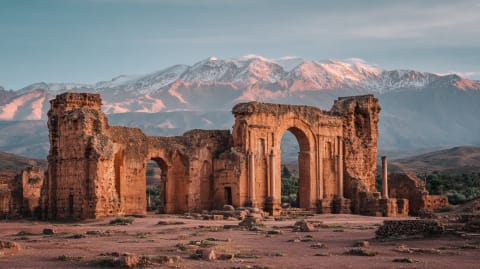
The kasbah is partially inhabited and partially in ruin. The pisé walls — sun-dried earth mixed with straw — dissolve in heavy rain, and the southern valleys have seen more rain in recent years than the buildings were designed to handle. Restoration is ongoing, funded partly by tourism and partly by cultural heritage organisations.
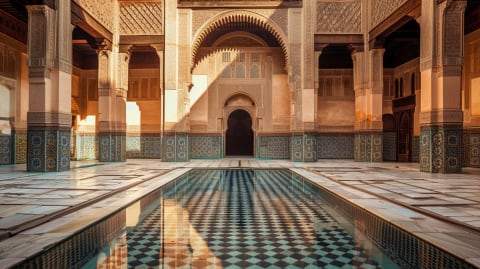
Tamnougalt was a stop on the trans-Saharan caravan route and a seat of local power. In the 17th century, the chief of the Mezguita hosted the Saadian sultan in these rooms. The reception hall — a high-ceilinged space with painted wooden beams — is still standing.
The kasbah receives few visitors compared to Aït Benhaddou. This is its virtue. You walk through the alleys with a guide from the village, and the guide knows the families because they are his family.
The Facts
- —The kasbah sits in the Draa Valley, about 10 kilometres from Agdz on the road from Ouarzazate to Zagora.
- —It was built roughly 600 years ago by the Mezguita tribe as a fortified village — a cluster of pisé towers and houses arranged
- —In the 17th century, the chief of the Mezguita hosted the Saadian sultan in these rooms.
Sources
- Gottreich, Emily. The Mellah of Marrakesh. Indiana University Press, 2007
- Terrasse, Henri. Kasbas Berbères de l'Atlas et des Oasis. 1938
- Naji, Salima. Art et architectures berbères du Maroc. Édisud, 2001
Practical questions