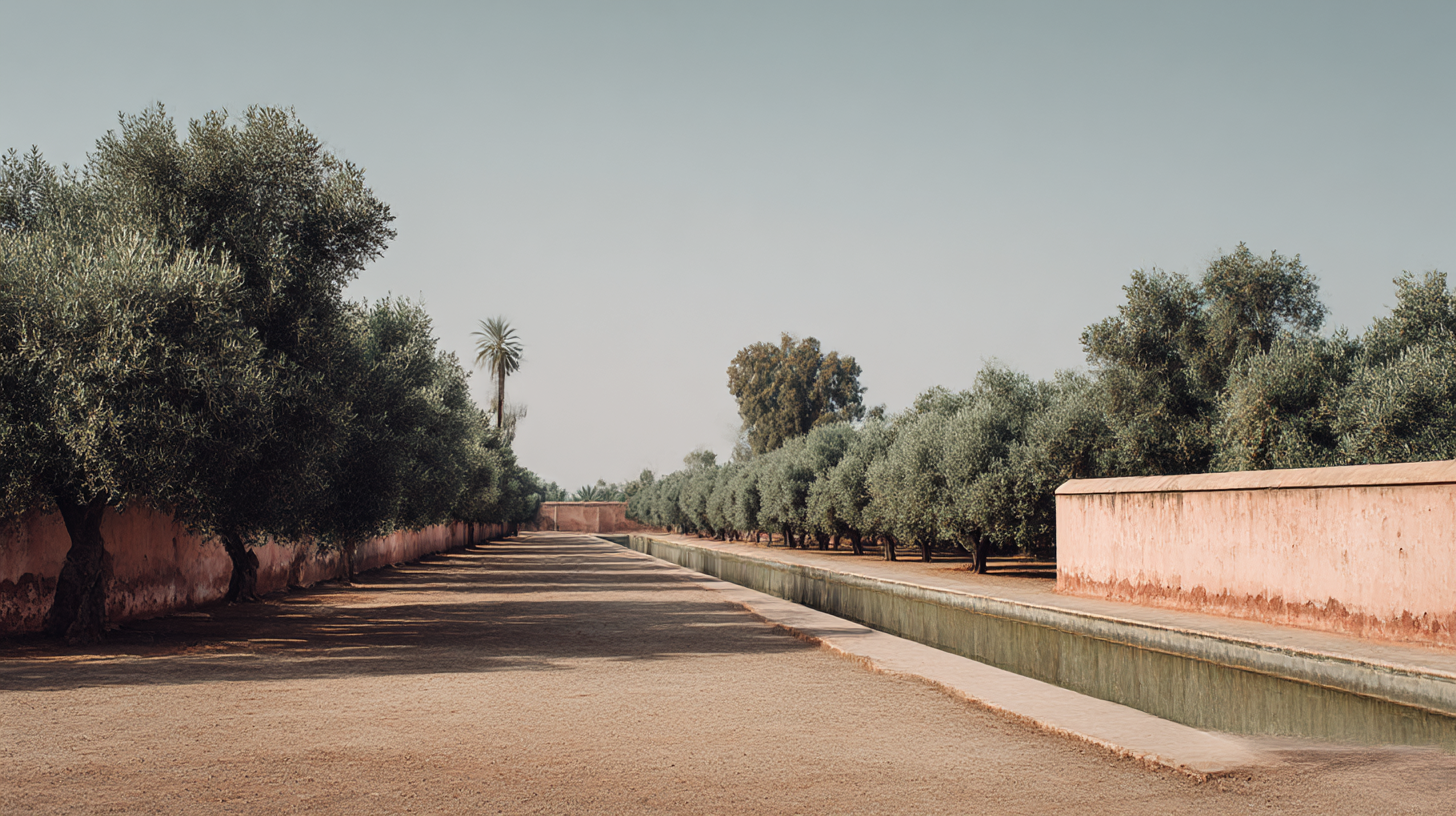
The Agdal Gardens are older than the Menara, larger than the Majorelle, and almost nobody visits them.
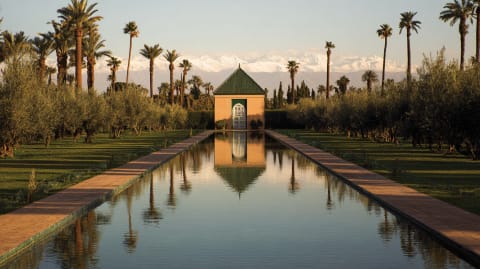
The gardens stretch south of the Royal Palace in Marrakech, enclosed by pisé walls, covering roughly 400 hectares — one of the largest historical gardens in the Islamic world. They were laid out in the 12th century by the Almohads, the same dynasty that built the Menara and the Koutoubia, as a royal orchard irrigated by a system of underground channels and surface basins.
The main basin — the Sahraj el-Hana, the "tank of health" — is enormous, fed by khettaras that draw water from the Atlas foothills 30 kilometres away. The engineering is the same principle as the Menara: store snowmelt in a basin, distribute it through channels, grow food on the edge of the desert.
The trees are olive, pomegranate, fig, citrus, and apricot. The orchards are still productive. The gardens are still royal property, which means access is intermittent — they are open to the public on Fridays and Sundays when the king is not in residence.
Because of the restricted access and the distance from the main tourist areas of the medina, the Agdal Gardens receive a fraction of the visitors the Menara or Majorelle attract. On the days they are open, you can walk for an hour through the orchards without encountering another tourist. The sound is wind in olive trees and irrigation water running through stone channels.
The gardens are a reminder that the Almohads were not building pleasure grounds. They were building food security. The fact that what they built is also beautiful was, for them, incidental.
The Facts
- —The gardens stretch south of the Royal Palace in Marrakech, enclosed by pisé walls, covering roughly 400 hectares — one of the
- —They were laid out in the 12th century by the Almohads, the same dynasty that built the Menara and the Koutoubia, as a royal
- —The main basin — the Sahraj el-Hana, the "tank of health" — is enormous, fed by khettaras that draw water from the Atlas
Sources
- Deverdun, Gaston. Marrakech: des origines à 1912. Éditions Techniques Nord-Africaines, 1959
- Ruggles, D. Fairchild. Islamic Gardens and Landscapes. University of Pennsylvania Press, 2008
- Wilbaux, Quentin. La médina de Marrakech. L'Harmattan, 2001
Practical questions