The first Koutoubia was wrong. Not slightly wrong. Not "close enough for government work" wrong. Wrong in the one way a mosque cannot be wrong: it didn't point at Mecca.
The Almohads conquered Marrakech in 1147 and immediately began building their great mosque on the ruins of the Almoravid palace. The engineers laid out the prayer hall, oriented the mihrab, raised the walls. Then someone checked the alignment. It was off. Not by much — but enough to matter, because "not by much" is not a direction you want to be facing when you pray, and "enough to matter" is a phrase that has ended careers in every century.
They could have adjusted. They could have explained. Instead, they did something characteristic of a dynasty that thought in centuries: they demolished the mosque and built it again, slightly rotated, on the correct axis. The original foundations are still there, visible in the archaeological traces beside the current building. Two mosques, overlapping, one correct and one erased. The Almohads did not do things by halves, which is admirable, and did not admit mistakes publicly, which is human.
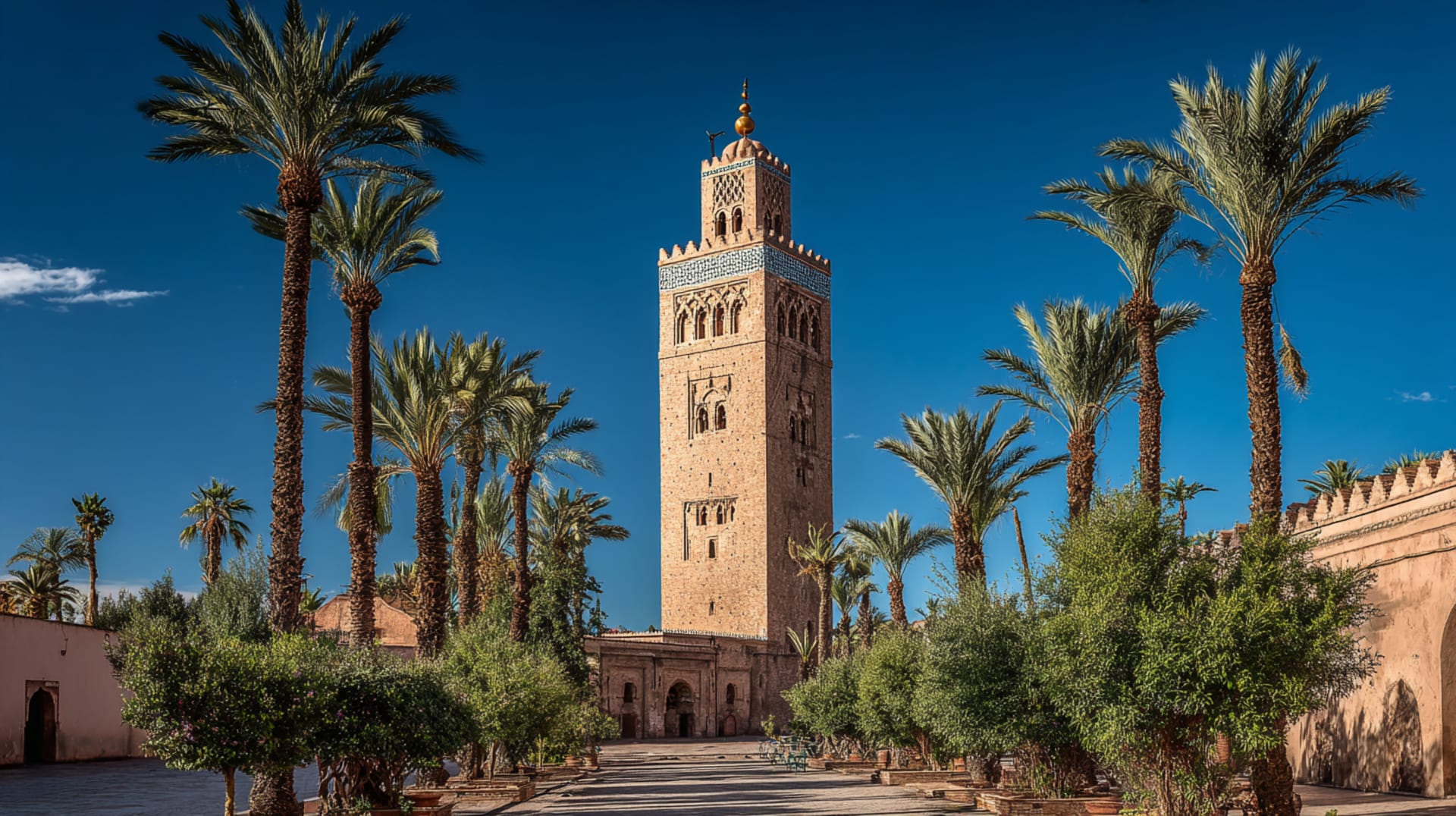
The minaret they raised on the second attempt got it right. The Koutoubia tower — 77 metres tall, visible from everywhere in Marrakech — became the prototype. Its proportions, 1:5 width to height, were copied at the Hassan Tower in Rabat and the Giralda in Seville. When the Spanish reconquered Andalusia, they didn't demolish the Giralda; they added a bell tower on top of the Almohad minaret, which is either adaptation or tribute depending on your politics. The template survived conquest. The proportions survived religion. A ratio devised in Marrakech now rings church bells in Spain.
The name "Koutoubia" means Mosque of the Booksellers — the souks around it once specialised in manuscripts. The booksellers are gone, replaced by tourist shops that sell things the booksellers would not have recognised. But the minaret remains, mathematically perfect, aligned with a city 4,000 kilometres away, built twice because once wasn't good enough.
At night, three bronze spheres at the tower's peak catch the light. Legend says they're solid gold. They're not — but the story persists, because in Marrakech even the architecture has gossip.
The minaret is the first thing you see from the airport road. Three days in Marrakech starts at its feet.
Tell us about your trip →The Facts
- —The first mosque was built circa 1147, then rebuilt for correct alignment
- —The minaret is 77 meters (253 feet) tall
- —Proportions are 1:5 (width to height), copied at Hassan Tower and Giralda
- —The name means 'Mosque of the Booksellers'
- —Three copper spheres crown the tower (not gold, despite legend)
- —Non-Muslims cannot enter the mosque
Sources
- Bloom, Jonathan. Minaret: Symbol of Islam. Oxford Studies in Islamic Art, 1989
- Deverdun, Gaston. Marrakech: des origines à 1912. Éditions Techniques Nord-Africaines, 1959
- Marçais, Georges. L'architecture musulmane d'occident. Arts et Métiers Graphiques, 1954
Further Reading
Practical questions