In 1195, Sultan Yacoub al-Mansour ordered the construction of the largest mosque in the world. Not the tallest minaret. Not the most beautiful courtyard. The largest. He was not a man who dealt in qualifiers.
The site: a hill overlooking the Bouregreg River in Rabat, visible from the Atlantic. The mosque would hold 20,000 worshippers. The prayer hall was designed with 348 columns — more than the Great Mosque of Cordoba. The minaret would rise to 86 metres, the tallest in the Islamic world. The ramp inside was wide enough for two horsemen to ride side by side to the summit, which is the kind of specification that tells you exactly how the Almohads thought about scale.
Construction began. The columns went up. The minaret rose. Workers came from across the empire — the same craftsmen who had built the Koutoubia in Marrakech and the Giralda in Seville. The red sandstone was quarried locally. The sebka decorative panels were carved on site. Everything was proceeding according to a plan that assumed the sultan would live forever.
In 1199, Yacoub al-Mansour died.
His successors had other priorities. The Almohad empire was fracturing. Money went to wars, not mosques. Construction stopped with the minaret at 44 metres — exactly half its intended height, as if the builders had paused mid-sentence and never found the next word.
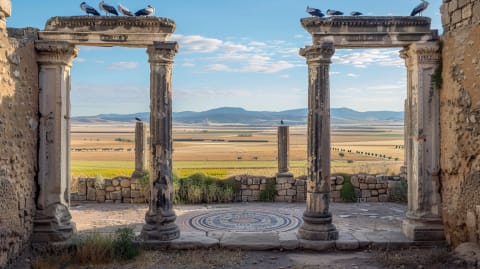
The prayer hall was never roofed. The 348 columns stood open to the sky, a forest of stone with no ceiling. The Lisbon earthquake of 1755 toppled most of them. Today, roughly 200 stumps remain, arranged in their original grid, rising about two metres from the ground. They look like a stone orchard, or a graveyard, or a chess game abandoned halfway through by a player who was called away on urgent business and never returned.
In 1960, King Mohammed V chose the site for Morocco's most important modern building: the Mausoleum of Mohammed V, where he and his sons Hassan II and Moulay Abdallah are buried. The unfinished tower now guards a completed tomb. The minaret that was meant to call the faithful to prayer stands instead as a sentinel over the dynasty that, 800 years later, took the hill for its own.
The Hassan Tower is the most beautiful ruin in Morocco. It was meant to be the most powerful building in the Islamic world. It became something better: a monument to the gap between ambition and mortality. Sometimes the fragment becomes the monument. Sometimes half a tower says more than the whole thing ever could.
The tower that stopped at half. The columns that lost their roof. The architecture pilgrimage passes through Rabat where al-Mansour's ambition still stands.
Tell us about your trip →The Facts
- —Ordered by Yacoub al-Mansour 1195
- —Intended height 86 meters (tallest in Islamic world)
- —Construction stopped at 44 meters when sultan died 1199
- —Mosque would have held 20,000 worshippers
- —348 columns planned (more than Cordoba)
- —Ramp wide enough for two horsemen side by side
- —Lisbon earthquake 1755 toppled most columns
- —~200 column stumps remain
- —Mohammed V mausoleum built beside it 1960
- —UNESCO World Heritage tentative list
Sources
- Bloom, Jonathan. Minaret: Symbol of Islam. Oxford Studies in Islamic Art, 1989
- Marçais, Georges. L'architecture musulmane d'occident. Arts et Métiers Graphiques, 1954
- Salmon, Xavier. Maroc Almoravide et Almohade. Musée du Louvre/Hazan, 2018
Further Reading
Practical questions