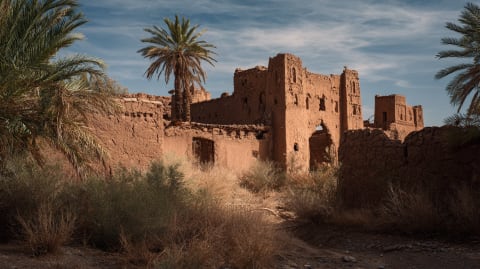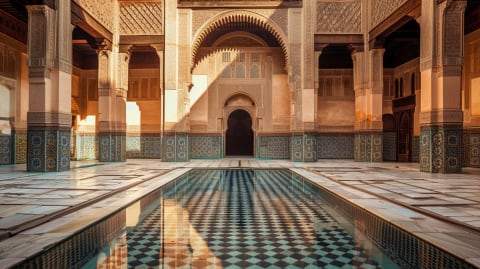
The ratio is 1:5. Width to height. The same on all three, which is how you know they were designed by the same mind — or at least the same obsession.
The Koutoubia in Marrakech. The Giralda in Seville. The Hassan Tower in Rabat. Built within decades of each other by the Almohad dynasty in the late 12th century. Separated by up to 2,000 kilometres. Connected by a proportional system so precise that if you scaled a photograph of one to match the base width of another, the heights would align within centimetres.
The architect was almost certainly the same man — or the same workshop. His name may have been Ahmad ibn Baso, though the sources are not definitive. What is certain: the proportions are identical. A square base. A ramp inside instead of stairs — wide enough for a horse to climb, which tells you something about the Almohads' expectations for their muezzins. Decorative panels that change pattern on each face, so the tower looks different from every direction. A building that refuses to repeat itself, even to itself.
The Koutoubia came first, completed around 1195. At 77 metres including the lantern, it set the template. The minaret sits beside a mosque that was actually built twice — the first version demolished because it didn't face Mecca accurately enough. The Almohads didn't tolerate approximation. They rebuilt the mosque on the correct axis and kept the minaret, which had been right all along.
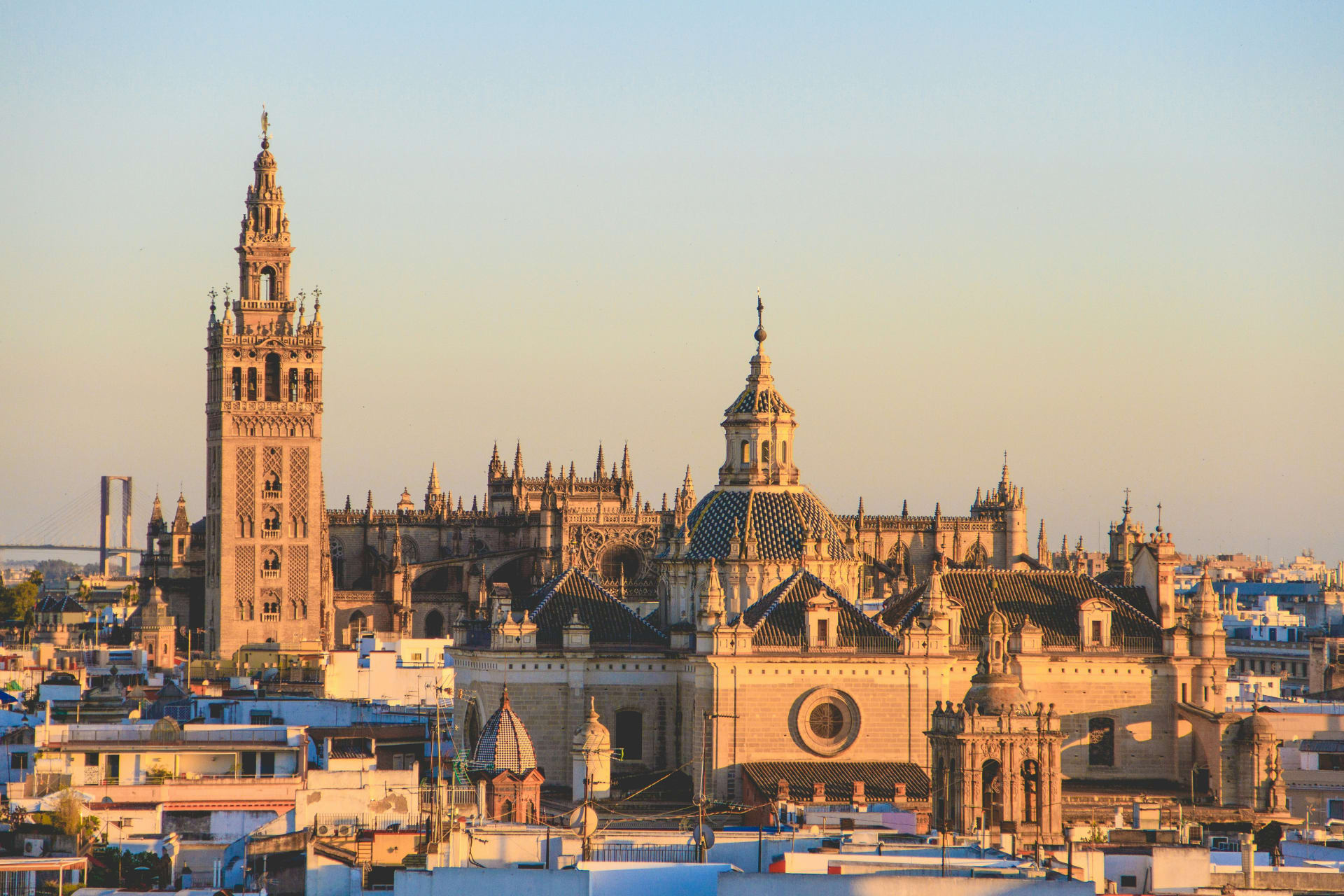
The Giralda came next, completed around 1198. Originally 82 metres, it was the tallest structure in Europe — an Islamic minaret on the Iberian Peninsula, calling the faithful to prayer in a city that would be Christian within fifty years. The Spanish added a Renaissance bell tower on top after the Reconquista, adding another 22 metres. But underneath the Christian addition, the Almohad proportions survive intact. The conquerors changed the religion but couldn't bring themselves to change the architecture. That is the highest compliment one civilisation can pay another.
The Hassan Tower was meant to be the largest of all — 86 metres, the tallest in the Islamic world. Sultan Yacoub al-Mansour died in 1199 before it was finished. It reached 44 metres. Exactly half. His successors had wars to fight and couldn't justify the expense. Eight centuries later, the tower still stands at half-height, surrounded by the stumps of the stumps of columns that were never given a roof.
Three sisters. One completed, one modified, one abandoned. The geometry holds across two continents, two religions, and eight centuries. The ratio is still 1:5.
Three minarets, one geometry. The architecture pilgrimage connects the Koutoubia in Marrakech to the ruins where the Hassan Tower still waits.
Tell us about your trip →The Facts
- —Ratio 1:5 (width to height) on all three
- —Koutoubia completed ~1195, 77m tall
- —Giralda completed ~1198, originally 82m (tallest in Europe)
- —Hassan Tower intended 86m, stopped at 44m when sultan died 1199
- —Architect possibly Ahmad ibn Baso
- —Ramps inside (not stairs) — wide enough for horses
- —Sebka pattern = Almohad signature
- —Koutoubia mosque was built twice (first misaligned to Mecca)
- —Giralda: Renaissance bell tower added on top after Reconquista
Sources
- Terrasse, Henri. Kasbas Berbères de l'Atlas et des Oasis. Horizons de France, 1938
- Naji, Salima. Art et architectures berbères du Maroc. Édisud, 2001
- UNESCO World Heritage. Ksar of Ait-Ben-Haddou, nomination file, 1987
Further Reading
Practical questions