The windows glow like Chagall. The building was designed by Algerian Jews who had fled to Casablanca and named it Beth-El — the House of God. Nobody told them they were building the last great synagogue in the Arab world. They just built it.
In 1948, Morocco had 275,000 Jews. Today, about 2,000 remain. Most live in Casablanca, where thirty synagogues still stand — a number that sounds like resilience until you learn how many have closed. Temple Beth-El is the largest, seating five hundred, its walls of white and gilded plaster rising beneath stained glass that throws coloured light across the sanctuary with the confidence of a building that does not know it is an anomaly.
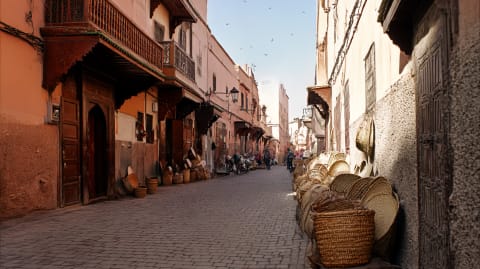
The mellah of Casablanca is young by Moroccan standards — barely a century old. Jews had been in Morocco for two thousand years before anyone built a Jewish quarter here. The first mellah was in Fes, established in 1438. The word means "salt" — possibly because Jews were assigned to salt the heads of executed criminals, possibly because the quarters were built on salted, infertile land. Neither etymology is cheerful. Both are probably true.
Beth-El wasn't built in the mellah. It was built in the ville nouvelle, by Algerian immigrants who brought their own traditions and their own sense of what a synagogue should feel like when you walked in. They refurbished the temple in 1997. The giant chandeliers. The coloured windows. The architecture that reaches for something just beyond the ceiling.
Around the corner, the Ettedgui Synagogue — partially destroyed by Allied bombing in 1942, rebuilt in the 1980s, reopened by King Mohammed VI himself as part of a project to preserve Morocco's Jewish heritage. The 2011 constitution gave Jewish history special status as part of Moroccan identity. Not as outsiders. Not as guests. As Moroccans. The distinction matters more than it sounds, in a region where Jewish communities in other countries have been erased from the official record.
The last Jewish day school in the Arab world is here — Neve Shalom, where children study Torah and Arabic and French and the particular art of belonging to a community that most of the world assumes no longer exists. The stained glass in Beth-El catches the afternoon sun and throws colour across empty pews. The light doesn't know how many people are watching. It illuminates the space anyway.
The stained glass synagogue still holds light the way it was designed to. The Mellah Route visits the communities that built it.
Tell us about your trip →The Facts
- —Morocco Jewish population: 275,000 in 1948, approximately 2,000 today | Casablanca: 30 synagogues, largest Jewish community in Morocco | Temple Beth-El: seats 500, refurbished 1997 | First mellah (Fez): 1438 | Neve Shalom: last Jewish day school, 90% Muslim students | 2011 constitution: Jewish heritage recognized as part of Moroccan identity | King Mohammed VI personally attended Ettedgui reopening
Sources
- Gottreich, Emily. The Mellah of Marrakesh: Jewish and Muslim Space in Morocco's Red City. Indiana University Press, 2007
- Laskier, Michael. The Alliance Israélite Universelle and the Jewish Communities of Morocco. SUNY Press, 1983
- Corcos, David. Studies in the History of the Jews of Morocco. Rubin Mass, 1976
Further Reading
Practical questions