The Call

Culture

The Call

The first call comes before dawn. Fajr. The sky is still dark. The muezzin's voice rises from the nearest minaret — amplified now, through speakers, but the melody is the same one that has sounded over this city since it was founded. The words are Arabic, unchanged since the 7th century: God is great. I testify that there is no god but God. Come to prayer. Come to success.

Then silence. The city turns over and sleeps again, which is a very human response to a very divine invitation.

The second call comes at midday. Dhuhr. The third in the afternoon. Asr. The fourth at sunset — maghrib, the one you will notice, because the light is changing and the city shifts gear. Shops close briefly. Streets empty for ten minutes. Then everything resumes, as if the city held its breath and let it go. The fifth comes at night. Isha. Five prayers, five calls, five pauses in the day's rhythm. The city is punctuated by God the way a sentence is punctuated by commas.

In a Moroccan city, you are never out of earshot of a minaret. Marrakech has over two hundred mosques. Fes has over three hundred. The calls are not synchronised — they overlap, so from a rooftop you hear them ripple across the city like a stone dropped in water, one starting as another finishes, a cascade that takes two or three minutes to complete. The effect is spatial. You can map the city by its minarets just by listening. Close your eyes and Marrakech is a sound map.

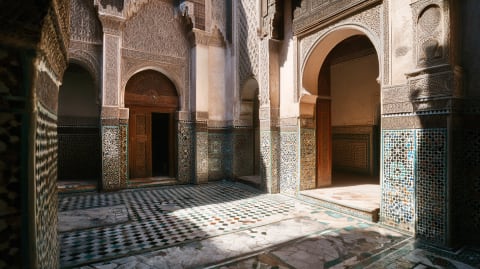
Non-Muslims cannot enter mosques in Morocco, with two exceptions: the Hassan II in Casablanca and a few historical medersas now operating as museums. This is not hostility — it is a boundary, the architectural equivalent of a closed door that is closed for a reason. The prayer space is reserved for prayer. The boundary is respected by everyone, and violated by almost nobody, because Morocco is a country that understands the difference between exclusion and privacy.

The adhan — the call itself — is not singing, though it sounds like it. It is recitation, governed by maqam — the melodic modes of Arabic music. Each muezzin brings his own voice, his own interpretation, his own relationship with the words. In a city of 200 mosques, no two calls sound identical. The text is fixed. The delivery is personal. The result is a chorus of individuals all saying the same thing in different voices, which is not a bad description of prayer itself.

After a week in Morocco, you stop hearing the adhan as interruption. You hear it as structure. After a month, you hear it as silence — the natural sound of a city being a city. To leave Morocco is to enter a world without the call, and the thing that surprises you is not adjusting to its absence. The absence is louder than the call itself.

The first call comes before dawn. By the fifth, you stop noticing. By the third day, you notice the silence between them.

Tell us about your trip →

The Facts

  • Five daily calls: Fajr (pre-dawn), Dhuhr (midday), Asr (afternoon), Maghrib (sunset), Isha (night)
  • Words unchanged since 7th century
  • Now amplified through speakers
  • Maghrib call most noticeable — shops close briefly, streets empty 10 minutes
  • Morocco has ~41,000 mosques
  • Muezzin's melody varies by region
  • Call is in Arabic regardless of local language

The Edit

One story about Morocco, every week. Free.