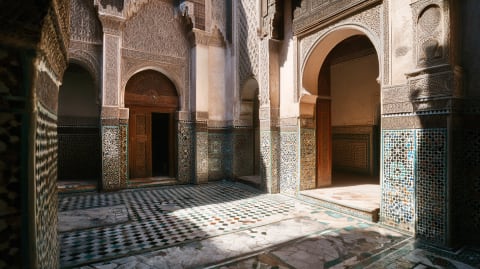
The sign is small. You will miss it. It is on Rue de la Bahia, around the corner from Bahia Palace, and the door looks like every other door in the medina — wooden, studded, unremarkable. There is no queue. There is no gift shop. There is no audio guide. You knock, someone opens, and you step into the life's work of a man who understood Morocco better than almost anyone who ever came here.
Bert Flint was born in the Netherlands in 1931. He studied Spanish at the University of Utrecht. He became interested in the Moorish-Andalusian Empire and wanted to understand its influence on Western culture, so he followed the thread south — through Spain, across the Strait, into Morocco. He arrived in Marrakech in 1957. He took a job teaching English and Spanish at a secondary school. He never went home.
The collector who preferred ox carts
In his spare time, Flint travelled. Not the way tourists travel. He went into the High Atlas, the Anti-Atlas, the Draa Valley, the Sahara. He crossed into Mauritania, Senegal, Niger, Mali. He reached Timbuktu. His preferred mode of transport was the ox cart rather than a Land Rover — "because it all shook a bit hard," he said, which was the closest he came to complaint.
He was looking for objects. Not antiques for a mantelpiece — tools, jewellery, tents, carpets, costumes, carvings, musical instruments, the material culture of Amazigh and Tuareg and Sahelian peoples along the trans-Saharan trade routes. He went to the villages where the objects came from. He asked who made them. He asked what they meant. He documented the patterns, the symbols, the techniques.
What he found changed his understanding of everything. The frog appeared as a fertility symbol in carvings, stone artefacts, and weaving across the whole of North Africa — different tribes, different regions, the same symbol. The Berber carpet, dismissed by European art historians as folk craft, was in fact a sophisticated abstract language. Women who could not read or write were encoding protection prayers, fertility symbols, and family identity into the knots. Without a pattern in advance. Without a school. The geometry was inherited, passed from mother to daughter, and it was as rigorous as anything in a European museum.
When Flint argued that Berber carpets were an art form — not craft, not decoration, not folklore, but art — the European establishment resisted. He did not care. He received an award from the Smithsonian Institution in Washington. He went further. After studying material culture across North Africa and the Middle East, he made a claim that made him unpopular in academic circles: the cradle of Western and Moroccan civilisation does not lie between the Tigris and Euphrates in 2000 BC, but in Africa, and much further back.
The house
In 1975, Flint bought a large dar on Rue de la Bahia — the former home of a teacher who had taught at the court of Bahia Palace. The cedar ceilings decided it. The house was big enough for his collection, which by then was enormous. A few years later, he opened the ground floor and the first floor to the public. He called it Maison Tiskiwin.
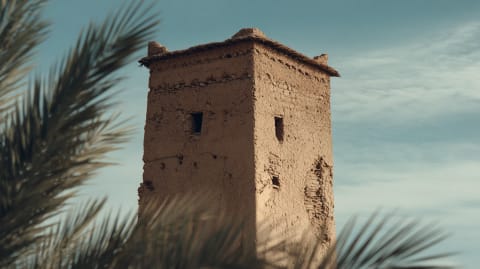
The museum is arranged as a journey. You begin upstairs, in the Atlas, and you travel south — room by room, region by region — along the old caravan route from Marrakech to Timbuktu. The High Atlas and Middle Atlas. The Draa Valley. The Saharan oases. The Tuareg country. Timbuktu. Then back.
Each room represents a region. Each region is represented by its material culture — the objects people made, wore, carried, lived with. A Berber festival tent. Tuareg silver jewellery. A camel saddle. A wedding blanket. Agricultural tools. Clothes worn to ward off spirits. Manuscripts praising the Prophet written by a mystic from Marrakech. The guedra — the trance dance of the southern Sahara — represented through the instruments and costumes that make it possible.
The display cases provide almost no explanatory text. In English, there is none at all. This is not a failure of curation. It is the point. Flint believed the objects spoke for themselves — and that if you needed a label to understand a Tuareg fibula, you were not ready to understand it.
The gift
In 2006, Flint donated both his house and the major part of his collection to the Cadi Ayyad University of Marrakech. The university established the Institut Bert Flint pour le Patrimoine du Nord-Ouest-Africain — the Bert Flint Institute for the Heritage of Northwest Africa. His life's work became an academic institution.
Flint could still be glimpsed on the premises until recently — a quiet, down-to-earth Dutchman among his objects. "If you don't keep your mind and your imagination stimulating," he said, "science becomes a boring kind of imitating each other."
The museum is open daily. Admission is 20 dirhams — less than two euros. The door is on Rue de la Bahia. The sign is small. You will miss it if you are not looking.
Look.
Sources
- Flint, Bert. Collection documentation, Musée Tiskiwin, Marrakech
- Naji, Salima. Art et architectures berbères du Maroc. Édisud, 2001
- Spring, Christopher. North African Textiles. British Museum Press, 1995
Practical questions