Morocco does not have a festival season. It has a festival year. Something is happening somewhere in every month — a rose harvest in May, a Gnawa ceremony in June, a marriage market in September, a film premiere in December. The question is not whether there is a festival during your visit. The question is which one is worth changing your dates for.
This is the calendar. Not the moussems — the local saint-day pilgrimages that number in the thousands and require a separate guide — but the major festivals that are public, accessible, and worth the trip.
January – February
The quiet months. Ramadan may fall here (the dates shift annually with the Islamic lunar calendar). During Ramadan, the rhythm of the entire country changes — restaurants close during daylight, the streets empty at midday, and the nights come alive after iftar. It is not a festival, but it is the most transformative experience Morocco offers. If you are here during Ramadan, do not eat, drink, or smoke in public during fasting hours. After sunset, accept every invitation.
March
The Almond Blossom Festival in Tafraout — a quiet celebration of the almond harvest in the Anti-Atlas. Pink and white blossoms against red granite. Small, local, no international press. Worth the drive.
April
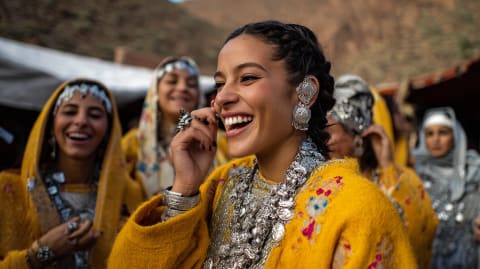
The Ahwach National Festival in Ouarzazate (dates vary). Troupes from across the south — High Atlas, Anti-Atlas, Souss — perform the collective dance that predates every other musical tradition in the country. The staged version, but still powerful. Three days.
May
The Rose Festival in Kelaat M'Gouna. The Dades Valley produces thousands of tonnes of Damask roses each spring, and the harvest is celebrated with a three-day festival — parades, floats, a Rose Queen, and markets overflowing with rosewater, oils, and soaps. The valley is pink. The air smells like the inside of a perfume bottle. Late May, sometimes early June.
The Fes Festival of World Sacred Music (dates shift — sometimes May, sometimes June, sometimes July). Founded in 1994 in the spiritual capital of Morocco. Sufi chanting, gospel, Andalusian orchestras, Indian ragas, and Gregorian plainsong — all performed in the courtyards and gardens of the Fes medina. The main stage is Bab Makina, the old arsenal gate. Tickets for headline concerts go on sale in March. The free daytime programming in the medina is often better than the ticketed shows.
June
The Gnaoua and World Music Festival in Essaouira. Three days. Thirty-plus Gnawa maalems alongside international artists. Jazz, Afrobeat, electronic, and fusion acts collaborate live with the guembri and qraqeb. The main stages are free. VIP passes for premium viewing cost around 1,200 MAD for the three days. The medina fills completely. Book accommodation nine to twelve months ahead. UNESCO inscribed Gnawa culture as Intangible Cultural Heritage in 2019. This festival is the public face of that inscription.
Mawazine in Rabat (late June, sometimes overlapping with Gnaoua). The largest music festival in Africa — 2.5 million attendees across six stages in Rabat and Salé. International headliners (Rihanna, Stevie Wonder, and The Weeknd have all played). Pop, rock, hip-hop, Arabic music, Moroccan chaabi. Free entry to most stages. This is not a cultural festival. It is a citywide party. If that is what you want, it delivers.
The Sefrou Cherry Festival — UNESCO-listed as intangible cultural heritage. A few miles from Fes in the Middle Atlas. Three days celebrating the cherry harvest with parades, traditional dance, food, and sports. A Miss Cherry is crowned. It has been running since 1920.
July
The Festival National des Arts Populaires in Marrakech (early July). Over fifty years old. Troupes from every region of Morocco perform traditional music, dance, acrobatics, and storytelling in the ruins of El Badi Palace. Ahidous from the Middle Atlas. Guedra from the Sahara. Tissint sword dancing from the deep south. The festival the country puts on for itself.
Timitar in Agadir (early July). Amazigh music meets world music on Agadir's coast. Free. Multiple stages. The festival exists to celebrate and preserve indigenous Amazigh culture — rwais ensembles, ahwach troupes, and contemporary Amazigh artists alongside international acts. Smaller than Mawazine, deeper than Mawazine.
The Asilah Arts Festival (July, dates vary). Since 1978, when two young men invited artists to paint the crumbling walls of Asilah, this Atlantic coast town has hosted a cultural festival of murals, exhibitions, performances, and cross-cultural dialogue. The painted walls remain year-round. The festival is the refresh.
August
The Moussem of Moulay Abdellah Amghar near El Jadida. One of the largest moussems in the country — a pilgrimage and festival honouring the local saint. Fantasia displays (horseback charges with synchronised musket fire), markets, music, and food. August heat is extreme. Bring water and shade.
September
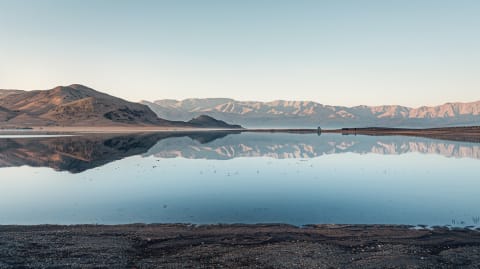
The Imilchil Marriage Festival in the High Atlas. An ancient gathering of three Amazigh tribes near a lake in the Middle Atlas where young people choose partners for marriage. The girls wink. If the man takes her hand, the bond is made. Up to 30,000 people arrive on horses, donkeys, and camels and camp in tents. The festival was once closed to outsiders. It is now open, but it is still remote — reachable only by 4x4. Dates shift with the harvest.
October
The Erfoud Date Festival in the Tafilalet oasis. Three days celebrating the date harvest — the primary crop of southeastern Morocco. Markets, music, camel races, and more dates than you have ever seen in one place. Combine with a desert trip to Erg Chebbi, forty-five minutes south.
November
Jazzablanca in Casablanca (dates shift — sometimes June, sometimes autumn). Morocco's premier jazz festival. Indoor and outdoor stages. International and Moroccan jazz, soul, funk, and fusion. The festival that makes Casablanca culturally relevant for a weekend.
December
The Marrakech International Film Festival (early December). Red carpet, international stars, free outdoor screenings on Jemaa el-Fna. The festival was founded in 2001 and has hosted Scorsese, Coppola, and regional filmmakers. Hotels in Marrakech triple in price. The free screenings in the square — projected on a giant screen, watched from plastic chairs with a bowl of harira — are better than the gala.
The one that moves
Ramadan. The dates shift earlier by roughly eleven days each year. In 2026, Ramadan falls approximately February 18 to March 19. In 2027, it will be earlier still. During Ramadan, most cultural festivals do not take place. But Ramadan itself is the deepest cultural experience Morocco offers — the communal iftar, the night markets, the changed pace, the generosity. It is not a festival. It is a month-long transformation. If you are open to it, plan around it, not away from it.
The rule
The biggest festivals are not the best festivals. Mawazine draws millions. The Rose Festival draws thousands. The Almond Blossom Festival draws hundreds. The quality of the experience is inversely proportional to the size of the crowd. If you want Morocco performing for the world, go to Essaouira in June. If you want Morocco performing for itself, go to Tafraout in March.
Sources
- Moroccan Ministry of Culture. National festival calendar
- UNESCO Intangible Cultural Heritage. Cherry Festival of Sefrou, 2012
- Hammoudi, Abdellah. The Victim and Its Masks. University of Chicago Press, 1993
Practical questions