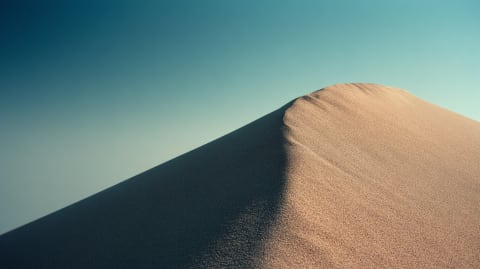
The first thing to know about the Moroccan Sahara is that most of it is not sand. The word Sahara — from the Arabic ṣaḥrāʾ — means desert, not dunes. The vast majority of it is hammada: flat, black, stone-paved nothingness that stretches to the horizon in every direction. The sand dunes — the ones in the photographs — are isolated formations called ergs. Morocco has two major ones. Everything else is rock.
The second thing to know is that there are three gateways, and each one gives you a different desert.
Merzouga — the postcard
Erg Chebbi is the desert most visitors see. The dunes rise 150 metres from the hammada, 22 kilometres long and 5 kilometres wide, glowing orange from iron oxide that has been rusting for millennia. The village of Merzouga sits at the edge. The camel ride to the camp takes about an hour. The sunset from the top of the dunes is the photograph everyone takes. The sunrise the next morning is the photograph everyone keeps.
Merzouga is accessible. The road from Marrakech takes roughly nine hours via the Tizi n'Tichka pass, Ouarzazate, and the Ziz Valley — or you can approach from Fes through Errachidia in about seven hours. The camps range from basic bivouacs to luxury tented lodges with hot showers, king beds, and Berber carpets. The infrastructure exists because the demand exists. Erg Chebbi receives more visitors than any other desert site in Morocco.
This is not a criticism. The dunes are extraordinary. The sand sings — a documented acoustic phenomenon where sliding grains vibrate at frequencies loud enough to hear from a kilometre away. The Gnawa community in nearby Khamlia descends from sub-Saharan Africans who arrived with the trans-Saharan caravans. The seasonal lake, Dayet Srji, fills in wet years and attracts flamingos. The stars at night are as dense as you will see anywhere on earth.
The best months are October to April. Summer temperatures exceed 45°C. If you have one night for the desert, this is where to spend it. If you have more time, keep reading.
Zagora and the Draa — the river
The road south from Ouarzazate crosses the Tizi n'Tichka pass and descends into the Draa Valley — the longest river in Morocco, a corridor of date palms, ksour, and oasis villages running through otherwise barren terrain. The journey from Ouarzazate to Zagora is about 160 kilometres and takes roughly three hours.
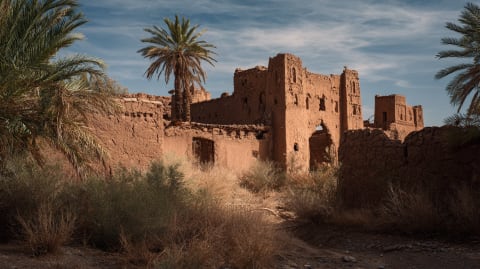
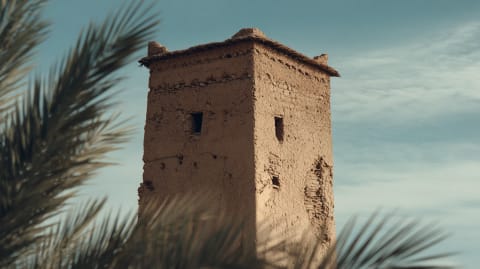
Zagora is not Merzouga. The dunes here are smaller, darker, and less photogenic. But the valley itself is the experience — a million date palms, fortified villages built from the same earth they stand on, and a sense of travelling along a route that caravans have used for a thousand years. The Draa disappears into the sand long before it reaches the sea. The water is there and then it is not.
South of Zagora, Tamegroute houses one of Morocco's most important libraries — manuscripts dating to the 13th century — and a pottery workshop producing the distinctive green-glazed ceramics found across the country. The road continues to M'Hamid, where the tarmac ends and the desert begins properly.
Choose Zagora if you want the valley more than the dunes. The drive from Marrakech is about six hours. The landscape changes every thirty minutes — mountains, river, palms, desert, river again. It is the journey, not just the destination.
M'Hamid and Erg Chigaga — the silence
M'Hamid el Ghizlane is the last town on the N9. South of here, there is no road. Erg Chigaga — the largest sand sea in Morocco — lies roughly 50 kilometres to the southwest, accessible only by 4x4 or camel. The drive takes about five hours over open desert. The camel trek takes two days.
Erg Chigaga is wilder and emptier than Erg Chebbi. The dunes are taller — up to 300 metres. The camps are fewer. The tourists are fewer. The silence is the kind that has weight — you feel it press against your ears. This is the desert that people who have already done Merzouga come back for.
The trade-off is access. M'Hamid is nine to ten hours from Marrakech by road. The last stretch from M'Hamid to Chigaga requires a local driver who knows the unmarked tracks. You cannot do this in a day trip. You should not try. The minimum is two nights — one to get there, one to be there.
What nobody tells you
The camel ride is uncomfortable. This is not an opinion — it is a biomechanical fact. The camel's gait produces a lateral rocking motion that works muscles you did not know you had. An hour is fine. Two hours requires commitment. If you have back problems, ask about 4x4 transfer to the camp and a short camel ride at sunset instead of a full crossing.
The camps vary enormously. A "luxury camp" in Morocco means anything from a genuine tented lodge with plumbing to a concrete room with a tent fabric roof. Ask for photographs. Ask specifically about bathrooms. Ask whether the camp has electricity.
The desert is cold at night. From November to February, temperatures drop near freezing after midnight. Bring layers. The camps provide blankets but not always enough.
The Sahara is not empty. People live here. The nomadic communities around Merzouga and M'Hamid are not a tourist attraction — they are families managing livestock, water, and climate in conditions that are getting harder every year. The last nomads are not a romantic idea. They are people watching their world change.
If someone offers you a sandboarding excursion followed by a quad bike ride across the dunes, you are in the wrong part of the desert. Keep driving.
Which desert?
One night, first time, accessible: Merzouga.
Two to three nights, the valley matters more than the dunes: Zagora and the Draa.
Three nights or more, you want the real emptiness: M'Hamid and Erg Chigaga.
All three are Morocco. None of them are the same desert.
Sources
- Porch, Douglas. The Conquest of the Sahara. Knopf, 1984
- Julien, Charles-André. History of North Africa. Routledge, 1970
- Bovill, E.W. The Golden Trade of the Moors. Oxford University Press, 1968
Practical questions