The diploma is written on a wooden board. It is twelve hundred years old, give or take a decade, and it belongs to the woman who built the place.
Fatima al-Fihri arrived in Fes from Kairouan in the early ninth century with her father and sister. When he died, she and her sister Mariam inherited his fortune. Mariam built the al-Andalusiyyin mosque across the river. Fatima spent her entire inheritance on something larger: a mosque, a madrasa, and what would become the oldest continuously operating educational institution on earth.
Al-Qarawiyyin opened in 859. It was named for Kairouan, the city the family had left. By some accounts, Fatima fasted for the entire eighteen years of construction. She is said to have attended lectures there in her later years. Her diploma — written on that wooden board — is still in the collection.
Whether al-Qarawiyyin is the oldest "university" depends on whom you ask. The Guinness World Records says yes. Many European scholars say no — that the word "university" belongs exclusively to the medieval European model, that Bologna in 1088 holds the title. The argument has been running for decades and will not be settled here. What is not debated: al-Qarawiyyin has been teaching, continuously, for over eleven hundred years. Oxford was founded 237 years later.
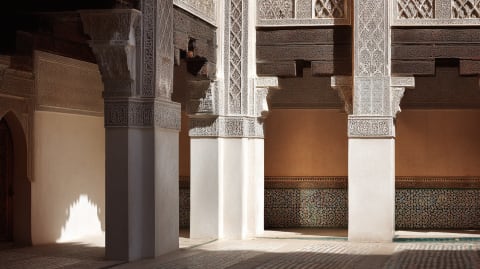
The curriculum started with the Quran and Islamic jurisprudence. It expanded to grammar, mathematics, medicine, astronomy, and philosophy. By the Marinid golden age in the fourteenth century, the reputation drew students from across the Islamic world and beyond. Satellite madrasas — Seffarine, Attarine, Bou Inania — sprouted in the surrounding streets to house the overflow.
The alumni list reads like a syllabus of medieval thought. Ibn Khaldun, often called the father of modern historiography, studied here before writing the Muqaddimah. Leo Africanus — born Ibn al-Wazzan, kidnapped by pirates, presented to the Pope — completed his education at al-Qarawiyyin before writing the most influential description of Africa that Europe had ever read. Maimonides may have studied here during his years in Fes, though the evidence is debated.
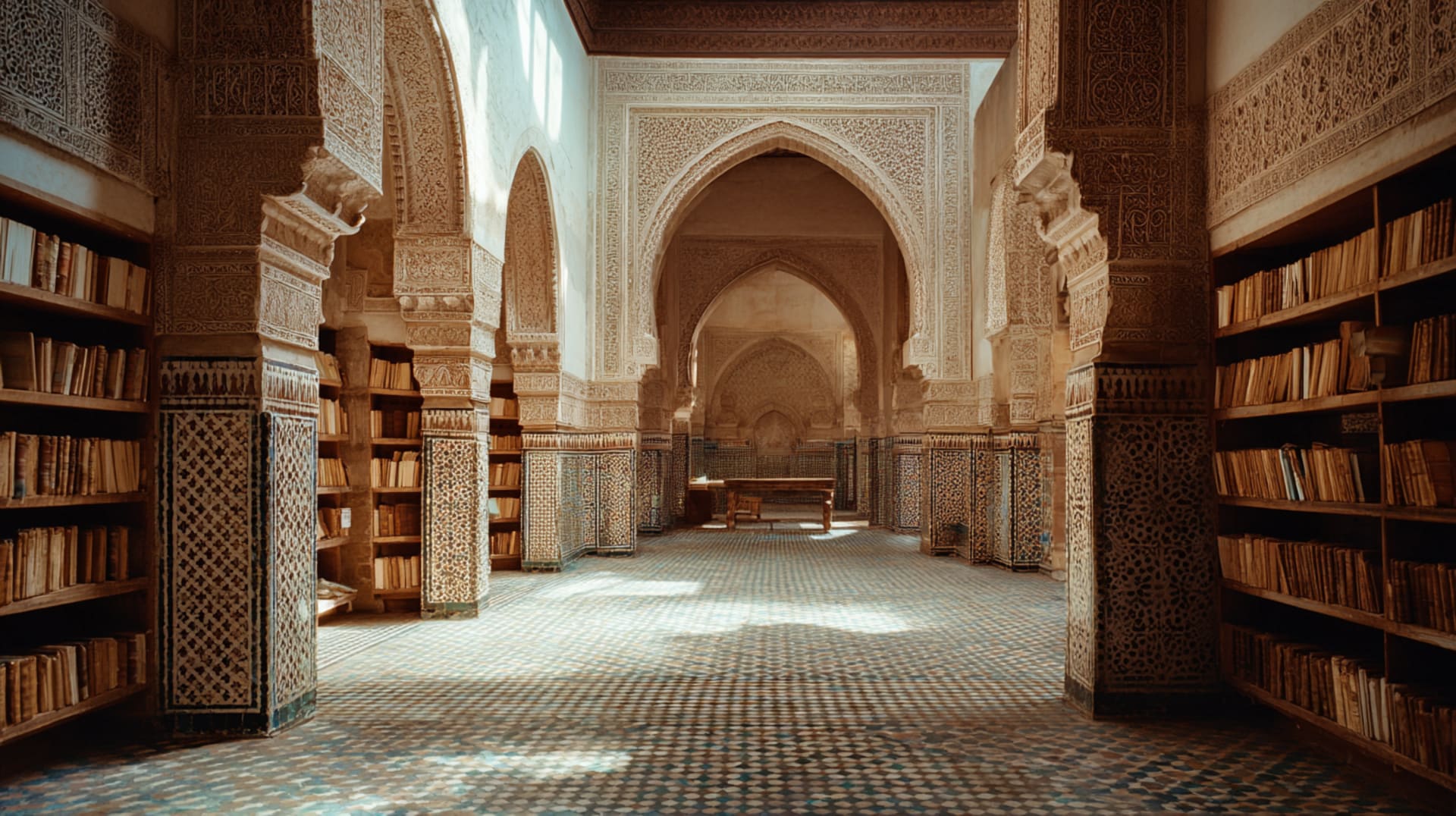
The library came later — formally established by 1359, during the Marinid period. Four thousand manuscripts accumulated over the centuries: a ninth-century Quran, a tenth-century account of the Prophet's life, a twelfth-century medical degree, scientific treatises, astronomical charts, philosophical texts. A fire in 1323 destroyed many of the earliest holdings. What survived was locked behind increasingly heavy doors as the centuries passed.
By the twentieth century, the library was crumbling. Rainwater from the neighbouring mosque's roof had been seeping in for years. Nobody noticed until a stream of water was discovered flowing beneath the floorboards. Rot had reached the foundations. The manuscripts were in danger.
In 2012, the Moroccan Ministry of Culture enlisted Aziza Chaouni, a Canadian-Moroccan architect originally from Fes, to oversee the restoration. She had never heard of the library. Engineers rebuilt the foundations, installed a new sewage system, and re-laid each tile of the iconic green roof by hand. Solar panels went in. A manuscript digitization laboratory was built. Digital locks were added to the rare book room. Air conditioning — the first in twelve centuries — was installed to control humidity.
The library reopened to the public in 2017. Founded by a woman in the ninth century, restored by a woman in the twenty-first. The diploma on the wooden board is still there, behind glass now, in a building that took eighteen years to build and twelve hundred to almost lose.
The oldest library in the world is a twelve-minute walk from Bab Boujloud. It holds a ninth-century Quran and the diploma of the woman who founded it.
Tell us about your trip →The Facts
- —Founded 859 CE by Fatima al-Fihri
- —Oldest continually operating educational institution (Guinness World Records)
- —Library established by 1359, oldest working library in the world
- —4,000+ rare manuscripts including 9th-century Quran
- —Fatima al-Fihri's original diploma: written on a wooden board, still in the collection
- —Notable alumni: Ibn Khaldun, Leo Africanus (Ibn al-Wazzan)
- —Restoration by architect Aziza Chaouni, completed 2016
- —Solar panels, new sewage system, manuscript digitization lab installed
- —A stream of water was found flowing beneath the floorboards during restoration
- —18 separate gates around the mosque perimeter
- —Non-Muslims cannot enter the mosque; library wing opened to public 2017
Sources
- Lulat, Y.G.-M. A History of African Higher Education from Antiquity to the Present. Praeger, 2005
- Makdisi, George. The Rise of Colleges: Institutions of Learning in Islam and the West. Edinburgh University Press, 1981
- UNESCO World Heritage. Medina of Fez, nomination file, 1981
Further Reading
Practical questions