The Marinids had a problem. They were Zenata Berbers from the eastern borderlands who had overthrown the Almohads by force, not by birthright. They could not claim descent from the Prophet. They had no sharifian credentials. In a kingdom where religious legitimacy was the currency of power, they were nouveau riche.
So they built. Between roughly 1271 and 1357, the Marinid sultans commissioned a chain of theological colleges in Fes so lavishly decorated, so extravagantly funded, and so central to the intellectual life of the Islamic world that the question of lineage became, if not irrelevant, at least secondary.
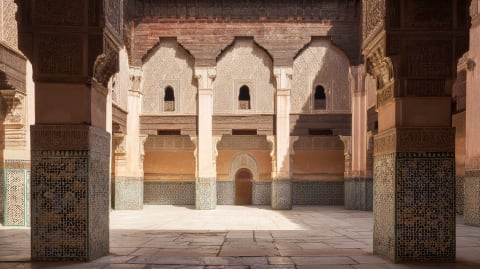
The plan was always the same. A central courtyard, open to the sky. A fountain — marble, usually — in the centre. A prayer hall on the qibla wall, facing Mecca. And stacked above, on two or sometimes three floors, the student cells. Each one two or three square metres. Barely room for a mattress and a lamp. The contrast was the point: the public spaces were paradise on earth, and the private spaces were monastic.
The Seffarine Madrasa, completed in 1271, was the first. It sits on Seffarine Square, where the coppersmiths still hammer brass trays with the same rhythm they have used for seven centuries. The building is austere by later standards — a rehearsal for what came next.
The Sahrij Madrasa, built in 1321, introduced the feature that gives it its name: a large marble basin in the courtyard. The water was not decorative. Students performed ablutions here before prayer, and the sound of running water masked the noise of the medina outside. The building sits behind an unmarked door in a narrow alley. You can walk past it a hundred times and not know it is there.
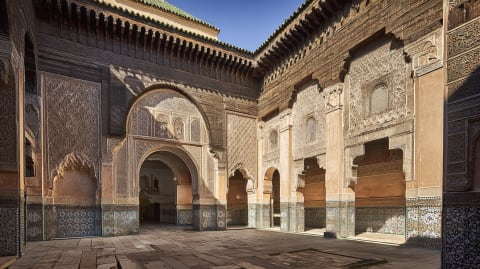
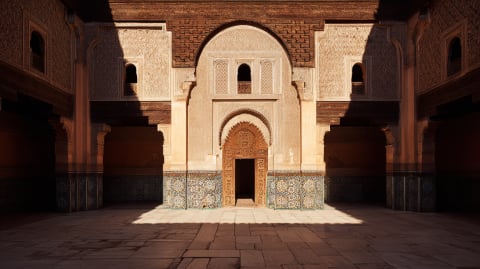
Al-Attarine, completed in 1325 by Sultan Abu Said Uthman, is where the Marinid style reaches maturity. The carved stucco on the walls is so fine it looks like lace. The zellige tilework on the floor contains geometric patterns that mathematicians have spent decades analysing — every one of the seventeen possible wallpaper symmetry groups is represented somewhere in Fes, and many of them are in this single courtyard. The cedar ceiling is carved and painted in polychrome. The onyx marble columns frame a view of the courtyard fountain that is calculated to the centimetre.
And then there is Bou Inania.
Sultan Abu Inan Faris was twenty-two when he seized the throne from his own father. He was violent, ambitious, and determined to leave a mark. The madrasa he built between 1351 and 1356 is the largest and most ornate of all the Marinid colleges — and the only one in Fes with its own minbar, the pulpit that designates a Friday mosque. This was a statement: Bou Inania was not just a school but a place of congregational prayer, rivalling al-Qarawiyyin itself.
The interior is overwhelming. Floor-to-ceiling zellige in the courtyard. Above that, carved stucco. Above that, carved cedar. Above that, a green-tiled roof. The water channel that bisects the courtyard is lined with marble. The bronze doors are original. The effect is of walking into a jewellery box the size of a house.
A famous story, possibly apocryphal, says that when Abu Inan saw the bill for the construction, he threw the accounts into the river, saying: "A thing of beauty is beyond reckoning."
The irony is upstairs. The student cells — dozens of them, stacked along narrow corridors — are bare, cramped, and dark. Two or three square metres per student. A window if you were lucky. A shared latrine at the end of the hall. The young scholars who came from across the Maghreb to study at the feet of Fes's greatest teachers lived in conditions that would embarrass a modern prison. The magnificence was not for them. It was for God, and for the sultan's reputation.
The Marinids fell in 1465. The madrasas they built survived. Bou Inania is one of the few religious buildings in Fes open to non-Muslim visitors, and the reason is practical: it is impossible to keep people out of a building that beautiful on a street that busy. Al-Attarine reopened after restoration. The Seffarine still sits on its square, the hammering still audible from the courtyard.
A dynasty with no lineage, compensating with geometry, carved cedar, and the most elegant schools in the Islamic world. The students are gone. The zellige is still on the floor, every tessellation in place, seven hundred years later.
The Marinid madrasas are open to non-Muslim visitors — carved cedar, zellige floors, marble fountains. The students' cells upstairs are the size of cupboards.
Tell us about your trip →The Facts
- —Marinid dynasty: c. 1244-1465
- —Bou Inania Madrasa: built 1351-1356 by Sultan Abu Inan Faris
- —Al-Attarine Madrasa: completed 1325 by Sultan Abu Said Uthman
- —Seffarine Madrasa: built 1271, oldest Marinid madrasa in Fes
- —Sahrij Madrasa: built 1321, named for its marble basin
- —Sbiaiyin Madrasa: 14th century, near Seffarine square
- —All follow same plan: courtyard, fountain, prayer hall, student cells
- —Student cells: 2-3 square metres, stacked on upper floors
- —Bou Inania: only Fes madrasa with its own minbar (pulpit) — functioned as Friday mosque
- —Decoration: carved cedar ceilings, chiselled stucco, zellige tilework, marble columns
- —Marinids were Zenata Berbers — no sharifian lineage
- —Built madrasas to legitimise rule through patronage of religion and learning
- —17 mathematical wallpaper groups all represented in Fes zellige
Sources
- Marçais, Georges. L'architecture musulmane d'occident. Arts et Métiers Graphiques, 1954
- Salmon, Xavier. Maroc Almoravide et Almohade. Musée du Louvre/Hazan, 2018
- Terrasse, Henri. L'art hispano-mauresque des origines au XIIIe siècle. Van Oest, 1932
Further Reading
Practical questions