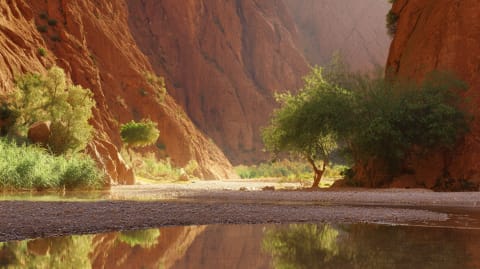
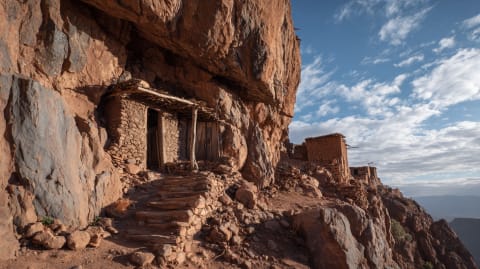
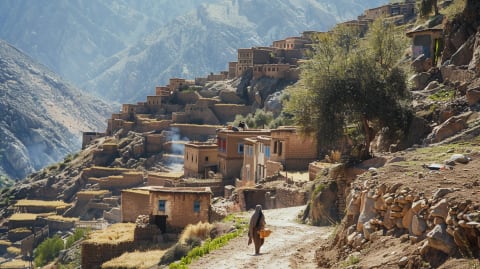
The square is called assarag. Every Amazigh village has one — a flat clearing of packed earth, sometimes between houses, sometimes at the edge of the settlement where the terraces drop toward the valley. There is no stage. There is no electricity. There are no microphones. When night falls and the circle forms, the only technology is the human body and a stretched goatskin.
Ahwach is the oldest continuous musical tradition in Morocco. It was here before the Gnawa — who arrived with the trans-Saharan caravans. It was here before the Arabs — who arrived in the 7th century. It was here before Islam. The circle was forming on these mountains when Rome was still a village on the Tiber.
What it is
Men gather at the centre of the assarag in white djellabas and turbans, carrying frame drums — the bendir, fitted with gut strings that buzz against the membrane, and the taguenza, a larger drum covered in sheepskin. A metal percussion instrument called the naqous adds a sharp bell-like ring. One man cups his hand to his mouth and sings the opening chant — the anksalim — a single voice, raw and unaccompanied, calling the circle into existence.
Women form around the men. They wear white, pink, or blue robes, heads wrapped in fringed scarves, silver Amazigh jewellery at their throats and wrists. When the drums begin, the women move — not choreography learned from a teacher but movement passed from grandmother to mother to daughter, a slow undulation that rises from the hips and the shoulders, synchronised not by instruction but by rhythm. The circle breathes together.
The drumming builds. The call-and-response multiplies. Twenty voices become fifty. Fifty become a hundred and fifty — in some villages, the entire community enters the assarag. The poetry that rides the rhythm is improvised on the spot by the amydaz — the poet — who composes in Tachelhit, the Amazigh language of the mountains. Love. Betrayal. The harvest. The rain. The memory of someone who left. The hope that someone will return. The themes are universal. The language is specific. The words are born in the circle and die when the circle ends. Nothing is written down.
What it does
Ahwach is not a performance. There is no audience. Everyone inside the assarag is a participant. The separation between watcher and watched — the thing that defines Western music, the thing that puts seats in rows facing a stage — does not exist. The circle faces inward. The sound stays inside.
The rhythm accumulates. An hour in, the drums have locked into a polyrhythmic pattern that the body responds to before the mind registers. Two hours in, the synchronisation of a hundred people moving, breathing, and singing together produces something that the French anthropologists who first documented it called "collective trance" — and that the Amazigh, who have been doing it for millennia, do not call anything at all. It simply happens. The circle takes you.
Very religious Moroccans sometimes choose not to participate. They believe the devil enters the ahwach. The Amazigh themselves acknowledge a supernatural dimension — there are stories from villages across the south of performers who became clairvoyant during the circle, who saw things they should not have been able to see. The pre-Islamic roots are visible to anyone who looks: the circle formation, the mixed-gender participation, the connection to fertility and harvest, the spiritual charge of the rhythm. Islam absorbed ahwach rather than erasing it. The poetry now references saints alongside older themes. But the circle was there first.
Where it lives
The High Atlas. The Anti-Atlas. The Souss Valley. The regions around Ouarzazate, Taroudant, Tafraout, Kelaat M'Gouna, Tata, and Telouet. Each village has its own variation — the drumming patterns differ, the poetry styles differ, the choreography differs. Ahwach cannot be standardised because it was never centralised. It belongs to each community independently, developed in isolation across centuries of mountain geography. Moving a hundred and fifty performers to a festival stage defeats the purpose. The assarag is not a venue. It is the village speaking to itself.
The Glaoui lords — the powerful caids who controlled southeastern Morocco during the colonial period — were devoted patrons of ahwach. The kasbahs of Telouet and Tifoultoute hosted elaborate performances. The Glaoui chiefs personally dictated the rules and acted as conductors. Their wives watched from behind the carved wooden screens of the upper windows. The troupes from these kasbahs are still among the most renowned specialists.
What it is not
It is not belly dancing. Belly dancing is Egyptian. It arrived in Morocco through film and television. The Amazigh women of the Atlas do not belly dance. They move from the shoulders, from the hips, in synchronisation with a hundred other women, inside a circle of drums, under stars, on earth.
It is not the Gnawa. The Gnawa tradition — the guembri, the qraqeb, the Lila ceremony — came from sub-Saharan Africa with the trans-Saharan slave trade. It is beautiful, powerful, and important. It is not indigenous to Morocco. Ahwach is.
It is not entertainment. The National Festival of Ahwach Arts takes place annually in Ouarzazate, and performances appear at moussems and cultural events. But ahwach staged for an audience is ahwach with its heart removed. The form survives. The function does not. When a hundred villagers stand in a circle at midnight in an assarag with no lights and no microphones and no tourists, the thing that happens in that circle is not the same thing that happens on a festival stage. Both are called ahwach. Only one of them is.
If you want to see it — the real thing, not the staged version — you need an invitation. A wedding, a harvest celebration, a moussem in a mountain village. You need to be there because someone brought you, not because you bought a ticket. And when the circle forms, you do not watch. You step in.
Sources
- Schuyler, Philip D. "Music and Meaning Among the Gnawa of Morocco." The World of Music, 1981
- El Hamel, Chouki. Black Morocco: A History of Slavery, Race, and Islam. Cambridge University Press, 2013
- Pâques, Viviane. L'arbre cosmique dans la pensée populaire et dans la vie quotidienne du nord-ouest africain. Institut d'Ethnologie, 1964
- Kapchan, Deborah. Traveling Spirit Masters: Moroccan Gnawa Trance and Music in the Global Marketplace. Wesleyan University Press, 2007.
Practical questions