Design
The Green No One Can Replicate
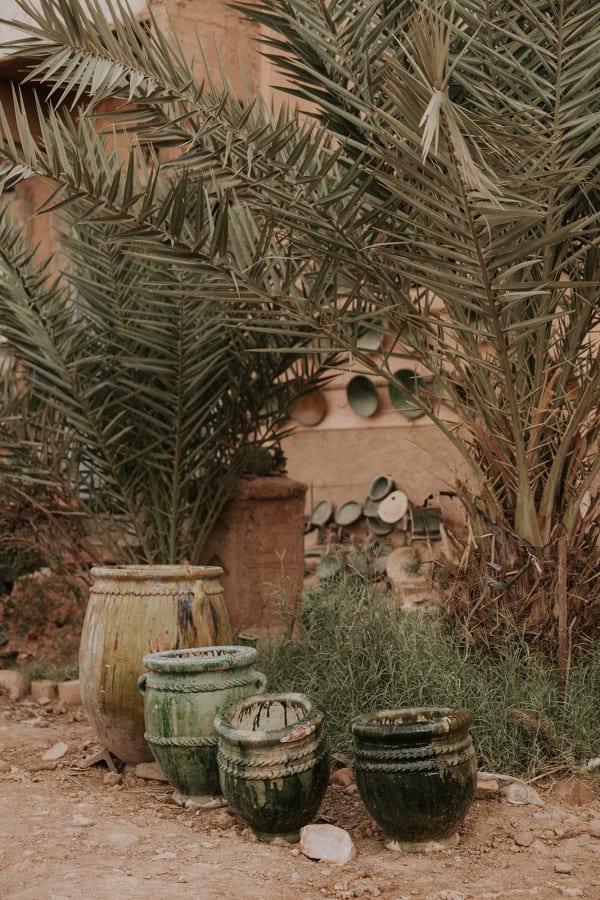
The green is like nothing else. No two pieces match. The glaze formula has stayed in one family for four hundred years at the end of the salt road.

Tamegroute is a small town in the Draa Valley, 18 kilometres south of Zagora. Its importance far exceeds its size. The Zawiya Nassiriya — a religious brotherhood founded in the 17th century — established a library here that once held thousands of manuscripts, including Qurans written on gazelle skin, astronomical treatises, and works of Sufi philosophy. A selection is displayed in a small museum. The pages are illuminated in gold and lapis lazuli.
The pottery cooperative in Tamegroute produces the distinctive green-glazed ceramics seen across Morocco — bowls, tagines, vases, and candlesticks in a green that comes from a mix of manganese, copper, and silica unique to the local soil. The kilns are open to visitors. The potters work by hand on foot-powered wheels.
Tamegroute is a stop on the road between Zagora and M'Hamid, and most visitors pass through in 30 minutes. The library and the pottery are the reasons to stop. The zawiya — still an active religious centre — gives the town a quiet gravity that the nearby tourist camps at Zagora do not have.
Places
Monuments
A desert library at the edge of the Sahara holding 13th-century manuscripts on medicine, astronomy, and Islamic law. Still consulted. Still functioning.
Workshops
The only source of Tamegroute green — a copper glaze fired in underground kilns at the edge of the desert.
Stories from Tamegroute
Design
The green is like nothing else. No two pieces match. The glaze formula has stayed in one family for four hundred years at the end of the salt road.

Architecture
Every colour in Morocco has a source — a plant, a mineral, a place. The colours are not chosen. They are grown, mined, and extracted.

Craft
Every Moroccan city produces pottery. No two cities produce the same pottery. The clay, the glaze, the firing, and the decoration are all regional signatures.

Sacred
Walk any Moroccan medina and you will pass a dozen zaouias without knowing it. A green-tiled dome. The scent of incense through a half-open door. A brass bar across the threshold that non-Muslims cannot cross. Behind it, twelve centuries of parallel power.
Plan your visit
Every journey we design includes private guiding, accommodation chosen for character rather than category, and the kind of access that takes years in Morocco to arrange.
Plan Your TripWritten from the medina. Sent when it matters.