Majorelle Blue is hex #6050DC. That is a fact you can look up. What you cannot look up is the feeling of seeing it for the first time — a cobalt so saturated it seems to vibrate against the terracotta of Marrakech, as if the wall is generating its own electricity.
Jacques Majorelle mixed it himself in the 1930s for his studio walls. After Yves Saint Laurent bought the garden in 1980, the blue escaped into the city's identity. It is now the most photographed colour in Morocco, which is saying something for a country that treats colour the way other countries treat infrastructure — seriously, specifically, and with centuries of practice.
Tamegroute green comes from a village 22 kilometres south of Zagora, where potters have produced distinctive green-glazed ceramics for centuries. The green is copper oxide, fired in a wood kiln. The glaze is imperfect by design — crackled, uneven, no two pieces matching. Mass production could replicate the colour. It could not replicate the crackle. The imperfection is the signature.
Saffron yellow comes from Taliouine. The crocus stigmas, when dried, produce a colour so intense that a single gram can tint a litre of water. Saffron has served as textile dye, food colourant, and manuscript pigment. The colour sits between gold and amber — warm, fugitive, meaning it fades with light exposure. The most expensive colour in Morocco is also the most ephemeral, which feels like something a poet would have arranged on purpose.
Henna red is vegetal. The Lawsonia inermis shrub grows in the Draa Valley and the Souss. Leaves dried, ground to powder, mixed with water — the paste stains skin through a chemical called lawsone, a naphthoquinone that bonds with keratin. The colour deepens over 24 to 48 hours, from bright orange to reddish brown. A bride's hands on the morning of her wedding are a different colour than they were the night the henna was applied. The chemistry has better timing than most wedding planners.
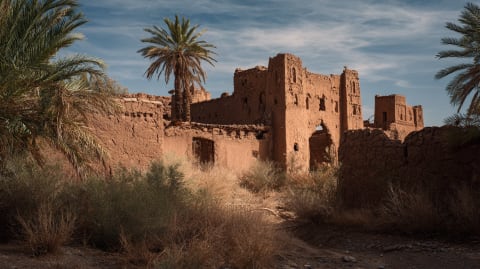
Marrakech itself is a colour — the terracotta pink of its ramparts and buildings. The pigment is the earth: iron-rich red clay mixed into the plaster. A city regulation requires buildings in the medina to maintain the palette. The colour is not paint. It is the ground, pushed upward into walls, and the walls returning slowly to ground. The city is the same material as the land beneath it, which is why it looks, from the air, like something that grew rather than something that was built.
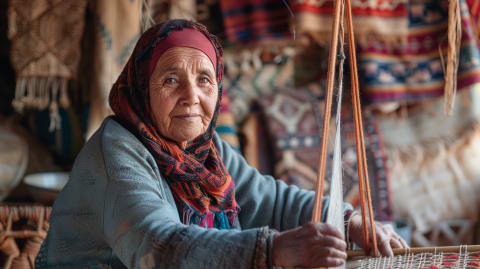
Indigo — the deep blue of Saharan robes and Tuareg veils — comes from the Indigofera plant. The dye bonds with fibre at the molecular level, becoming part of the cloth rather than sitting on its surface. Over time, the colour transfers to the wearer's skin. A Tuareg man's blueness is his wealth, worn not on his wrist but in his body. The most intimate colour in Morocco is the one you cannot wash off.
Every city has a colour. We design journeys that cross them — Marrakech ochre to Chefchaouen blue to Fes tannery brown. The palette is the itinerary.
Tell us about your trip →Data and visualisation by Dancing with Lions
The Facts
- —Marrakech: red (pisé walls, local earth)
- —Chefchaouen: blue (multiple origin theories — Jewish, anti-mosquito, aesthetic)
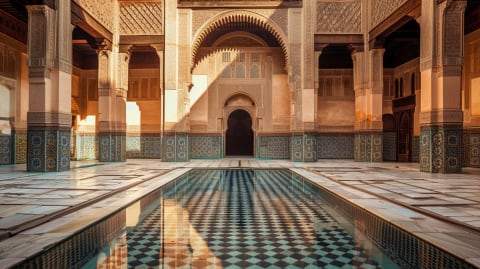
- —Fes: blue-white (zellige tiles)
- —Casablanca: white (Art Deco whitewash)
- —Green: colour of Islam, royal colour
- —Saffron yellow: Taliouine
- —Tamegroute green: distinctive pottery glaze
- —Indigo: Tuareg/Saharan tradition
Sources
- Parker, Richard. A Practical Guide to Islamic Monuments in Morocco. Baraka Press, 1981
- Touri, Abdelaziz & Benaboud, Mhammad. Patrimoines du Maroc. UNESCO/Ministry of Culture
- Fili, Abdallah & Messier, Ronald. "The Earliest Ceramics of Sijilmasa." In The Archaeology of Medieval Islamic Frontiers
Practical questions