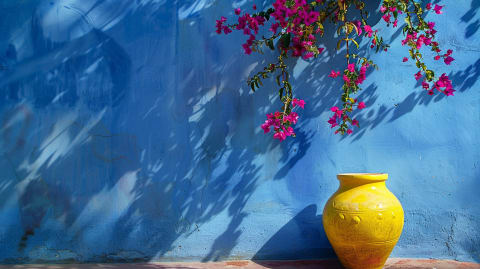
The blue has no other name. It's just Majorelle Blue.
Jacques Majorelle arrived in Marrakech in 1919, a French painter looking for light and cheap living. He found both. He bought a palm grove at the edge of the medina and started building — not a house, but a world. Cacti from Mexico. Bamboo from China. Bougainvillea from Brazil. Water channels, pathways, an Art Deco studio where he painted the Berber scenes that paid the bills.
And everywhere, that blue.
Majorelle mixed it himself — a cobalt so saturated it seems to vibrate. He painted the walls, the planters, the studio, the fountains. Against the terracotta of Marrakech and the green of his jungle, the blue was electric. It wasn't Moroccan. It wasn't French. It was his.
The garden consumed him. Forty years of obsessive cultivation. Every franc from his paintings went back into plants, water, maintenance. When his marriage collapsed and his health failed, there was nothing left but the garden. He opened it to visitors, charged admission, tried to hold on. A car accident in 1955 cost him his left leg. A second accident in 1962 sent him to Paris for treatment, where he died. He went back to France and died broke.
The garden began to die with him.
By the 1980s, it was overgrown, crumbling, slated for demolition. A hotel developer had plans. Then two men intervened: Yves Saint Laurent and his partner Pierre Bergé. They'd visited Marrakech, fallen for the city, and heard about the garden. In 1980, they bought it — reportedly for around $60,000, the price of a Paris apartment.
They restored everything. The blue was remixed to Majorelle's original formula. The plants were nursed back. The studio became a museum of Berber culture. When Saint Laurent died in 2008, his ashes were scattered in the garden.
Today, Majorelle Garden is the most visited site in Morocco — over 700,000 people a year. They come for the blue, for the peace, for the Instagram shots. They're walking through one man's obsession, saved by another man's wealth, preserved in a color that exists nowhere else on earth.
Majorelle died penniless. His blue is immortal.
Majorelle is best at opening time, before the queues. We arrange early entries when possible, or skip the garden and visit the Berber Museum instead.
Tell us about your trip →The Facts
- —Jacques Majorelle arrived in Marrakech in 1919
- —He opened the garden to the public in 1947
- —Majorelle died in Paris in 1962
- —Yves Saint Laurent and Pierre Bergé bought the garden in 1980
- —Saint Laurent's ashes were scattered there in 2008
- —Over 900,000 people visit annually — Morocco's most visited attraction
- —The Berber Museum opened in the studio in 2011
- —YSL created entire fashion collections using colors taken directly from the garden
Sources
- Wilbaux, Quentin. La médina de Marrakech. L'Harmattan, 2001
- McLeod, Madison. Pierre Bergé & Yves Saint Laurent in Morocco. Abrams, 2017
- Majorelle, Louis. Aquarelles marocaines. Self-published, 1922