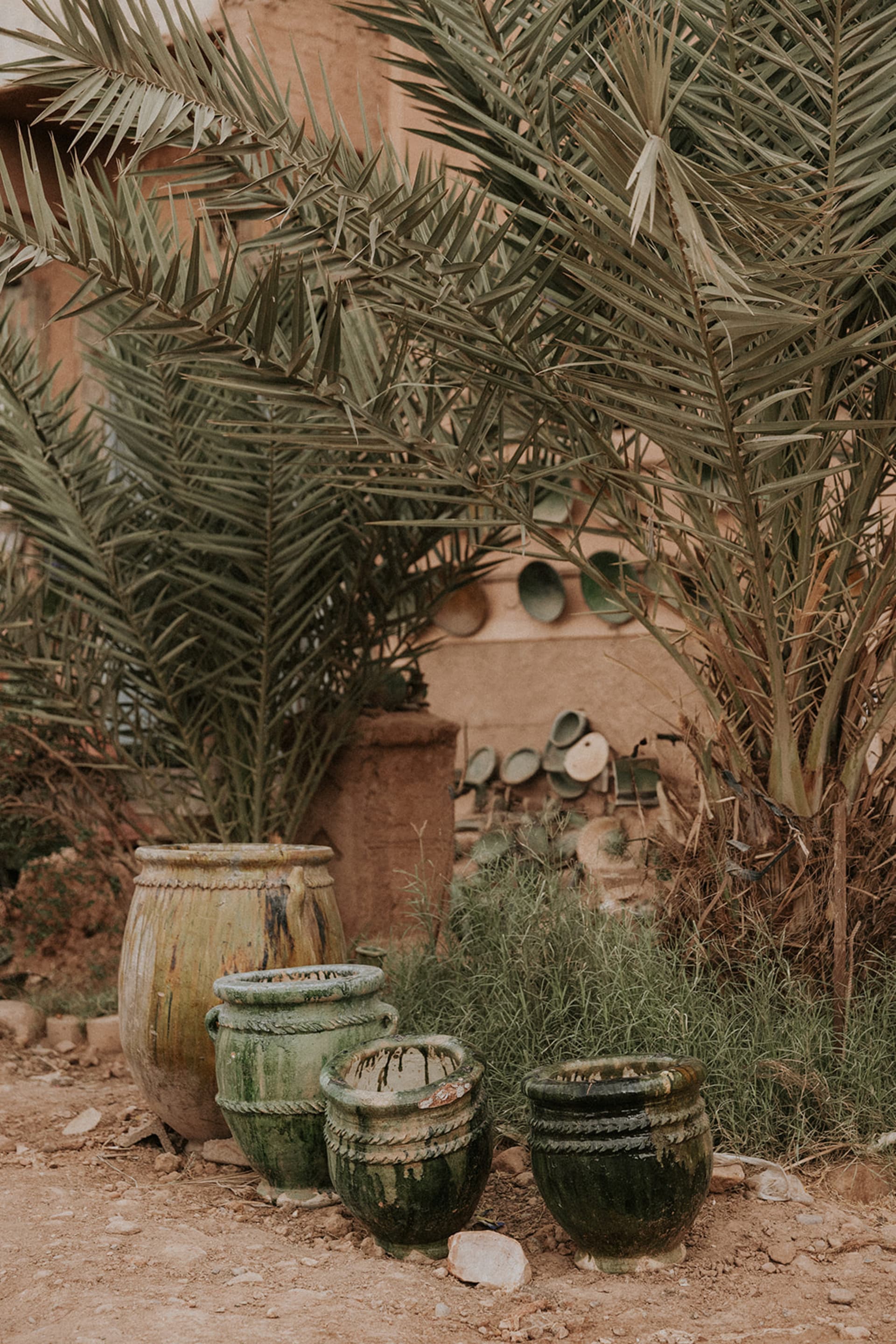
The green is like nothing else — deep, uneven, alive. No two pieces match. The secret is in the glaze, and the secret has stayed in one family for four hundred years. This is not a brand strategy. This is a village.
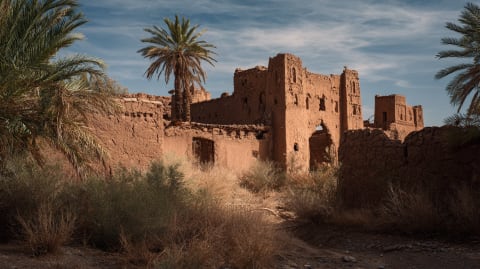
Tamegroute sits at the end of the salt road, where the Draa Valley gives way to the Sahara. For centuries it was a stopover for caravans — a place to rest, pray at the ancient library, and buy pottery for the long journey ahead. The green-glazed ceramics of Tamegroute were traded across Africa and into Europe by people who had no idea the colour would one day appear on Pinterest mood boards, and would not have cared if they had.
The technique is closely guarded. The base clay comes from the valley, shaped by hand on kick wheels that haven't changed in design since the Middle Ages. The forms are simple — bowls, plates, tagines, storage jars. Nothing delicate. These are objects built to survive rough use in harsh conditions, and they look like it, which is their beauty.
The magic is the glaze. A mixture of copper oxide, silica, and compounds whose exact proportions are family secrets produces a green that shifts from jade to turquoise to emerald depending on the firing. The colour is never uniform — it pools in depressions, thins on curves, breaks over edges. Each piece is unique because the chemistry is too complex to control perfectly, and the imperfection is the whole point. A perfectly uniform Tamegroute bowl would be a contradiction in terms.
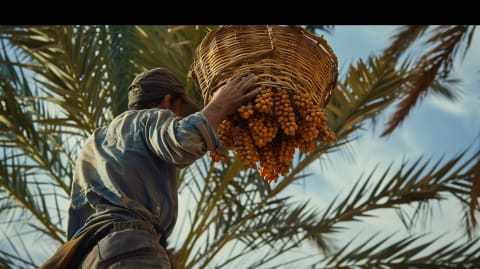
Only a handful of families still work in the traditional way. Their kilns are mud structures built into hillsides, fired with palm fronds and olive pits. The temperature is judged by eye. The results are judged by four centuries of accumulated opinion. International designers now commission Tamegroute pieces for luxury interiors, which means that a glaze developed for camel caravans is now sitting on shelves in apartments that cost more than the village. The potters find this amusing. The green doesn't care where it ends up. It is the same green either way.
The green pottery of Tamegroute is fired once in a kiln that has been burning for four centuries. The workshop is on the route.
Tell us about your trip →The Facts
- —Production dates to at least 17th century
- —Green glaze from copper oxide mixture (exact formula secret)
- —Clay sourced locally from Draa Valley
- —Traditional kilns fired with palm fronds and olive pits
- —Associated library contains 4,000+ manuscripts
- —One of the last centers of traditional green-glaze pottery
- —Each piece unique due to variable kiln conditions
- —Exported historically via trans-Saharan trade
Sources
- Paccard, André. Traditional Islamic Craft in Moroccan Architecture. Éditions Atelier 74, 1980
- Naji, Salima. Art et architectures berbères du Maroc. Édisud, 2001
- Degeorge, Gérard & Porter, Yves. The Art of the Islamic Tile. Flammarion, 2002