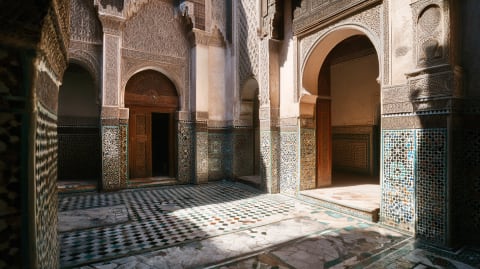
The word means "corner" in Arabic — zawiya, a nook, a retreat. It was first used for the cells of Christian monks. Then it was borrowed for small prayer rooms, and then for the places where Sufi masters gathered their students, and then for the buildings that grew around the tombs of those masters after they died. In Morocco, the zaouia became something that exists nowhere else in quite the same form: part shrine, part school, part hostel, part grain store, part court of arbitration, part political headquarters. A zaouia could feed you, teach you, shelter you, judge your dispute with your neighbour, and connect you to a chain of spiritual transmission reaching back to the Prophet. All from one building. All from one saint's grave.
By the fifteenth century, they covered the country. Not as isolated shrines — as a network. A system running parallel to the state, sometimes supporting it, sometimes replacing it, occasionally threatening to overthrow it entirely.
The deal
The relationship between the throne and the zaouias has followed one rule since the Alaouites took power in the seventeenth century: you may have spiritual authority, or political authority. Not both.
The Dila'iyya tried for both. They were a Sufi brotherhood of Sanhaja Berbers in the Middle Atlas — originally a modest zawiya founded around 1566 near the village of M'ammar. By the 1630s, as the Saadian dynasty collapsed and Morocco fractured into warring factions, the Dila'iyya filled the vacuum. They built walls around their zawiya, added palaces and mosques, accumulated a library that scholars travelled from the cities to consult. By 1641, they controlled Fes. They conducted foreign diplomacy — signing a treaty with the Dutch in 1651. They ran, for all practical purposes, a state.
Moulay Rashid, the first effective Alaouite sultan, ended it in 1668. He marched into the Middle Atlas, defeated the Dila'iyya army at Fezzaz — half the opposing troops defected before the battle began — sent the Dilaite leader into exile in Tlemcen, relocated the zawiya's inhabitants to Fes, and razed the building to the ground. The message was not subtle: the zaouias could pray, teach, heal, and bury their dead. They could not govern.
Every brotherhood since has understood the terms.
The seven saints
Moulay Ismail, who succeeded Moulay Rashid, went further. He did not merely suppress the zaouias' political ambitions — he co-opted their spiritual power. In the late seventeenth century, he created the pilgrimage of the Seven Saints of Marrakech: seven tombs, seven days, a sacred circuit through the medina. Sidi Bel Abbes, the blind saint and patron of the city, whose zawiya in the northern medina had been a centre of devotion for centuries. Al-Jazuli, the Sufi poet whose body was exhumed and transferred from a village burial to a grand Marrakech tomb by the Saadians a century earlier. Five others, each chosen with care.
The motivation was political. The Regraga, a Berber tribe near Essaouira, had their own "seven saints" and their own pilgrimage, attracting followers the monarchy could not control. Moulay Ismail's answer was to create a rival circuit — urban, Arab-rooted, royally sanctioned. He charged a Berber scholar named Abu Ali al-Hasan al-Yusi, a man who knew the zaouias from the inside, with establishing it. The pilgrimage worked. It made Marrakech a spiritual capital, not just a political one. Three centuries later, the circuit is still walked.
The root system
Most Moroccan Sufi orders branch from a single root. Abu al-Hasan al-Shadhili, a Moroccan who died in Tunisia in 1258, founded the Shadhiliyya — and from it grew the Jazuliyya, the Darqawiyya, the Nasiriyya, the Wazzaniyya. The other major trunk runs through Baghdad: the Qadiriyya, from which the Boutchichiyya eventually branched. Each order has a silsila — a chain of transmission, teacher to student, stretching back to the Prophet through an unbroken line. The chain is everything. Without it, a shaykh is just a man with opinions.
The Tijaniyya stands apart. Founded in Fes in 1784 by Ahmad al-Tijani, it forbids its followers from belonging to any other order — unusual in a landscape where multiple affiliations were common. It spread south through the Saharan trade routes into West Africa and took root. Today, its followers number upward of 300 million, most of them in Senegal, Nigeria, and across the Sahel. The tomb of Ahmad al-Tijani in Fes draws tens of thousands of West African pilgrims every year. Many don Moroccan clothing before entering the zawiya. Many visit the tombs of former Moroccan kings as well, treating them as saints descended from the Prophet.
There is an irony that locals in Fes notice: the Tijaniyya zawiya, built by a man they consider Moroccan, is visited overwhelmingly by people they consider foreign. The neighbourhood around it has adapted — West African restaurants, Senegalese tailors, currency exchange shops — but the disconnect between the pilgrims' devotion and the residents' indifference is something scholars have documented and nobody has quite resolved.
The library in the desert
In Tamegrout, at the edge of the Draa Valley where the road runs out and the Sahara begins, the Nasiriyya zaouia holds a library that most visitors walk past in twenty minutes without understanding what they have seen. Four thousand manuscripts. Illuminated Qurans from the twelfth century. A Pythagorean text translated into Arabic. Medical treatises. Star charts. Works on astronomy, mathematics, jurisprudence. The pages are kept in a dimly lit room, open to anyone who asks, and the guardian will turn them for you with bare hands while traffic passes on the road outside.
The Nasiriyya were founded around 1640 by Muhammad ibn Nasir, a young imam from a small village upstream who walked to Tamegrout to study with the Sufi master there. He stayed. His descendants built the zaouia into a centre of learning that radiated across the Sahara — its scholars carried manuscripts to Timbuktu, its shaykhs mediated between the sultan's armies and the desert tribes. When the sultan's military expeditions pushed south, a Nasiri shaykh often accompanied them as a political advisor, negotiating with the tribes so the army wouldn't have to fight.
The 2003 pivot
For most of the twentieth century, Sufism in Morocco occupied a quiet middle ground — tolerated, occasionally patronised, never central. The French protectorate had confiscated many zaouia properties and marginalised the system that funded them. Independence brought secular nationalism. The brotherhoods survived but their political influence faded.
Then came May 16, 2003. Fourteen suicide bombers attacked five targets in Casablanca. Forty-five people died, including the bombers. The perpetrators were young, poor, radicalised by Salafi preachers in the shantytown of Sidi Moumen. Mohammed VI's response was to reshape Moroccan Islam — and the zaouias became strategic.
The Boutchichiyya, a Qadiri order based in the village of Madagh near Berkane, became the monarchy's preferred instrument. Their shaykh, Sidi Hamza, attracted educated, urban followers — doctors, lawyers, engineers — who practised a Sufism that looked modern and moderate. The Minister of Islamic Affairs was a Boutchichi disciple. State-regulated imam training programmes were expanded. Sufism went from tolerated to promoted, from heritage to policy.
Morocco now uses the Tijaniyya as its primary vector of religious diplomacy in sub-Saharan Africa. The Mohammed VI Foundation of African Ulema operates through Tijani networks. Moroccan-funded mosques and religious schools follow the same routes the Tijani missionaries walked two centuries ago. Soft power through spiritual kinship — and the zaouias, which once threatened the throne, now extend its reach across a continent.
The Gnawa exception
The Gnawa are not a tariqa in the classical sense. They have no single founder, no unified doctrine, no silsila tracing back through an unbroken chain of masters. What they have is a memory. Sub-Saharan Africans — enslaved, transported to Morocco over centuries — who carried their rhythms, their spirits, their healing practices into a new land and wove them into the fabric of Moroccan Islam. The guembri and the qraqeb are the sound of that history. The lila ceremony, running from sunset to sunrise through seven suites of spirits each identified by colour, is the ritual. UNESCO recognised it in 2019. The monarchy embraces it. The tourists come for the music.
But the Gnawa occupy a space that the classical zaouia system never quite made room for. They are too African for the Arab orders, too Islamic for the ethnomusicologists, too spiritual for the concert stage, and too popular to ignore. They are the exception that proves the rule of Moroccan sacred geography: that power and faith have always negotiated, always accommodated, always found a way to coexist — even when the terms were imposed by the stronger party.
The map
Walk through Marrakech and the green domes appear and disappear between the rooftops. Sidi Bel Abbes in the north. The Jazuliyya south of the Mouassine. The tomb of Sidi Abdelaziz Tebba'a tucked near the fountain. In Fes, the zaouia of Moulay Idris II — rebuilt lavishly by Moulay Ismail — anchors the old city. The Tijaniyya zawiya nearby fills with West African voices. In Meknes, the Aissawa, founded around 1500 by Muhammad ibn Issa, still gather for ecstatic dhikr. In Ouazzane, the Wazzaniyya. In the Middle Atlas, the ghost of the Dila'iyya, razed but not forgotten.
The network is invisible to most visitors. It has no signage, no visitor centres, no audioguides. It predates the medinas it inhabits. It will outlast whatever comes next. The green tiles are still there. The incense is still burning. The brass bar across the threshold still holds.
The zaouia map is the invisible architecture of Marrakech. The saints' tombs orient the streets around them.
Tell us about your trip →Data and visualisation by Dancing with Lions
The Facts
- —Zawiya = "corner" in Arabic — originally the cell of a Christian monk, adopted for Sufi prayer rooms
- —Functions: tomb, school, hostel, grain store, court of arbitration, political headquarters
- —Dila'iyya Zawiya controlled central Morocco from the 1630s until Moulay Rashid razed it in 1668
- —Moulay Ismail created the Seven Saints pilgrimage in Marrakech to counter the Regraga Berber pilgrimage near Essaouira
- —Tijaniyya (founded Fes, 1784): 300M+ followers worldwide, mostly West Africa
- —After 2003 Casablanca bombings, Mohammed VI promoted Sufism as state-endorsed counter to Salafi extremism
- —Boutchichiyya became the monarchy's preferred spiritual instrument — the Minister of Islamic Affairs is a Boutchichi disciple
- —Nasiriyya zaouia in Tamegrout holds 4,000+ manuscripts including 12th-century Qurans
- —5–10% of Morocco's population belonged to a zaouia in 1939
- —Gnawa is not a classical tariqa — no single founder, no silsila — but a spiritual practice born from forced migration
Sources
- Cornell, Vincent J. Realm of the Saint: Power and Authority in Moroccan Sufism. University of Texas Press, 1998
- Abun-Nasr, Jamil M. The Tijaniyya: A Sufi Order in the Modern World. Oxford University Press, 1965
- Trimingham, J.S. The Sufi Orders in Islam. Oxford University Press, 1971
- Eickelman, Dale F. Moroccan Islam: Tradition and Society in a Pilgrimage Center. University of Texas Press, 1976
- Bekkaoui, Khalid & Larémont, Ricardo. "Moroccan Youth Go Sufi." The Journal of the Middle East and Africa, 2011
- Maghraoui, Driss. "Strengths and Limits of Religious Reform in Morocco." 2009
- Berriane, Johara. "Ahmad al-Tijânî and his Neighbors: The Inhabitants of Fez and their Perceptions of the Zawiya." In Aushandlungen des Islams, 2012
- UNESCO Intangible Cultural Heritage: Gnawa, 2019 inscription
Practical questions