The horse stumbled. Moulay Rashid, the first Alaouite sultan to unify Morocco, fell and struck his head on a tree branch in his palace orchard. He was dead. The year was 1672. His half-brother, Moulay Ismail, was twenty-six.
Ismail seized the throne and held it for fifty-five years — the longest reign in Moroccan history, a fact that becomes more impressive when you learn that fifty-five years in 17th-century Morocco meant fifty-five years of rebellion, invasion, tribal warfare, and siblings who wanted the job. He unified a fractured country, expelled the English from Tangier and the Spanish from Larache, resisted Ottoman expansion, and built an imperial capital that rivalled anything in Europe. He was, depending on the source, a genius, a monster, or both. The sources are not in disagreement. He was both.
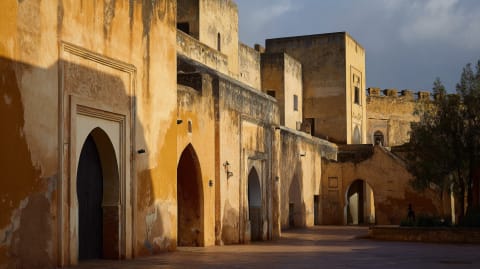
He chose Meknes. Not Fes with its scholars. Not Marrakech with its traders. Meknes — a garrison town with good water and a strategic position. He commissioned 25 kilometres of walls, more than fifty palaces, mosques, gardens, and a granary complex with stables for 12,000 horses. The materials came from everywhere: marble from Volubilis, cedar from the Middle Atlas, zellige from Fes. Some of the marble came from El Badi Palace in Marrakech, which he deliberately demolished. Taking another sultan's palace apart and using the pieces to build your own is a statement that does not require translation.
Louis XIV was building Versailles at the same time. The two monarchs knew of each other. Ismail sent an ambassador to Paris. He proposed a diplomatic marriage to Louis's daughter. The French politely declined, which was unwise — Ismail held French captives in Meknes. He also proposed an exchange of prisoners with Louis, which worked rather better than the marriage proposal.
The Black Guard — the Abid al-Bukhari — were his army. Recruited or captured from sub-Saharan Africa, trained from childhood as an elite military corps loyal only to the sultan, they numbered perhaps 150,000. They were his instrument of control: the force that held the empire together through a reign that outlasted everyone who opposed it.
Ismail had hundreds of sons — the Guinness Book of World Records credits him with 888, though the number is almost certainly inflated by a court that considered excess a virtue. What is certain: when he died in 1727, the succession was violent, prolonged, and predictable. The sons fought. Meknes declined. The buildings he raised with such ferocious energy began the long process of settling into ruin.
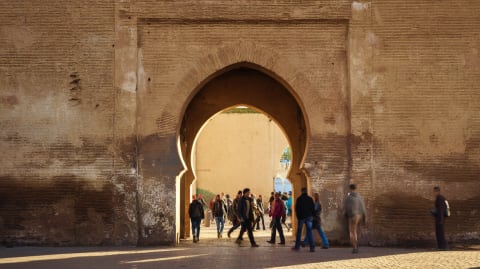
The Bab Mansour gate remains — the largest and most decorated gate in Morocco, possibly in North Africa. It is named not for the sultan but for the Christian renegade architect who designed it, which tells you something about Ismail's pragmatism: he would use anyone's talent, from any background, if it served the building.
Meknes is the city most itineraries skip. We don't. Moulay Ismail's walls are the reason.
Tell us about your trip →The Facts
- —55-year reign: 1672-1727 (longest in Moroccan history)
- —888 children documented by 1703
- —500 concubines
- —25,000 Christian slaves built Meknes
- —Black Guard grew to 150,000 soldiers
- —40 km of walls around Meknes
- —Proposed to Louis XIV's daughter
- —Expelled English from Tangier 1684
Sources
- El Mansour, Mohamed. Morocco in the Reign of Mawlay Sulayman. Ithaca Press, 1990
- Meakin, Budgett. The Moorish Empire. Swan Sonnenschein, 1899
- Terrasse, Henri. Histoire du Maroc. Atlantides, 1949
Further Reading
Practical questions