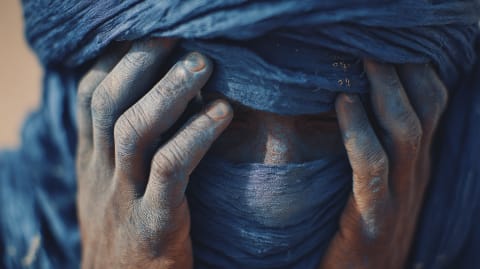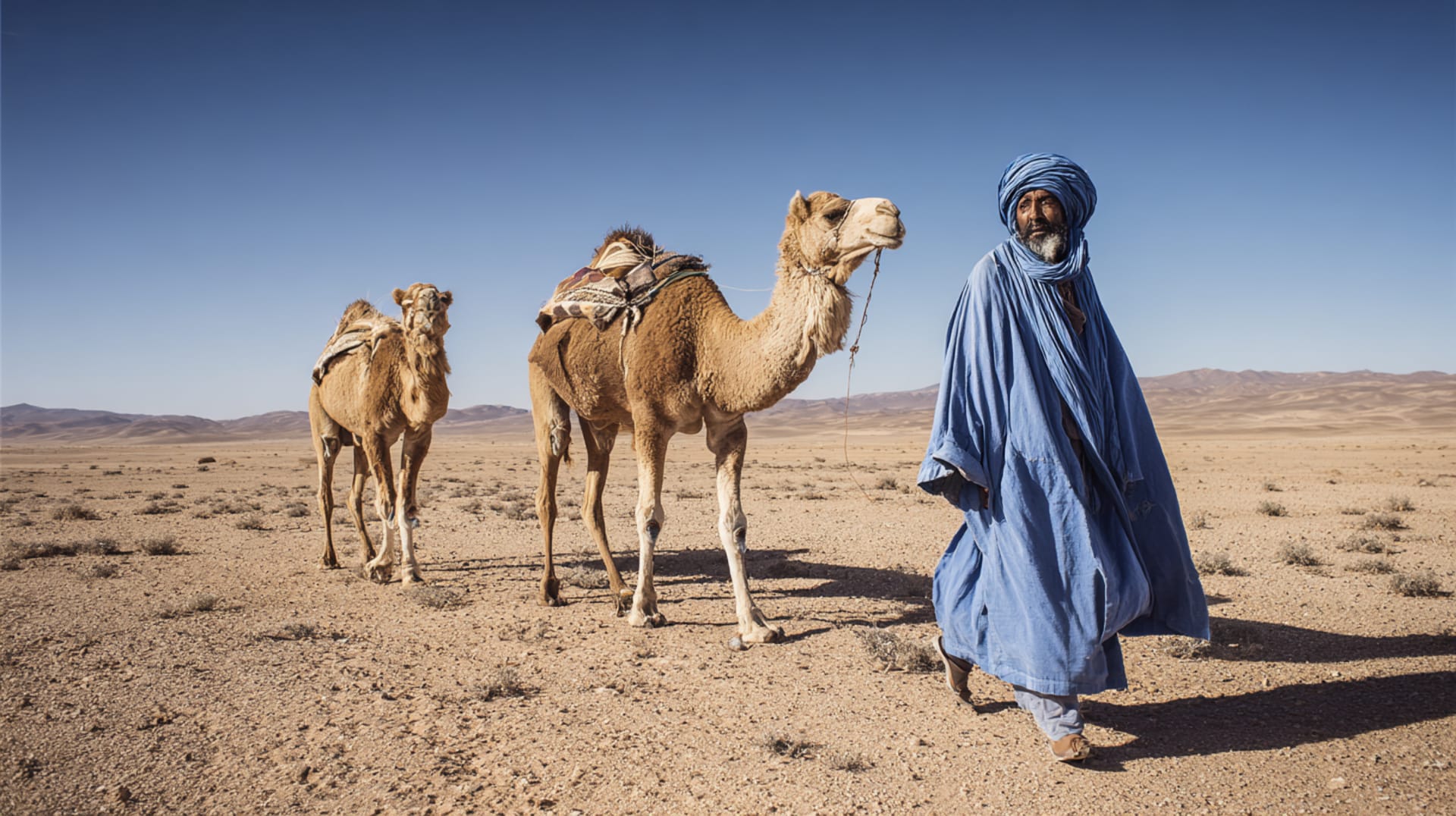
"Everything has changed," said Moha Ouchaali, his features framed by a black turban. "I do not recognise myself anymore in the world of today. Even nature is turning against us."
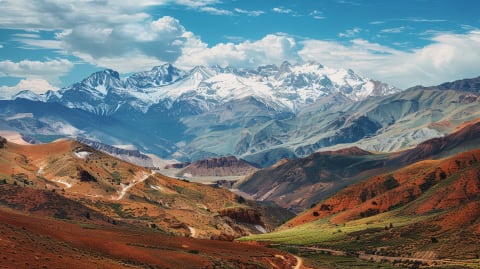
Near the village of Amellagou, 280 kilometres east of Marrakech, Ouchaali and his family have pitched two black woollen tents beside a dry riverbed. One for sleeping and guests, one for cooking. The view has not changed in centuries. The water has. The grass has. The future has.
Morocco's 2014 census counted 25,000 nomads — down by two-thirds in a single decade. A 2025 estimate puts the number closer to 12,000. The anthropologist Ahmed Skounti, himself from a nomadic family, predicts the lifestyle will disappear entirely within ten years. "If these people, used to living in extreme conditions, cannot resist the intensity of global warming," he says, "that means things are bad." The sentence is more alarming for being spoken quietly.
The Ait Aissa Izem once moved three times a year — summers in the cool valleys of Imilchil, winters in the lowlands around Errachidia. Now they move once, if at all. The traditional routes are what one community leader calls "ancient history." Pastures have been privatised. Investors have drilled boreholes that drop the water table below the reach of anyone who cannot afford a pump. Drought — always a feature of this landscape — has become the landscape itself.
The knowledge is going with the people. How to read the sky for weather. Which plants cure which ailments. Where the water hides in a landscape that looks dry. How to navigate by stars, by wind, by the behaviour of animals who know things that instruments do not measure. This knowledge was transmitted orally, through families, on the move. When the movement stops, the transmission stops. A shepherd who can find water in the Atlas by reading the rock cannot pass that skill to a son who drives a taxi in Casablanca.
The tents are still standing near Amellagou. The family is still there. But the black wool is thinner than it was, and the riverbed beside the camp has been dry for longer than anyone can remember being comfortable with. The last nomads are not a romantic idea. They are people, in a place, watching the conditions that sustained their lives disappear faster than any generation before them has experienced. They are adapting, because that is what nomads do. But there is a limit to adaptation, and the limit looks like a dry riverbed.
The last nomadic families still move with the seasons. This journey follows the routes they take.
Tell us about your trip →The Facts
- —Red ironstone indicates water within 200 meters due to iron oxidation
- —Saharan navigation routes have been used for over 3,000 years
- —Routes are encoded in songs and oral poetry passed down generations
- —GPS and satellite navigation fail during sandstorms
- —The number of practicing nomads decreases each year
- —Traditional navigation requires knowledge of geology, astronomy, and memorized routes
- —Some families still practice full nomadic life in the Draa and Tafilalet regions
Sources
- Chatty, Dawn. Nomadic Societies in the Middle East and North Africa. Brill, 2006
- Lancaster, William. The Rwala Bedouin Today. Cambridge University Press, 1981
- Haut-Commissariat au Plan. Nomadic population census data
Further Reading
Practical questions