Her name was Zaynab an-Nafzawiyya, and she married four times. The first three marriages made her wealthy. The fourth made her queen. The sequence was not accidental.
She was born in the early 11th century in Aghmat, the commercial capital of southern Morocco before Marrakech existed. Her tribe, the Nafza, were Berbers. Her father was a merchant. By the time she was thirty, she had already been married to the ruler of Aghmat and was known across the region for her beauty, her intelligence, and her fortune — three qualities that tend to attract attention, and in her case attracted an empire.
Then the Almoravids arrived. Saharan warriors from what is now Mauritania, religious reformers who had built an army in the desert. Their leader, Abu Bakr ibn Umar, conquered Aghmat in 1058. He killed the ruler. Then he married the ruler's widow — Zaynab. This was politics, not romance. Zaynab brought wealth, connections, and the kind of local legitimacy that an invading army cannot manufacture.
The marriage lasted three years. In 1071, Abu Bakr was called south to crush a Saharan rebellion. Before he left, he divorced Zaynab and instructed her to marry his cousin Yusuf ibn Tashfin for safekeeping. She married Yusuf after the required waiting period. And then she built him a kingdom.
When Abu Bakr returned expecting to resume power, Zaynab advised Yusuf on how to manage the situation. Meet him with respect. Bring lavish gifts. Make it clear that returning to the throne would mean war. Abu Bakr, who preferred the desert to diplomacy, went back south. He never returned to Marrakech. Zaynab stayed. So did the power.
She became the de facto co-ruler of the Almoravid state. She managed finances, advised on appointments, negotiated alliances. She used her own fortune to build infrastructure — wells, bridges, roads, the unglamorous investments that empires actually run on. Arab chroniclers called her "the magician." The title was not about sorcery. It was about a woman who could make one husband give up a kingdom and another husband build one, in a century that did not consider this a woman's skill.
Yusuf ibn Tashfin crossed the strait in 1086 and crushed the armies of Castile. His empire stretched from Senegal to Spain. But Marrakech — the city Zaynab watched rise from red dirt — remained the capital. She had chosen the ground. She had chosen the man. She had built the machine. Four marriages, each more strategic than the last, each moving her closer to the centre of a world that was not designed to put her there.
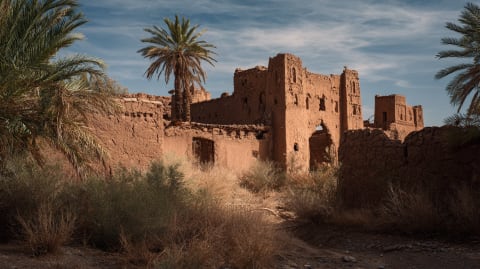
Zineb al-Nafzawiya built the infrastructure the Almoravid Empire ran on. The architecture she commissioned is still standing.
Tell us about your trip →The Facts
- —Title: 'al-qa'ima bi mulkihi' (the one in charge)
- —Married four times: last to Yusuf ibn Tashfin 1071
- —Called 'the Magician' for negotiating skills
- —Advised founding of Marrakech
- —Almoravid Empire stretched from Ebro to Mauritania
- —Yusuf would not decide without consulting her
- —Empire lasted until 1147
Sources
- Cornell, Vincent J. Realm of the Saint: Power and Authority in Moroccan Sufism. University of Texas Press, 1998
- Brett, Michael & Fentress, Elizabeth. The Berbers. Blackwell, 1996
- Abun-Nasr, Jamil. A History of the Maghrib in the Islamic Period. Cambridge University Press, 1987
Further Reading
Practical questions