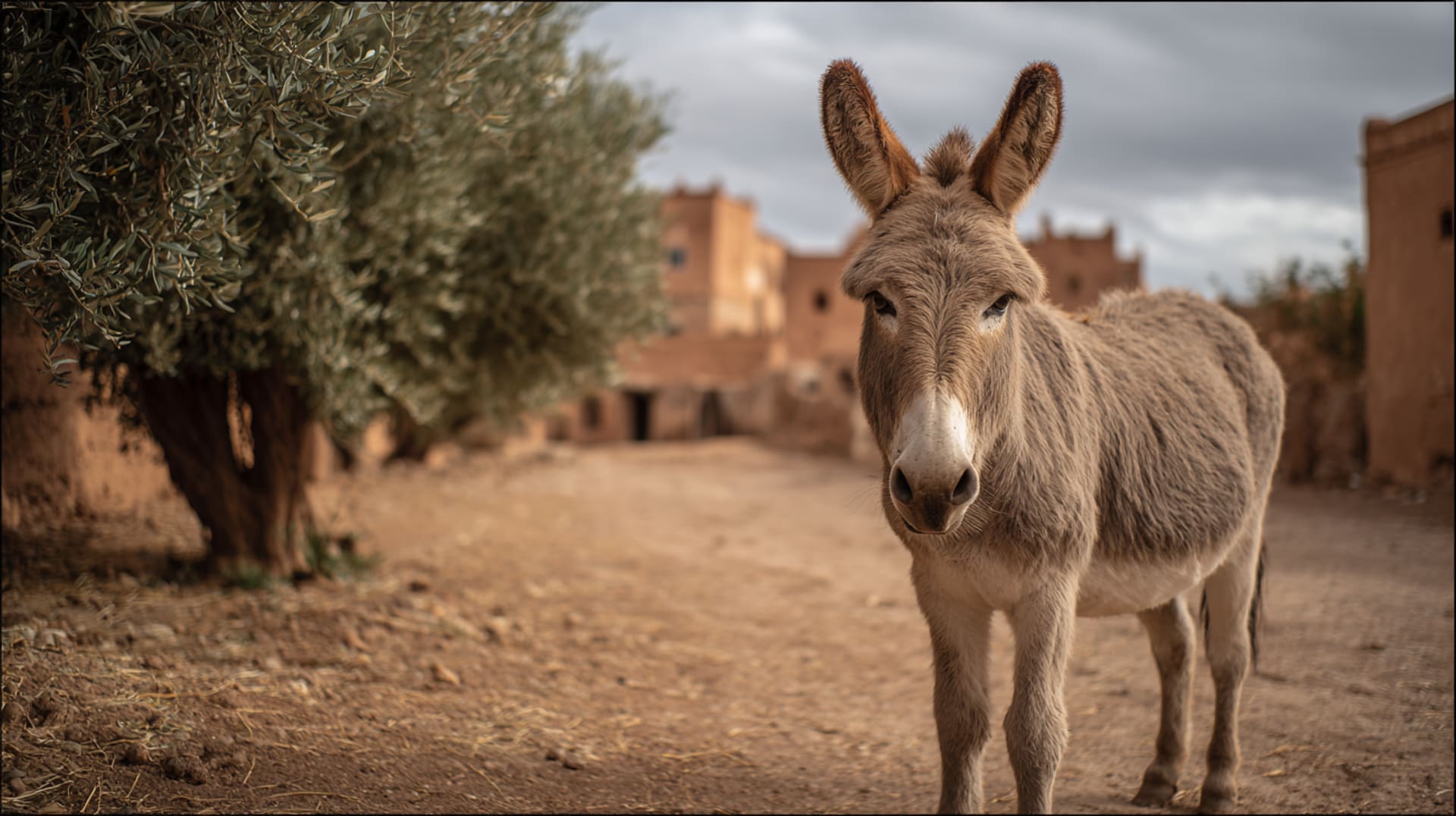
The veterinary team knew the jenny couldn't be saved. They also knew the foal still could. Dr. Boubker led the emergency caesarean. The mother was euthanised. The foal lived. They named him Tommy, after the son of the British Ambassador who happened to be visiting the clinic that day.
Tommy spent two years at SPANA. The vets used him in their classroom — a gentle donkey the local children could pet, building something rarely taught in Morocco: emotional connection to working animals. But adolescence changed him. He grew aggressive, bit several people, and needed work and space and a strong-willed female companion to settle him.
Twenty-four kilometres south of Marrakech, in the village of Oumnass, two retired English lawyers had just built a house in the foothills of the High Atlas. Susan Machin and Charles Hantom had named it Jarjeer — Arabic for wild rocket, the herb that covered their land when they bought it. Susan had spent her career in mental health law. The name felt right. They agreed to take Tommy.
A professor at Liverpool University, who had advised during Tommy's caesarean birth, recommended castration and pairing him with a dominant female donkey. It worked. Tommy calmed. He became the sanctuary's first ambassador.
Two donkeys turned into twelve. Twelve turned into a decision. Susan could either keep twelve pet donkeys or build something larger. She chose larger. The Jarjeer Mule and Donkey Refuge became a registered charity, and its objective was specific: relieve the suffering of working animals in Morocco, and help owners maintain the standards needed to keep them healthy.
The numbers tell you why it matters. Morocco still depends on working equines — in the Atlas Mountains where roads don't reach, in the medinas where alleys are too narrow for vehicles, on farms and building sites and trekking routes. Donkeys carry water to remote villages. Mules haul cement up mountain paths. When they can no longer work — too old, too injured, too sick — they become a financial burden their owners can't carry. They're abandoned at building sites, left tethered without food, worked until they collapse.
Jarjeer takes them in. Once an animal arrives, it stays for life and is never tethered again. The refuge sits on six hectares of land with paddocks, stables, courtyards, an olive grove of 750 trees, and views of the Atlas. The animals are fed four times a day on alfalfa and sugar beets. Two staff members travel constantly, collecting donkeys and mules from across the country.
The residents now number more than 270. Each one has a name and a story. Pablo was a grey donkey so malnourished he could barely stand when he arrived. He lived three peaceful years at Jarjeer before dying of old age, surrounded by everyone. Lucky was found tethered at a building site, left to die because he'd lost all his teeth from harsh bitting and could no longer eat. Clover came from Tangier with half a hoof missing. Jules arrived from the north completely blind, his lungs wrecked by parasites. Byed — Arabic for "white" — was going blind with cataracts and failing health. She recovered completely. A donkey called Clover became her guide.
Twenty-five of the animals are permanently disabled. Vets advised euthanasia for most of them. Jarjeer chose life. The staff make splints for broken legs and repair damaged hooves — skills Susan says probably don't exist elsewhere in Morocco.
The refuge employs 14 local staff, which means 14 families in Oumnass have stable income. They purchase wheat locally, which means villagers can grow it at home rather than travelling to Marrakech for work. The sanctuary didn't just change the animals' lives. It restructured a small economy around the act of caring for them.
Visitors are welcome. You can sit on the viewing platform with mint tea, watch the donkeys in the paddock, and listen to stories that will quietly rearrange your priorities. Children under ten can take a donkey ride — suspended if temperatures exceed 34°C, because the animals come first. There's a small shop. A cafe. A garden full of bees and butterflies and the sound of hee-haws at feeding time.
Susan and Charles could have stayed in England. They could have retired to a quiet village and kept a garden. Instead they built a retirement home for animals that most people walk past without seeing — the donkeys hauling goods through the medina, the mules on mountain tracks, the caleche horses pulling tourists through the heat. They decided those animals deserved a twilight with dignity. And then they spent the rest of their lives making sure they got one.
Jarjeer is 24 kilometres south of Marrakech, in the foothills of the High Atlas. It is open to visitors. It runs on donations.
Reading List
Fiction and Novels
The Spider's House — Paul Bowles. Set during the 1954 nationalist uprising in Fes. Bowles lived in Tangier for over fifty years. This is probably his most subtle novel.
The Sheltering Sky — Paul Bowles. Three Americans unravel in the Sahara. Published in 1949, filmed by Bertolucci in 1990. The book that made Bowles.
The Caliph's House — Tahir Shah. A humorous memoir about moving from London to a crumbling mansion in Casablanca, complete with resident djinn.
Hope and Other Dangerous Pursuits — Laila Lalami. Four Moroccans cross the Strait of Gibraltar on an inflatable boat. A Moroccan-born writer telling Moroccan stories from the inside.
In the Country of Others — Leïla Slimani. Identity and marriage in colonial Morocco. Slimani won the Prix Goncourt. This is her most personal novel.
Tangerine — Christine Mangan. A thriller set in 1950s Tangier. Two women, a disappearing husband, a city that keeps its secrets.
For Bread Alone — Mohamed Choukri. A raw autobiography of poverty, hunger, and survival in northern Morocco. Translated from Arabic by Paul Bowles.
The Lioness of Morocco — Julia Drosten. Historical fiction set in nineteenth-century Mogador (Essaouira). An Englishwoman trades London for the commodity markets of Morocco's Atlantic coast.
Lord of the Atlas — Colin Falconer. A disgraced British soldier takes a job helping the Sultan crush a rebellion in 1893 Morocco. Captured by a warlord in the High Atlas, the fight stops being about money. Wilbur Smith called it "a fantastic read."
The Storyteller of Casablanca — Fiona Valpy. Dual-timeline novel set in wartime Casablanca (1941) and the modern city. A diary hidden beneath floorboards connects two women seventy years apart.
Non-Fiction, Memoir, and Culture
The Voices of Marrakesh — Elias Canetti. A slim, hypnotic account of a visit to the city in 1954. Less a travelogue than a series of encounters — with sounds, with crowds, with the unseen. Nobel Prize in Literature.
In Morocco — Edith Wharton. Her 1920 travelogue, written when few Westerners had seen the interior. Wharton travelled with the French Resident-General's entourage. Colonial gaze, extraordinary detail.
Dreams of Trespass — Fatima Mernissi. A memoir of growing up in a Fes harem in the 1940s. Gender, power, and storytelling through a child's eyes. Mernissi was one of Morocco's greatest writers.
A House in Fez — Suzanna Clarke. A memoir about buying and renovating a crumbling riad in the Fes medina. The walls keep revealing layers.
The Last Storytellers — Richard Hamilton. Stories from the halqa performers of Jemaa el-Fna, recorded before the tradition fades. An oral history in written form.
Lords of the Atlas — Gavin Maxwell. The rise and fall of the Glaoui warlord brothers who ruled southern Morocco from 1893 to 1956 with the opulence of Indian princes and the aggression of gangland bosses. T'hami returned from the Queen's coronation in 1953 and mounted severed heads on his gates. By the author of Ring of Bright Water. Richard Ford called it "one of the great adventure stories of the twentieth century."
Walking with Nomads — Alice Morrison. Three expeditions across Morocco with Amazigh guides and camels, from the Draa river to the Sahara to the Atlas Mountains. See also Adventures in Morocco and her BBC series Morocco to Timbuktu. More at alicemorrison.co.uk.
Design and Food
Marrakesh by Design — Maryam Montague. Zellige, tadelakt, carved cedar, embroidered textiles, fountains, gardens — the building blocks of Moroccan interiors, photographed in real homes and riads. Montague runs the guesthouse Peacock Pavilions outside Marrakech. More at mmontaguesouk.com.
Casablanca: My Moroccan Food — Nargisse Benkabbou. 100 recipes from family tagines to ras el hanout carrot cake. Born in Morocco, raised in Brussels, trained at Leiths. Nigella Lawson called it "as accessible as it is inspiring." See also her newer Madaq.
The working animals of the medina are still here — donkeys, mules, horses in the narrow streets. The retirement home is real.
Tell us about your trip →The Facts
- —October 11, 2009: donkey with tetanus arrived at SPANA clinic, Marrakech
- —Heavily pregnant, in final stages
- —Emergency caesarean by Dr. Boubker — mother euthanised, foal survived
- —Named Tommy after British Ambassador's son visiting that day
- —SPANA: veterinary charity serving working animals
- —Tommy spent 2 years at clinic, used in children's education
- —Working donkeys essential to medina life — narrow alleys inaccessible to vehicles
Sources
- Jardin d'Enfants (Donkey Sanctuary, Marrakech). Programme documentation
- The Donkey Sanctuary UK. Morocco operations report
- SPANA (Society for the Protection of Animals Abroad). Morocco programme data
Practical questions